Activity
Mon
Wed
Fri
Sun
Oct
Nov
Dec
Jan
Feb
Mar
Apr
May
Jun
Jul
Aug
Sep
What is this?
Less
More
Owned by Karrie
For midlife women, becoming confident, AI-powered creators—showing up consistently, marketing with clarity, & growing fearlessly with simple systems.
Skool Scale Camp
5.9k members • Free
AI + KDP Profit Stacking
345 members • Free
AI-Driven Business Community
8.6k members • Free
AI Money Hub
3k members • $49/month
The Owner's AI Room
733 members • Free
Claude Code Club
8.2k members • $9/month
Women Build AI
6.4k members • Free
Empowered AI Collective™
3.6k members • Free
Maker Zero: Claude Code, AI
24.9k members • Free
8 contributions to AI Automation First Client

Mar 29 •
The Simple Contract That Protects Both of Us 🔥
No contract = Problems waiting to happen. Here is the simple template I use. THE SECTIONS: 1. SCOPE "I will build [specific automation] that [does specific thing]." List exactly what is included. List what is NOT included. 2. TIMELINE "Work begins on [date]. Target completion: [date]." 3. INVESTMENT "Setup fee: $X (50% due before work begins, 50% upon completion)" "Monthly maintenance: $X (begins after completion)" 4. MAINTENANCE INCLUDES - Weekly monitoring - Bug fixes - Minor adjustments - Email support 5. MAINTENANCE DOES NOT INCLUDE - New features (quoted separately) - New document types (quoted separately) - Additional integrations (quoted separately) 6. REVISION POLICY "Includes 2 rounds of revisions within original scope." 7. TERMINATION "Either party can cancel with 30 days notice." THE TOOLS: HelloSign (free tier): Digital signatures Google Docs: Draft the contract PDF export: Professional delivery THE CONVERSATION: "I'll send over a simple agreement that outlines what we discussed. Just covers scope, timeline, and investment. Take a look and let me know if anything needs adjusting." THE REALITY: In 12 months and 11 clients: - Contracts signed: 11 - Disputes about scope: 0 - Confusion about what's included: 0 Clear contracts prevent uncomfortable conversations. THE MINIMUM: Even for small projects, get in writing: - What you're building - What they're paying - When it's due Text message confirmation works better than verbal. 📚 More templates in Github Do you have a simple contract template ready for your first client?

1 like • Apr 11
I guess this answered my question in another post. Super helpful as always. Thank you!

Apr 5 •
Our PTA Meetings Were Chaos Until Someone Actually Tracked the Decisions 💥
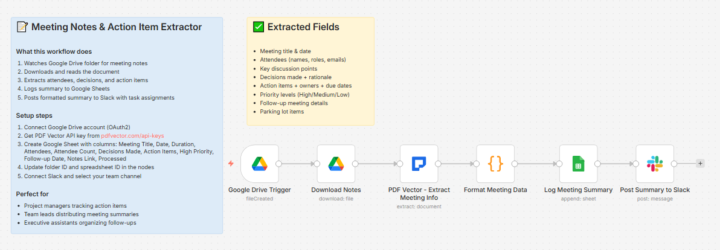
PTA volunteer here. Monthly meetings. Lots of talking. Nobody remembers what we decided. Same conversation every month: "Didn't we already discuss this?" "Who was supposed to do that?" "What did we agree on?" THE VOLUNTEER NIGHTMARE Our secretary took notes. Handwritten. Sometimes typed later. Sometimes not. Action items buried in paragraphs. Due dates mentioned verbally but never tracked. Spring carnival planning: Four meetings discussing the same vendor because nobody remembered we'd already decided. Fall fundraiser: Treasurer never knew she was supposed to get quotes because nobody told her. Just assumed she heard it. We're all volunteers with jobs and kids. Nobody has time to chase this down. THE MEETING TRACKER I BUILT Recording goes to folder after meeting. Workflow processes automatically. Extracts who attended, what decisions were made with the reasoning, every action item with who owns it and when it's due. Follow-up items that need more discussion get flagged. Summary posts to our group chat within 20 minutes of meeting ending. Action items listed with names attached. Due dates clear. Everyone sees the same information. No "I didn't know" excuses. Added a weekly reminder that pings people whose items are coming due. Gentle nudge. Not nagging. THE DIFFERENCE NOW Before: Monthly amnesia, repeated discussions, dropped balls, frustrated volunteers. After: Decisions documented, action items tracked, people actually do their tasks because they can't pretend they didn't know. Our principal asked what changed. Meetings feel more productive now. The extraction isn't perfect on crosstalk sections. When everyone talks at once it struggles. But main decisions and clear action items catch reliably. Takes me 10 minutes to review and fix anything the automation missed. Better than 2 hours reconstructing from memory. This is the workflow i want to share
1 like • Apr 11
Love these practical use cases! Thanks for sharing
Mar 20 •
The Free Tools That Got My First 5 Clients 🔥
Spent $0 on software until client 6. Here is the exact stack. FOR FINDING PROSPECTS (FREE): LinkedIn (free account): Search posts with pain keywords Apollo.io (free tier): 50 email lookups monthly for contact info Google Sheets: Track prospects and pipeline FOR OUTREACH (FREE): Gmail: Send personalized messages Loom (free tier): Record 5-minute video demos Calendly (free tier): Let prospects book discovery calls FOR BUILDING (FREE/LOW COST): n8n (self-hosted): Completely free workflow automation Make.com (free tier): 1,000 operations monthly Google Drive: Store and process documents Google Sheets: Output destination for demos FOR DEMOS (FREE): Zoom (free tier): 40-minute calls plenty for discovery + demo Their actual documents: The most powerful demo tool costs nothing THE TOTAL COST: Months 1-3: $0 Revenue months 1-3: $4,200 Only upgrade when clients pay for the solution. THE RULE: Do NOT buy pro subscriptions before you have clients. Do NOT invest in fancy tools before revenue. Do NOT spend money you have not earned. THE UPGRADES (WHEN NEEDED): n8n Cloud ($20/month): When self-hosting becomes annoying Make.com paid ($9/month): When you hit free tier limits Calendly paid ($10/month): When you want multiple meeting types Total at month 6: $39/month Revenue at month 6: $2,400/month THE PHILOSOPHY: Free tools until revenue covers paid tools. Client money funds your growth. Your money stays in your pocket. What free tool will you set up today to start prospecting?
1 like • Apr 11
Agreed! When I first started, I ran my business for a long time for only $12.95 / month. The cost of Canva since its resizing tool would save me so much time.i would add PayPal or WaveApps for invoicing and a free tier of a tool like Dubsado for contracts. Would love to hear more about contracts and what is in it. Handover or ongoing support, etc.

Mar 30 •
What non-technical skills matter most in AI automation freelancing?
Hey everyone, I’m 16 and currently learning AI automation with n8n, planning to start freelancing soon. One thing I’ve realized is that technical skills are getting commoditized, and what really makes the difference are the non-technical (soft + business) skills. So instead of focusing only on tools, I want to apply the 80/20 principle — focusing more on the small set of skills that actually drive results. The problem is… I don’t clearly know what those high-impact skills are yet. Would love to learn from people already doing this: What non-technical skills have made the biggest difference in your freelancing journey? If you had to start again, which skills would you prioritize first? Any specific frameworks or ways to practice these skills as a beginner? What mistakes should I avoid early on? I’m trying to build a strong foundation early instead of just chasing tools. Really appreciate any guidance
1 like • Apr 11
I would say confidence. Inside you may not feel confident but you need to show up enthusiastic and confident that you can figure it out. 💪 I used to say when I do not know the answer right then, I have a network of people to back me up and will help me solve which was true. Between software tech support, Claude, YouTube, or paying to be in a group that offers tech support, there’s no way you can’t solve anything that comes your way.
Apr 3 •
60 Days Ago I Had Zero Clients. Here's What I'd Tell Past Me. 🔥
If I could go back to day 1, here is the advice I'd give myself. THE THINGS I WORRIED ABOUT (THAT DIDN'T MATTER): Not having enough technical skills → You learn by doing. First client teaches you more than 100 tutorials. Not having a portfolio → Build 3 demo workflows. That's your portfolio. Not knowing what to charge → Calculate their annual cost. Charge 10% as setup. Easy. Being found out as a beginner → They care about results, not resumes. Demo proves capability. THE THINGS I SHOULD HAVE DONE SOONER: Reached out to my network first → Your first client probably knows you already. Picked one industry → Generic = forgettable. Specific = referable. Asked for the sale → They want to be asked. They're waiting for you to offer. Followed up more → Most "not interested" was actually "bad timing." THE THINGS THAT ACTUALLY MATTERED: Sending messages (even imperfect ones) Showing up on calls (even nervous) Following through on delivery (even when stuck) Asking for referrals (even awkwardly) THE MATH AT 60 DAYS: Total clients: 3 Total setup revenue: $4,600 Monthly recurring: $420 Hours spent prospecting: ~40 Hours spent building: ~50 Effective hourly rate: ~$51 (low, but real money) THE TRAJECTORY: Day 1: Terrified Day 14: First call booked Day 23: First client signed Day 40: Second client signed Day 52: Third client signed + first referral Day 60: Confident this works THE LESSON: Everyone starts at zero. Everyone feels unready. Everyone has doubts. The difference: Taking action anyway. THE NEXT 60 DAYS: More outreach More demos More clients Higher prices Better templates More referrals And it all started with one message to one person about one problem. What action will you take in the next 24 hours toward your first client?
1 like • Apr 11
Great pep talk and 100% agree. Just need to build my demos! 🙌🏼 working on that now.
1-8 of 8

@karrie-chariton-4535
Helping women coaches 50+ automate the busywork and build consistent lead systems with AI. 🤖 Founder, Fearless AI Lab.
Active 3h ago
Joined Apr 2, 2026
Chicago Burbs, Illinois