Activity
Mon
Wed
Fri
Sun
Mar
Apr
May
Jun
Jul
Aug
Sep
Oct
Nov
Dec
Jan
Feb
What is this?
Less
More
Owned by Julia
A community designed for the urban grower - combining modern urban life with nature for those who value community & healthier food systems.
Memberships
The Perennial Poacher
132 members • Free
The farming way➖field to fork
12 members • Free
The Profitable Baker
58 members • Free
The Cottage Bakery Backend
23 members • Free
Regenerative Gardening
136 members • Free
Sourdough Made Simple
162 members • Free
Rustic Roost Homestead
27 members • Free
Vertical + Urban Farm Academy
166 members • Free
Syntropic Sunlands w/ Milan
89 members • Free
2 contributions to Syntropic Sunlands w/ Milan

11d •
We're in for one of the wettest winters - What do we do about it ?
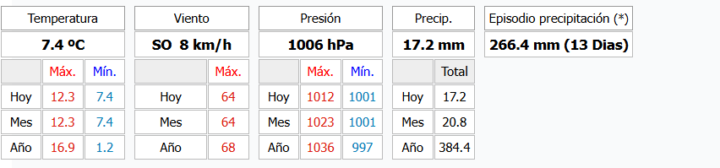
I’ve never seen such a wet January — it’s often the driest winter month here in Andalucía. Here’s a screenshot of the meteorological records for my area for January alone — nearly 400 mm! That’s almost what we usually get in a whole year, since the annual average is around 450–500 mm. If we add the rainfall since Autumn 2025, we’re probably already over 600 mm. It looks like we’re in the middle of a La Niña influence. I’m no meteorologist, but here’s what my gut tells me: - The last two years, aquifers have been able to recharge more than during the previous drought years. - We seem to have perfect conditions for larger-scale plantings, thanks to the rainfall. This is one of the reasons why, after seeing the heavy autumn 2024 rains, and the total rainfall of 2025 we went ahead with a large syntropic planting (~6000 m²). Doing this is especially important when water is limited - mind you, we’re on a hill where wells dry up faster than in the lowlands. So why is this the right time to plant? El Niño and La Niña cycles don’t happen from one year to the next. Each phase usually lasts 2–7 years, because ocean and atmospheric systems take time to shift. This creates clusters of wet or dry years, rather than a perfect alternating pattern. For planting, this is crucial: if we’re at the end of a wet phase, it’s a great opportunity to plant. The soil still has moisture, the aquifers are recharged, and there’s a high chance of more rain during the rest of winter and spring, maybe even into early June if we’re lucky. Let the trees and the soil soak up that rainfall, we'll end up with deeply taprooted trees that will grow more vigorously than in drought years, it's the perfect opportunity - the timing couldn't be better !
1 like • 11d
Hey Milan! Here in Canada we are getting much more snow than usual, its definitely interesting to see the rapid rise in water levels once a warm week hits and it all melts at once. The last summer was extremely hot and dry for the plants so I guess this is natures way of making up for that as I expect it to be a VERY wet spring.
15d •
Designs - Don't overthink it - 7 Lessons
After a design lesson I taught to some Spanish students a few days ago, I thought I’d share some insights: 7 lessons for beginners when it comes to designing. From the start, people often think designing is some complicated process only consultants can handle. I’m here to call bullshit on that. There’s too much of it in this space. Designing is something we can do ourselves -without paying someone half your monthly salary for a single day of their time. Let’s empower each other to design! Anyone who gatekeeps this knowledge, making it seem more complicated than it is so you remain dependent on them, is a con artist. I’ve dealt with those people and I don’t want you to. They stunt progress in this space and actively disempower others. That’s where I come from when it comes to designing, and yes, a bit of a rant - but it matters. With that in mind, here are 7 lessons for beginners: 1 – Design should be practical, not theoretical. Start with what’s actually around you. What plants grow in your area? Don’t assume you need one perfect species - especially if you haven’t seen it thrive in your conditions. Experience matters far more than fancy spreadsheets or theoretical plant lists. Don’t get bogged down in the theory - learn by doing. That's difficult for us nerds out there - and yes I'm a big nerd to when it comes to technicalities. Step away from that even though it's hard. 2 – Use powerhouse plants. Don’t shy away from fast-growing plants. Eucalyptus, acacias, or other “aggressive” species are often the most effective for your system. Growth rates in the Mediterranean are much slower than in subtropical regions so keep that into account too . If you’re hesitant because a plant grows quickly, that’s usually a sign you should use it. 3 – Focus on early-stage species, not later succession species; Your main concern should be the placenta and early secondary species. Later succession species can be planted once you understand your site better. Trying to plan everything at once often leads to frustration and failure. Early-phase gaps have a bigger impact than gaps in later succession.
1 like • 14d
Thank you so much for these insights - they've very applicable to the plans I've been working on and make getting started seem a little less intimidating. Especially excited to use more trial species even though I'm uncertain about how they'll turn out.
1-2 of 2
@julia-roul-1565
An Urban Agronomist passionate about showing others how to be in control of their own food systems.
Active 3d ago
Joined Jan 24, 2026