
Jan 29 • Design and Soil Preparation
Designs - Don't overthink it - 7 Lessons
After a design lesson I taught to some Spanish students a few days ago, I thought I’d share some insights: 7 lessons for beginners when it comes to designing.
From the start, people often think designing is some complicated process only consultants can handle. I’m here to call bullshit on that. There’s too much of it in this space. Designing is something we can do ourselves -without paying someone half your monthly salary for a single day of their time. Let’s empower each other to design!
Anyone who gatekeeps this knowledge, making it seem more complicated than it is so you remain dependent on them, is a con artist. I’ve dealt with those people and I don’t want you to. They stunt progress in this space and actively disempower others. That’s where I come from when it comes to designing, and yes, a bit of a rant - but it matters.
With that in mind, here are 7 lessons for beginners:
1 – Design should be practical, not theoretical. Start with what’s actually around you. What plants grow in your area? Don’t assume you need one perfect species - especially if you haven’t seen it thrive in your conditions. Experience matters far more than fancy spreadsheets or theoretical plant lists. Don’t get bogged down in the theory - learn by doing. That's difficult for us nerds out there - and yes I'm a big nerd to when it comes to technicalities. Step away from that even though it's hard.
2 – Use powerhouse plants. Don’t shy away from fast-growing plants. Eucalyptus, acacias, or other “aggressive” species are often the most effective for your system. Growth rates in the Mediterranean are much slower than in subtropical regions so keep that into account too . If you’re hesitant because a plant grows quickly, that’s usually a sign you should use it.
3 – Focus on early-stage species, not later succession species; Your main concern should be the placenta and early secondary species. Later succession species can be planted once you understand your site better. Trying to plan everything at once often leads to frustration and failure. Early-phase gaps have a bigger impact than gaps in later succession.
4 – Don’t be afraid to overplant. There’s no such thing as “too many plants.” It’s better to prune later than to wish you’d planted more. In the Mediterranean, spontaneous growth is limited, so higher initial density usually pays off. Plus, we usually don't have the luxury of spontaneous plants that will fill up your gaps - like it would in tropical and subtropical climates.
5 – Trial before committing. Test as many species as possible. I’ve personally tried around 50 species in trials, and it took me 2-3 years to find the powerhouse plants for my context. Never assume a plant will work because someone said it would or because it succeeded elsewhere. After a year of experimentation, you’ll know which species are best adapted to your soil and climate.
6 – Strata doesn’t have to be perfect from the start. You don’t need every layer of your system figured out initially. Nature starts with emergent pioneers, then medium and low strata emerge later. Planting can follow this logic -
medium and low strata species can come after the pioneers have done their work.
7 – Choose the right design method for your context and resources
- All-at-once method: Plant everything from pioneers to climax species at once. Most consultants teach this, but it’s expensive, resource-intensive, and requires lots of amendments.
- Successional Accumulation method: Start with 1–3 tough species that thrive in poor conditions. Let them establish into an uninterrupted hedge, then a few years later, once they've cycled properly, add succession species after pruning them. Much cheaper, simpler, and allows large-scale planting with minimal inputs. You can adjust as you gain clarity over time. I cover that with Scott Hall in the interview I had with him- it's on the platfrom, go have a look if you wanna know more about it.
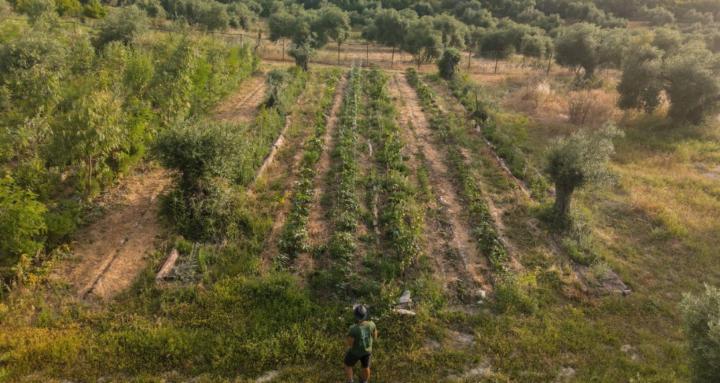
- Hybrid approach: Mix methods depending on context. For example, in the almond grove we planted this autumn, I placed almonds at final spacing but also added acacias, casuarina, eucalyptus, and myoporums to make this infestation of plants, an uninterrupted hedge. Amendments were used. Later succession plants like viburnum tinus and grevillea robusta will be added once the early species have matured. I used this method here because of water scarcity. I don't want to water this system more than 5-6 years and almonds need only slightly more water than acacias. And they're tough. So they can work together
I hope these lessons help! If you have additional tips, questions, or lessons from your own experience, share them in the comments - I’d love to see what you’ve learned too.
8
5 comments
Designs - Don't overthink it - 7 Lessons
powered by
skool.com/syntropic-agroforestry-w-milan-3000
Mediterranean Syntropic Agroforestry made practical.
Efficient design, minimal water, low inputs — maximum impact.
Suggested communities
Powered by