Activity
Mon
Wed
Fri
Sun
Apr
May
Jun
Jul
Aug
Sep
Oct
Nov
Dec
Jan
Feb
Mar
What is this?
Less
More
Memberships
Legacy Solar Panel Camp
17 members • $49/month
Ruta del Electricista
159 members • Free
Electrical Academy
77 members • Free
Electricians Wired Together
108 members • Free
The Electricity Lab
181 members • Free
AutoCAD Electrical
74 members • Free
Solar Cleaners Network Pro
291 members • Free
DIY Solar Alliance
54 members • Free
Solar Union Ascension
102 members • Free
30 contributions to Energy Data Scientist
1d •
Commodities Trading- Interview
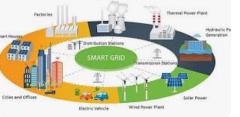
See the plot. You must explain what is happening. Source: JP Morgan round1 , February 2026. - What is the key conclusion ? Answer: oil prices are very sensitive to major global events. - Oil Prices why would they fall? Answer : When there is a global crisis that slows down the economy (like a recession or a pandemic), people travel less and factories slow down. Because the world needs less oil, the price drops. - Oil Prices why would they Rise? Answer: When there is a war or conflict, especially in areas that produce a lot of oil, markets panic that the global oil supply will be cut off, causing prices to spike. - Explain what we see on 1 Sept. 2008: Answer: When the global financial crisis hit, the global economy crashed, causing the demand for oil to become extremely low. - Explain the 2 March 2020 : When the world went into covid lockdown, travel stopped and industries paused. Because nobody was using fuel, the price of oil plummeted to the lowest ( $20 a barrel). - Explain 3. Feb. 2022 : Russia is one of the world's largest oil producers. When the war started, countries feared Russian oil would be cut off from the market. This panic caused the price to immediately spike back over $100. - Explain 4. Feb. 2026 : Iran sits right next to the Strait of Hormuz, where a massive portion of the world's oil is shipped. Because of the conflict, the market is scared that this vital shipping lane will close, causing a sharp spike in prices.

Feb 10 •
New Online Course: Energy Storage Trading & Arbitrage in Python
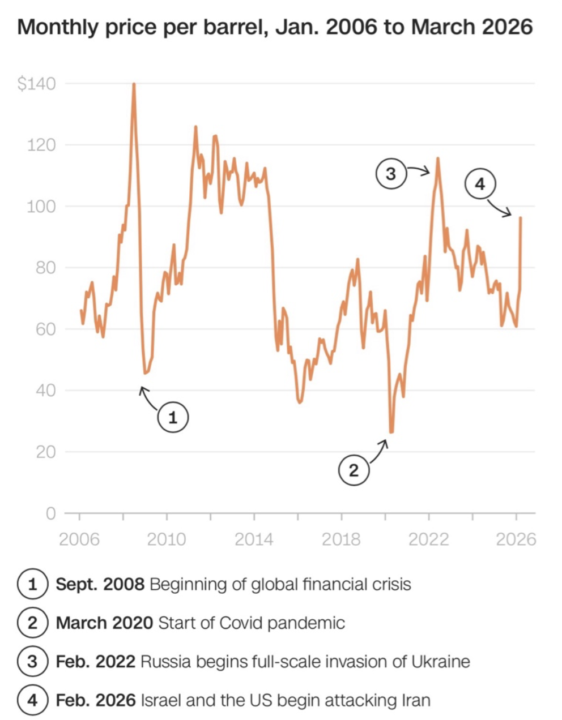
The course (available in Classroom) teaches how to develop a profit-maximizing arbitrage strategy for energy storage using mathematical optimization (Linear and Mixed-Integer programming) in Python. Full Python code available to download and fully explained in the video (1 hour and 15 minutes). No prerequisites (beginner-friendly). Energy storage can make money through various ways, one of which is energy storage trading (arbitrage). See the attached figure summarising the energy storage arbitrage strategy. The algorithms and strategies taught in this course are the industry standard for the following roles: - Quantitative Analysts (Quants) in energy firms - Energy Traders - Data Scientists (Energy) - Asset Managers Where is this code used? This specific type of optimization (Arbitrage & Dispatch) is used in firms across the energy and financial sectors: - Hedge Funds & Prop Trading - Investment Banks - Commodity Trading Houses - Energy Majors & Tech Energy Storage : - Utilities (e.g., Duke Energy, NextEra, Enel) own batteries (energy storage) to help stabilise the electricity grid. - Independent Power Producers (IPPs) (e.g., Vistra, AES, Neoen) are companies that build and own power plants (solar, wind, batteries) specifically to sell electricity for profit. They are very active users of arbitrage strategies. - Investment Funds (e.g., Gresham House, Gore Street Capital) are specialized funds that buy batteries as financial assets, similar to how a real estate fund buys apartment buildings to collect rent. - Hedge funds (like Citadel, D.E. Shaw, or Millennium) thrive on volatility. In energy markets, prices can jump from $20 to $2,000 in minutes.
0 likes • Feb 12
Very good code for algorithmic trading in energy
Feb 7 •
Energy Storage Arbitrage: 2 common Interview Questions
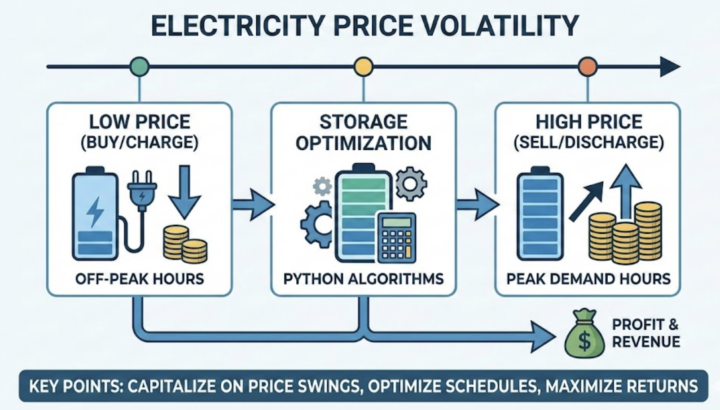
A new online course is being prepared about Energy Storage Trading using optimisation, machine learning (including reinforcement learning) , beginner-friendly ( no prerequisites ). This course will explain what energy storage trading is, what energy storage arbitrage is, etc - also all developed in Python. This is a topic that all energy companies are interested in, so there is very high probability that a relevant interview question will be asked . Even if you're not looking for jobs at the moment, you may look soon, so it is definitely useful to know this terminology. Here are two common interview questions: Interview Question1: What do we mean by Energy Storage Arbitrage? Interview Question2: What is the difference between Financial Arbitrage and Energy Storage Arbitrage? ================== Answer to Question1: It is when an Energy Storage unit buys electricity when the electricity price is low, and sells it when the electricity price is high. This operation generates economic profit by exploiting this price volatility over the course of a day, as shown in the attached slide. Answer to Question 2: The main difference is between space and time. Financial arbitrage exploits price differences between two different locations (e.g. New York and London) at the same moment (i.e. we buy a financial asset in New York and immediately we sell the same asset in London at a slightly higher price e.g. $100 versus $100.1 ). While Energy Storage arbitrage exploits price differences at different times within the same location (electricity market) e.g. the same storage unit (same location) buys electricity when its price is low, and sells it when the price is high. VIDEOS: Also, in the Classroom/6.3 I have uploaded 2 videos, each for these two questions (they provide some extra analysis). These two videos will also be part of the new course (in a few days).
1 like • Feb 7
Complex topic! Real vs financial assets much difference!
Feb 4 •
Interview Questions (Since October 2025)
The goal of this community is to help you secure jobs across the wider energy sector. That includes: - Major Energy Firms (Trading houses, Utilities, Oil & Gas). - Non-Energy Firms that manage their own energy assets or investments. - Academia (PhD applications and research roles). I have compiled a list of recent questions that candidates have faced in interview stages mostly between October 2025 and January 2026 ( retrieved from student databases ). You can also see below the company they were applying to. When reading these questions we need to ask ourselves: "Could I answer this question under pressure (with maybe 1 minute of thinking)"? Also, my answers to each question are in Classroom 6.3 compiled in the form of a PDF file. This PDF file has 5 more questions included as well (and answers). 1. Energy Quant (Power/Gas) - BP: “Walk me through a forward-curve model you would use for power or gas. How do you handle seasonality, mean reversion, and spikes?” - Shell Energy Trading: “Design a risk framework for an options book on power. Which metrics would you report daily, and how would you stress test extreme events?” 2. Energy Trader - TotalEnergies: “Explain the spark spread and how it links fuel prices, heat rate, and power prices. When does a plant dispatch?” - Trafigura: “You have a short physical position for next month. How would you hedge it with futures, swaps, and optionality, and what basis risks remain?” 3. Electricity Market Analyst (ISO/Utility) - National Grid ESO: “Explain Locational Marginal Pricing (LMP): what are its components, and what data does the market-clearing optimization need?” - EPRI: “How would you build a day-ahead load forecast and quantify uncertainty? Which error metrics matter most for operations?” 4. Project Finance Analyst - Macquarie: “Define DSCR and explain how it drives debt sizing. What DSCR range would you expect for a contracted wind or solar project?”
1 like • Feb 4
great!

Jan 30 •
LLMs Best Practices
Hey everyone, I’m asking this because LLMs weren’t really part of our workflow before, but now that they’re available it’s difficult not to leverage them given their productivity benefits. How are you using LLMs in data science workflows, and what best practices should I be aware of? Also, from a manager’s perspective, what expectations or concerns do you have about their use? PS: I am one of those that do not use it much especially for work or academia and looking for the correct ways to integrate it.
0 likes • Jan 30
@Henrik Larsson Yes. I use it for drafting client-facing deliverables like executive summaries, slide outlines, and “plain English” explanations. Best practice is to keep it away from confidential client details and to fact-check everything. As a manager, I’d care about brand risk if AI-written content contains errors
0 likes • Jan 30
@Liam Smith yes!
1-10 of 30
@joshua-levvy-1786
energy focus - machine learning forecast models at M. Lynch
Active 1d ago
Joined Nov 1, 2025
ISFJ
USA