Activity
Mon
Wed
Fri
Sun
Sep
Oct
Nov
Dec
Jan
Feb
Mar
Apr
May
Jun
Jul
Aug
What is this?
Less
More
Ruth Performance Lab
352 members • Free
5 contributions to Ruth Performance Lab

Feb 6 •
Anyone up for an experiment?
I have created an algorithm that can predict your "max sustainable pace" for sport-specific movements (like RMU, burpees, box jump overs, light TnG power snatches, etc). I'm really excited about the prospects of this... but I need to gather data. The tests are simple, Day-1 - 1min max rep of the movement Day-3 - 5min max rep of the movement For example Monday - 1min max reps RMU Wednesday - 5min max reps RMU These need to be done in a low-fatigue environment so before metcons / etc within training. All I need are those two data points and I can provide you with some really cool data that you can use inside training and competition. The movement selection doesn't matter as I am (fairly) confident that the formula I've come up with will predict sustainable rep-rates regardless of the movement. If anyone is interested in participating... let me know (1) what you're planning to test, and then (2) just upload your results directly here.

2 likes • Feb 6
Okay, I'm gonna be that guy - thrusters 95lbs for me
0 likes • Feb 7
@Kyle Ruth sounds good to me 💪
Dec '25 •
Program Design Review #1 is LIVE
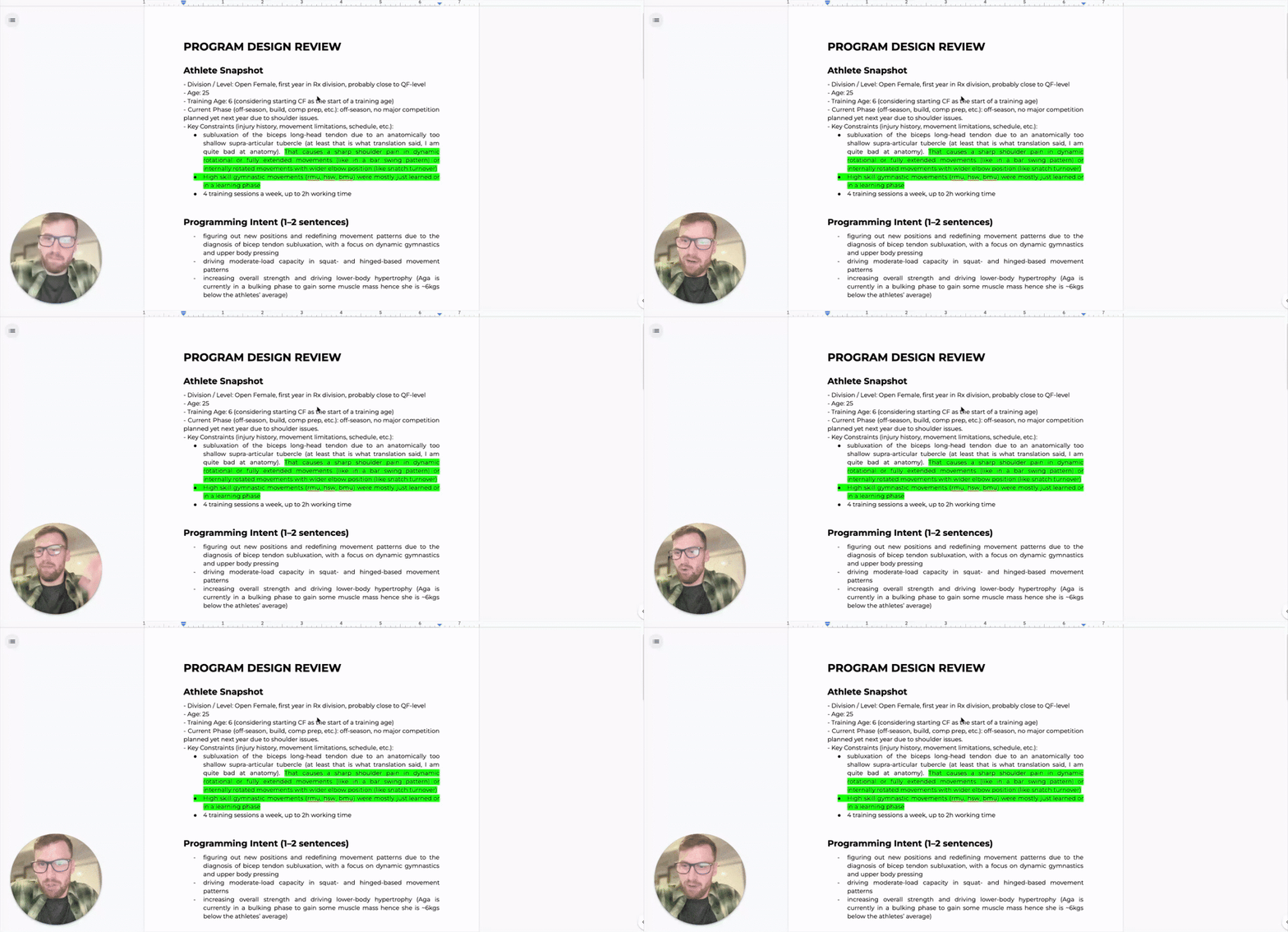
First, thanks to @Jan Lenczuk for being willing to submit a real athlete’s program and open it up for discussion. It takes some guts to put your work out there. The intent behind these reviews is simply to give back to the coaching community. I’ve been coaching for a long time, and this is a way to share how I actually think through program design when I’m working with real constraints, not ideal scenarios. In this review, I walk through a full training week for Aga (Jan's client), a first-year RX athlete dealing with a shoulder issue, limited weekly training time, and long-term development goals. I start with athlete context and intent, then move into strength and hypertrophy decisions, gymnastics progressions, conditioning structure, and where I’d make adjustments or ask different questions. This is for coaches who want to improve how they think about programming, not just copy templates. If you have feedback on the format or ideas for making these more useful, let me know!
0 likes • Dec '25
Great work Coach! Thanks so much for doing this, and more than happy to volunteer again, I have more questions than I had before 😅 Couple of points from the vid itself: 1) You missed the second tab with the following week of program, I would love to hear your opinion about the week-by-week progressions 2) It will be great to hear some finishing thoughts of yours, like if there is anything particular that you think the program is missing, if the issues/pain points described in the initial doc were rightly addressed Couple of points for people who would like to submit the programming (basically me next time): 1) Add PR metrics / reference points if you write the weights 2) Add more coaching-specific comments regarding the progression / excercise choice to give Kyle an option to dive deeper into the structure 3) For non-English guys, make sure you have translated everything ("rower" in Polish means "bike", haha) Also, an idea for the Office Hours session: we can do a brainstorming deep-dive session as a follow-up to that video on the programming structure / thoughts, happy to be the first lab rat again :D
1 like • Dec '25
@Kyle Ruth all clear and once again great initiative!
Dec '25 •
Program Design Review
I’m looking to pilot test a very brief program design review video series. The basic concept is: a coach submits a week or 2 weeks of programming for an athlete (along with context / athlete details / bullets re: intention) and I will film a short voice-over video (15min max) talking through my thoughts on the program, highlighting things that I think are creative solutions to problems and identifying places for possible upgrades. My plan would be to house these inside the skool platform and maybe eventually share clips from them on social media. Is anyone interested in submitting a program for a pilot review? If so, just drop a response here and I’ll reach out directly.
0 likes • Dec '25
I'm all in 😍
Dec '25 •
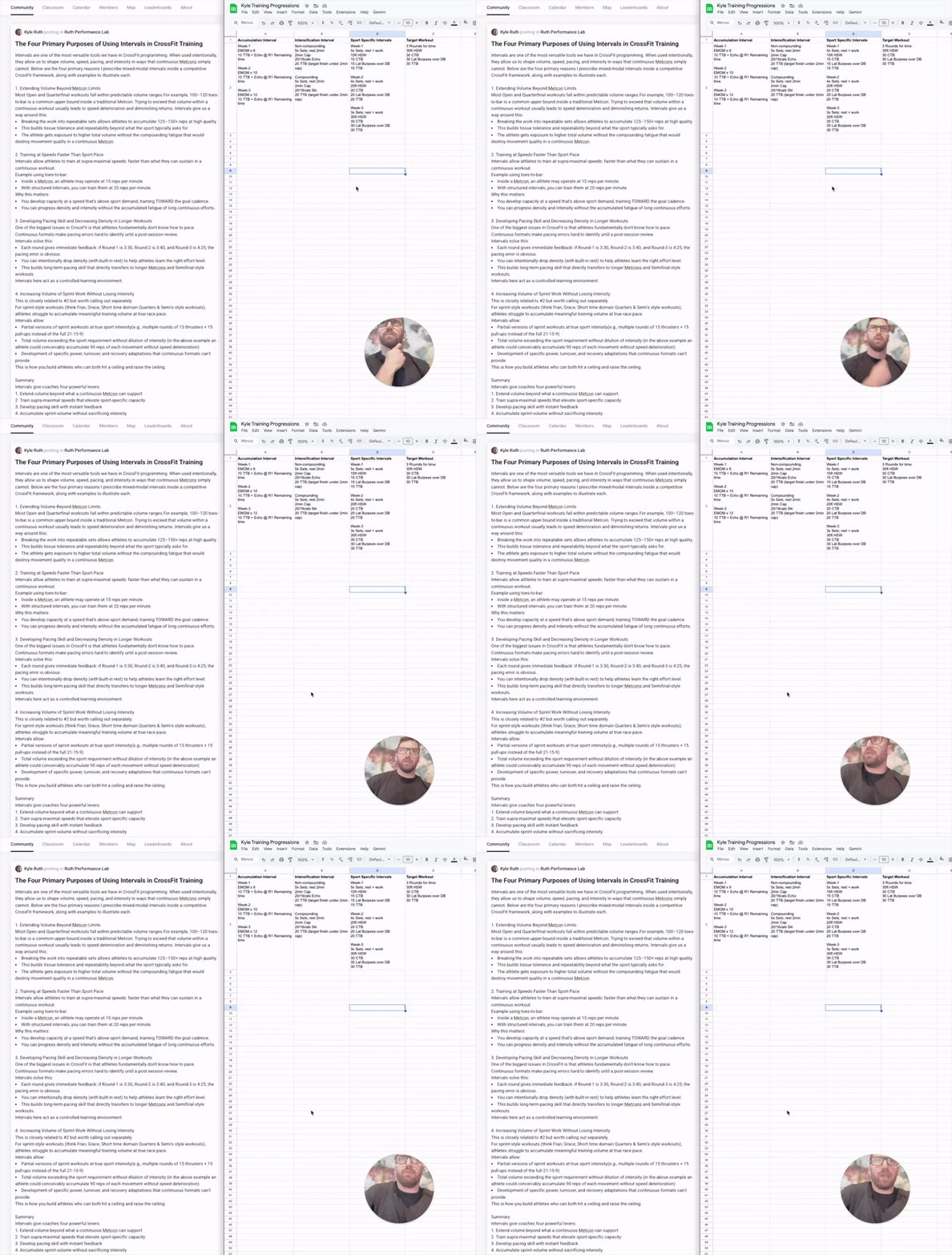
The Four Primary Purposes of Using Intervals in CrossFit Training
Intervals are one of the most versatile tools we have in CrossFit programming. When used intentionally, they allow us to shape volume, speed, pacing, and intensity in ways that continuous Metcons simply cannot. Below are the four primary reasons I prescribe mixed-modal intervals inside a competitive CrossFit framework, along with examples to illustrate each. 1. Extending Volume Beyond Metcon Limits Most Open and Quarterfinal workouts fall within predictable volume ranges.For example, 100–120 toes-to-bar is a common upper bound inside a traditional Metcon. Trying to exceed that volume within a continuous workout usually leads to speed deterioration and diminishing returns. Intervals give us a way around this: - Breaking the work into repeatable sets allows athletes to accumulate 125–150+ reps at high quality. - This builds tissue tolerance and repeatability beyond what the sport typically asks for. - The athlete gets exposure to higher total volume without the compounding fatigue that would destroy movement quality in a continuous Metcon. 2. Training at Speeds Faster Than Sport Pace Intervals allow athletes to train at supra-maximal speeds: faster than what they can sustain in a continuous workout. Example using toes-to-bar: - Inside a Metcon, an athlete may operate at 15 reps per minute. - With structured intervals, you can train them at 20 reps per minute. Why this matters: - You develop capacity at a speed that’s above sport demand, training TOWARD the goal cadence. - You can progress density and intensity without the accumulated fatigue of long continuous efforts. 3. Developing Pacing Skill and Decreasing Density in Longer Workouts One of the biggest issues in CrossFit is that athletes fundamentally don't know how to pace. Continuous formats make pacing errors hard to identify until a post-session review. Intervals solve this: - Each round gives immediate feedback: if Round-1 is 3:30, Round-2 is 3:40, and Round-3 is 4:25, the pacing error is obvious. - You can intentionally drop density (with built-in rest) to help athletes learn the right effort level. - This builds long-term pacing skill that directly transfers to longer Metcons and Semifinal-style workouts.
0 likes • Dec '25
Great content Coach! Question regarding: do you think this style of intervals progression needs a specific timing in a season prep or is it fully athlete-dependent? To clarify, I refer to intervals created to focus on pacing improvement, not movement capacity / efficiency.
Nov '25 •
Welcome to The Ruth Performance Lab!
I’ve created this as a community for athletes and coaches in the competitive fitness space to learn and collaborate. I’ll be sharing deep dives of training concepts, program design breakdowns, and inviting subject matter experts in everything from mental performance training and nutrition to niche topics like breathing and BFR. What to expect here: For my individual coaching clients: 1. Weekly Office Hours starting the first week after Thanksgiving 2. A full library of all Office Hours recordings 3. A resource library for everything training and performance related from the Competitors Manual, travel guidelines, pacing breakdowns, to nutrition and supplement guides. For everyone else: 1. Training education, system breakdowns, and long-form posts. 2. A place to ask questions and learn alongside other serious athletes and coaches. Thanks for being here, I’m excited to grow this alongside you!
3 likes • Nov '25
That's me knowing how much great stuff is going to be here
1-5 of 5

@jan-lenczuk-8585
12 years of trying to become a professional football player ended with an already 9-year-long CrossFit addiction. Full-time CF coach & dogs owner.
Active 3d ago
Joined Nov 24, 2025
Wrocław
Powered by