Activity
Mon
Wed
Fri
Sun
Oct
Nov
Dec
Jan
Feb
Mar
Apr
May
Jun
Jul
Aug
Sep
What is this?
Less
More
Owned by Ian
This is for You if you feel there is something not working in your life and you need tools to examine that and possibly make a BIG change.
Modern British English
183 members • Free
Skoolers
160.4k members • Free
Self Inquiry Support Group
7.3k members • Free
AI Automation Society
454.7k members • Free
Change Starts With Choice
58 members • Free
Skool Course
71.1k members • $29/month
Cob & Natural Building School
1.6k members • $10/month
32 contributions to When Life Stops Working
Apr 20 •
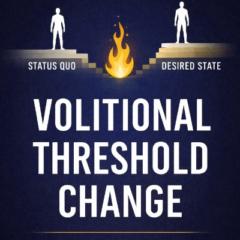
The Quiet Panic of Having Options
There is a moment that does not arrive with drama. No announcement, no crisis, no clear line in the sand. It tends to slip in quietly, often on an ordinary day, while you are doing something routine. You are working, travelling, sitting with a coffee, or staring at a screen that you have stared at a thousand times before. And then, almost without warning, a thought appears that does not feel like the others. You realise you have options. Not theoretical ones. Not the kind people talk about casually. Real ones. The kind that would actually change your life if you acted on them. At first, it sounds like good news. Freedom, after all, is what most people say they want. More choice, more flexibility, more control. We are told that having options is the goal. It is what we work towards, what we sacrifice for, what we quietly hope will arrive one day and make everything feel easier. But something strange happens when it does arrive. It does not feel like relief. It feels like pressure. Because the moment you recognise that you could change things, staying the same is no longer something that just happens to you. It becomes a decision. And that changes everything. Before that moment, there is always a story you can tell yourself. The job is what it is. The circumstances are what they are. The responsibilities, the expectations, the timing. There is always a reason why things cannot be different right now. Those reasons may be valid, but they also provide a kind of cover. They allow you to move forward without questioning too much. Options remove that cover. Once you can see a different path clearly enough to walk it, you can no longer pretend you are stuck. You may still choose to stay where you are, but you cannot say you had no choice in the matter. That quiet realisation introduces a new kind of weight. It is not imposed from the outside. It comes from within. And that is where the panic begins, although it rarely looks like panic in the way we expect. It is subtle. It shows up as restlessness, as overthinking, as a low level unease that does not quite go away. You start to notice things you previously ignored. Small irritations become more visible.
1
0
Apr 12 •
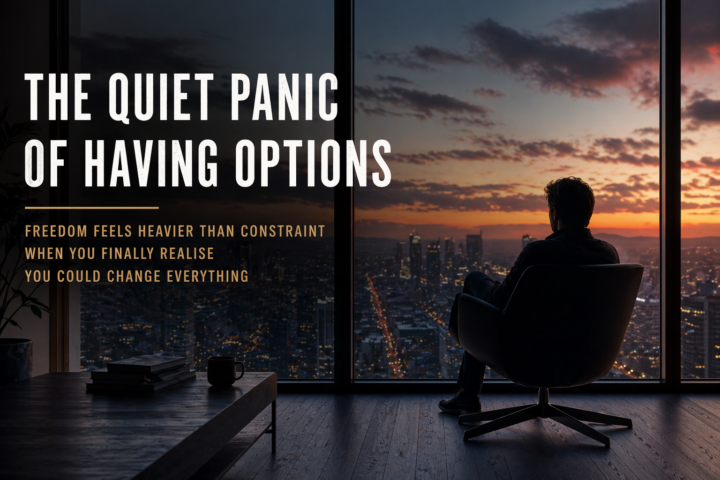
Pushing on the Wrong Door
Most people don’t struggle because they’re not trying hard enough. They struggle because they’re trying hard in the wrong place. We’re taught to push, persist, and prove ourselves—but almost never to step back and question the direction itself. This one is about the cost of forcing doors that were never meant to open. If something in your life feels harder than it should, this might explain why. Read it, sit with it—and ask yourself the uncomfortable question. https://ianasimon.substack.com/p/pushing-on-the-wrong-door
Apr 11 •
The Day Nothing Was Wrong
There’s a moment most people don’t talk about. Not when life falls apart, but when it doesn’t… and still something feels off. This piece is a personal account of that quiet shift. When everything still works on the surface, but no longer feels like it belongs to you underneath. If you’ve ever felt that and couldn’t quite explain it, this one might land. Read it, and see what it brings up. https://ianasimon.substack.com/p/the-day-nothing-was-wrong
2
0
Apr 5 •
The Hobby I Took More Seriously Than My Career
I used to think I was the problem, not in an obvious or dramatic way, but as a quiet and persistent suspicion that something in me did not quite operate the way it should. I could begin things well enough. In fact, I was often strong at the start. I would commit, organise, and apply myself with a level of intent that felt convincing at the time. There was always a sense, especially in those early stages, that I was finally approaching things properly, that this time I would hold the line long enough for it to take root. But the same pattern would return, and it returned so consistently that it became difficult to ignore. It never collapsed suddenly. It would begin with small shifts, a delay here, a task postponed there, a subtle resistance that I could not quite explain but could certainly feel. I would respond in the only way I knew how, by tightening things further, by applying more structure, more discipline, more pressure on myself to stay aligned with the plan I had created. It never held. Each attempt followed the same trajectory. Effort, structure, early traction, and then a gradual erosion that brought me back to the same place I had been before. I began to internalise that pattern as a flaw in me rather than a signal about what I was doing. It felt as though I was capable enough to understand what needed to be done, but not capable enough to sustain it, as though there was some internal weakness that prevented me from becoming the person I believed I should be. What I did not question, and what did not even occur to me to question at the time, was whether the direction itself was the issue. Alongside all of this, there was another part of my life that behaved in a completely different way, and I dismissed it without much thought. The garage. It was not something I analysed or tried to develop. It was simply where I went. A place to work with my hands, to step away from the mental strain of trying to force myself into a version of life that never quite settled. I told myself it was how I relaxed, a way to switch off after a day of effort.
1
0

Mar 11 •
The World Wants Your Reaction
One of the quiet pressures of the modern world is the constant demand to react. Every day something happens that seems to demand our attention. Politics erupts, headlines multiply, social media amplifies outrage, and communities split into arguments about what we should think, support, or condemn. The emotional atmosphere shifts constantly, and many people find themselves adjusting their thinking and direction every time the wind changes. But if someone has taken the time to examine their life carefully, something different can happen. They step back from the noise and begin asking harder questions. What actually fits my life? What no longer does? What direction makes sense for the person I am becoming? These are not easy questions. They require honesty, patience, and a willingness to confront the quiet friction that builds when our lives drift away from who we really are. Most people avoid that work because it is uncomfortable. It is far easier to follow the expectations already circulating around us. Yet occasionally someone pauses long enough to see the pattern. They realise that much of their direction has been inherited rather than chosen. Career paths, definitions of success, social expectations, even the pace at which life should unfold, all quietly absorbed without ever being examined. When that realisation arrives, something important begins to form. Not a detailed plan. Not a guaranteed destination. But a direction that feels honest. And this is where the real test begins. Because once someone begins moving in a direction that actually fits them, the surrounding world rarely remains neutral. Friends question it. Family worry about it. Cultural pressure encourages conformity. News cycles generate fear and urgency. Gradually the person who found clarity begins to wonder whether they should adjust again, not because their direction was wrong, but because the surrounding noise has become difficult to ignore. This is where steadiness matters. Direction is not the same as destination. A destination may evolve as reality unfolds. But direction acts as a compass. Without it, every new event becomes a reason to change course.
1
0

1-10 of 32
@ian-simon-6148
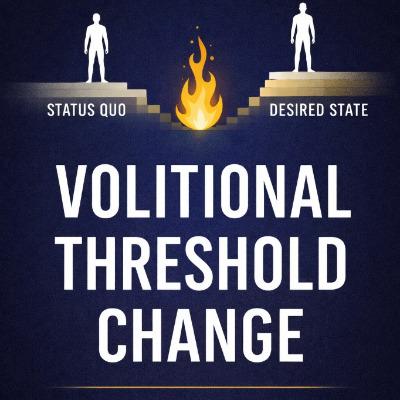
I started this community because I felt compelled to share what I’ve learned about real change. Author of Volitional Threshold Change (Amazon)
Active 106d ago
Joined Jan 2, 2026