Activity
Mon
Wed
Fri
Sun
Sep
Oct
Nov
Dec
Jan
Feb
Mar
Apr
May
Jun
Jul
What is this?
Less
More
Memberships
AF Coaching
307 members • Free
Mind | Muscle | Meals
147 members • Free
TE
The Enhanced Athlete Academy
35 members • $27/month
Pharmacology Teaching System
220 members • Free
BioOptimization Collective
298 members • Free
Coach Cam's Peptide Academy
1.4k members • $10/m
2 contributions to BioOptimization Collective

Jun 10 •
Can Only Pick One
If you had to choose just one peptide for the rest of your life, which would you pick? Mine would be Ipamorelin which supports the body's natural growth hormone production, promotes recovery, helps maintain lean muscle, improves sleep quality, and supports healthy aging without replacing the body's own hormones.
1 like • Jun 11
Hgh or Reta
Feb 20 •
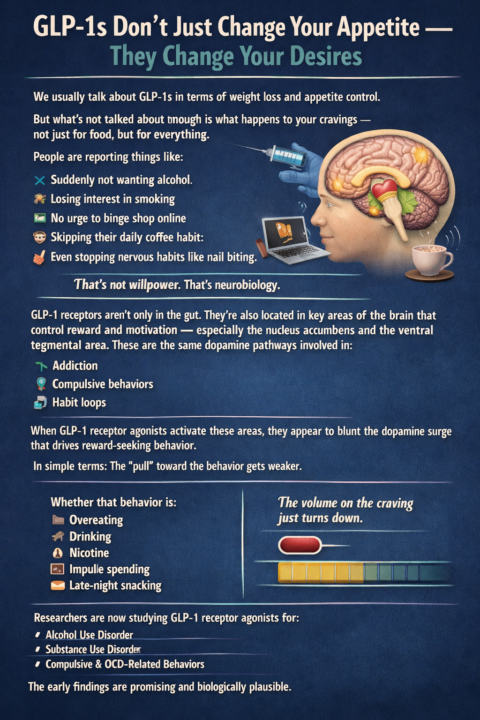
GLP-1s Don’t Just Change Your Appetite — They Change Your Desires
We usually talk about GLP-1s in terms of weight loss and appetite control. But what’s not talked about enough is what happens to your cravings — not just for food, but for everything. People are reporting things like: - Suddenly not wanting alcohol - Losing interest in smoking - No urge to binge shop online - Skipping their daily coffee habit - Even stopping nervous habits like nail biting That’s not willpower. That’s neurobiology. GLP-1 receptors aren’t only in the gut. They’re also located in key areas of the brain that control reward and motivation — especially the nucleus accumbens and the ventral tegmental area. These are the same dopamine pathways involved in: - Addiction - Compulsive behaviors - Habit loops When GLP-1 receptor agonists activate these areas, they appear to blunt the dopamine surge that drives reward-seeking behavior. In simple terms: The “pull” toward the behavior gets weaker. Whether that behavior is: - Overeating - Drinking - Nicotine - Impulse spending - Late-night snacking The volume on the craving turns down. Researchers are now studying GLP-1 receptor agonists for: - Alcohol use disorder - Substance use disorders - Compulsive and OCD-related behaviors The early findings are promising and biologically plausible. So I’m curious — What’s the most unexpected thing a GLP-1 made you lose interest in? Drop it below. I think this conversation is going to surprise a lot of people.
1 like • Mar 8
I stopped drinking alcohol and it made me not crave it.
1-2 of 2
@hector-montoya-8085
Just trying to get rid of this dad bod lol
Active 7h ago
Joined Mar 8, 2026
Powered by