Activity
Mon
Wed
Fri
Sun
Apr
May
Jun
Jul
Aug
Sep
Oct
Nov
Dec
Jan
Feb
Mar
What is this?
Less
More
Memberships
Ruth Performance Lab
264 members • Free
1 contribution to Ruth Performance Lab

Dec '25 •
My strain Recovery Philosophy
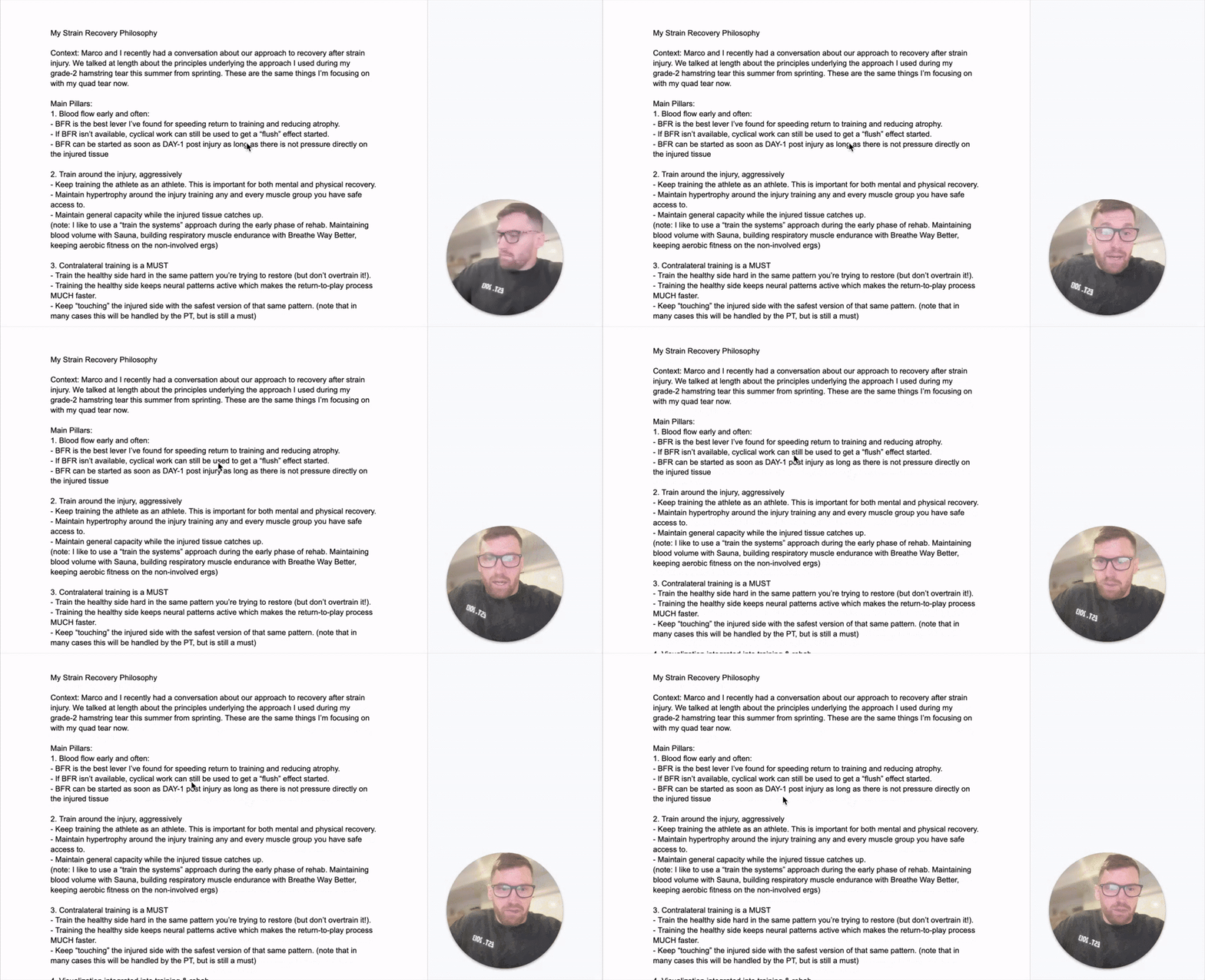
My Strain Recovery Philosophy Context: @Marco Mar and I recently had a conversation about our approach to recovery after strain injury. We talked at length about the principles underlying the approach I used during my grade-2 hamstring tear this summer from sprinting. These are the same things I’m focusing on with my quad tear now. Main Pillars: 1. Blood flow early and often: - BFR is the best lever I’ve found for speeding return to training and reducing atrophy. - If BFR isn’t available, cyclical work can still be used to get a “flush” effect started. - BFR can be started as soon as DAY-1 post injury as long as there is not pressure directly on the injured tissue 2. Train around the injury, aggressively - Keep training the athlete as an athlete. This is important for both mental and physical recovery. - Maintain hypertrophy around the injury training any and every muscle group you have safe access to. - Maintain general capacity while the injured tissue catches up. (note: I like to use a “train the systems” approach during the early phase of rehab. Maintaining blood volume with Sauna, building respiratory muscle endurance with Breathe Way Better, keeping aerobic fitness on the non-involved ergs) 3. Contralateral training is a MUST - Train the healthy side hard in the same pattern you’re trying to restore (but don’t overtrain it!). - Training the healthy side keeps neural patterns active which makes the return-to-play process MUCH faster. - Keep “touching” the injured side with the safest version of that same pattern. (note that in many cases this will be handled by the PT, but is still a must) 4. Visualization integrated into training & rehab - Visualization is “free volume” for the brain. - No tissue cost + positive transfer to movement patterns. - Can be integrated during rest periods of rehab work. ------------------------------------------------------------ General takeaways 1. The fastest recoveries I’ve seen happen when we keep the athlete training, not when they take time completely off.

0 likes • 11d
I personally think the cross-education work (contralateral lifting) within RTP/RTT is massively over looked AND misunderstood. I was actually talking to some of our physios about this yesterday. “Train the non-injured side” becomes a default instruction, detached from the underlying physiology that actually drives contralateral transfer. Cross-education is not a general training effect, it's a specific central nervous system adaptation, and the quality of the stimulus determines the quality of the outcome. At its core, cross-education reflects increased neural drive to homologous musculature on the untrained limb. Unilateral resistance training: 1. Enhances corticospinal excitability bilaterally (It makes the brain better at sending movement signals to muscles on both sides of the body). 2. Reduces interhemispheric inhibition (The brain’s two halves interfere with each other less and work together better). 3. Improves voluntary activation capacity on the injured side. Importantly, these adaptations occur in the absence of peripheral loading, highlighting that the effect is neural rather than morphological. The 3 principles I try to stick with when dealing with an limb compromised player are: Load matters: Higher-intensity work produces greater central drive and more robust contralateral effects than low-load high-repetition protocols. If the stimulus does not meaningfully challenge motor unit recruitment and rate coding, the nervous system has little reason to adapt. Contraction type matters: Eccentric-biased loading consistently demonstrates superior cross-education effects, probably due to greater cortical involvement and afferent feedback. Tempo is not a cosmetic variable IMO; it directly influences neural demand. Frequency matters more than volume: Repeated neural exposure appears more effective than sporadic high-volume sessions. From a motor learning perspective, regular reinforcement outperforms episodic overload. Sorry for the lengthy one, I got on a role. What are you thoughts Kyle?
1 like • 10d
@Kyle Ruth yeah tbh it wasn’t until a year ago or so that I revisited it myself as I was convinced there was more to it than just single limb work.
1-1 of 1
Active 1d ago
Joined Feb 24, 2026
Powered by