Activity
Mon
Wed
Fri
Sun
Apr
May
Jun
Jul
Aug
Sep
Oct
Nov
Dec
Jan
Feb
Mar
What is this?
Less
More
Memberships
Heart-In-Mind | Free Circle
12 members • Free
2 contributions to Heart-In-Mind | Free Circle

Jan 19 •
Your Practice This Week
I want to share something I see over and over again with men who come into this space. Most people think stress lives in the mind. Thoughts. Worries. Overthinking. But stress actually shows up in the body first. Before you ever realize you’re overwhelmed, your nervous system has already shifted. Your body has already decided whether it feels safe or not — and it does that without language. That’s why stress often shows up as: - tightness in your chest or jaw - shallow breathing - restlessness or agitation - fatigue that doesn’t make sense - or numbness, zoning out, feeling disconnected None of this means you’re failing at regulation. It means your body learned how to hold stress instead of releasing it. Biologically, stress is meant to move through us. Activate → respond → return to baseline. But when stress is constant, emotional, or unspoken, that cycle doesn’t complete. The body stays on alert — quietly. Here’s a small awareness practice I want you to try today or tomorrow: Take 60 seconds and ask yourself: “What am I feeling in my body right now — physically?” Not why. Not how do I fix it. Just where and what. Tension? Pressure? Heaviness? Nothing at all? All of it counts. This is how regulation actually begins — not by forcing calm, but by understanding what your body has been carrying for you. If you feel comfortable, drop a comment: 👉 Where do you tend to hold stress in your body?

1 like • Feb 3
For me , it's the fatigue.
Jan 29 •
Are you familiar with Differentiation
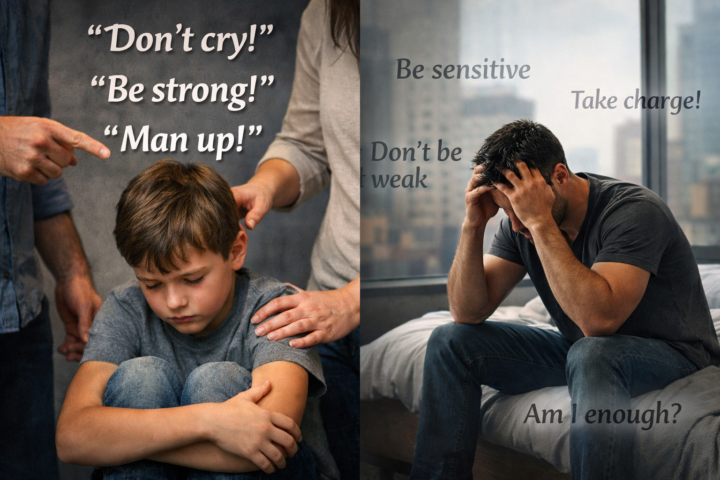
One of the least understood skills in relationships is differentiation — the ability to tell the difference between what belongs to you emotionally and what belongs to someone else. Most men were not taught this growing up. Many were taught two things instead: • push down what you feel • step up and protect On the surface, those lessons look like strength. Underneath, they often blur the line between self and other. When you’re trained to suppress your own emotional experience, you lose practice noticing internal signals in real time — tension, fear, disappointment, overwhelm. Those signals don’t disappear; they just go unrecognized. Then add the protector role. When emotion shows up in someone you care about, your system doesn’t slow down to ask, “What’s happening inside me right now?” It moves straight to action: fixing, reassuring, explaining, taking responsibility. This is where confusion starts. Not because you don’t care. But because your nervous system has learned that emotional intensity equals responsibility. Here’s where differentiation becomes practical. A differentiated response starts with internal sorting before external action. You can practice this in three steps: First: notice activation Pay attention to your body before your thoughts. Tight chest, urgency, irritation, pressure to speak or solve — these are signs your system is mobilizing. Second: name what’s yours Ask yourself quietly: “What am I feeling right now?” Not what should I do — what am I actually experiencing? This might be discomfort, helplessness, fear of being blamed, or the urge to make the situation go away. Third: separate responsibility Then ask: “Is this emotion coming from my internal state, or am I absorbing someone else’s?” You can be affected by someone without being responsible for regulating them. This is the difference between: • supporting vs rescuing • listening vs fixing • staying present vs abandoning yourself Differentiation doesn’t mean becoming distant.
1 like • Jan 31
this hits close
1-2 of 2

@derek-jones-4765
Just an average guy trying to cope with life and relationships and all that they bring. never dealt with childhood or adult trauma in a healthy way.
Active 5d ago
Joined Jan 31, 2026