
Write something

Feb 12 •
The Expectations Placed on Men — And the Breakdowns No One Talks About
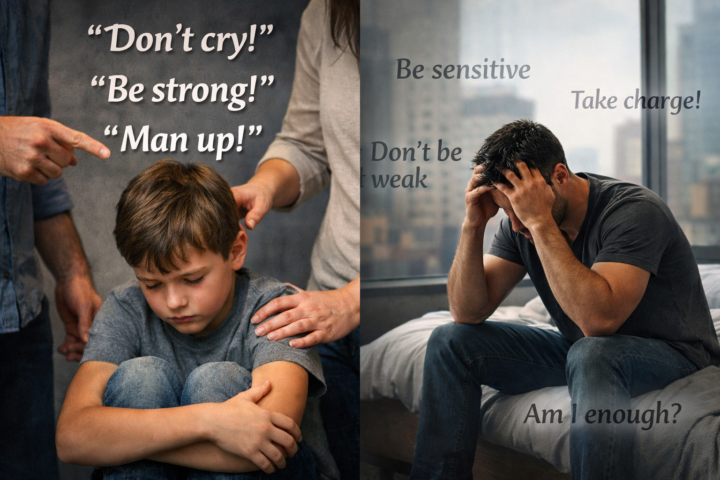
Most men don’t enter relationships trying to fail. They enter trying to be strong. To provide. To protect. To not be “too much.” To not be weak. To not mess it up. And quietly — to be respected. But here’s where it breaks down. Many men were never taught how to relate to themselves. So they show up in relationships with invisible expectations: - “I should always have it together.” - “If I feel hurt, I shouldn’t show it.” - “If she’s upset, I must have failed.” - “If I need reassurance, I’m weak.” Those expectations aren’t about her. They’re about the identity you built to survive. And when that identity gets threatened — conflict feels like rejection, distance feels like betrayal, feedback feels like disrespect. That’s when breakdowns happen. Not because of love. Because of unexamined self-protection. The Self Always Comes First Before boundaries between two people exist, there are boundaries inside you. Healthy boundary: “I feel overwhelmed. I need 20 minutes to regulate before we continue.” Unhealthy boundary: Silent withdrawal. Emotional shutdown. Or controlling the conversation so you don’t feel exposed. Healthy boundary: “I’m not comfortable with that.” Unhealthy boundary: Agreeing to avoid conflict, then building resentment. Healthy boundary protects integrity. Unhealthy boundary protects ego. One builds connection. The other slowly erodes it. Most Breakdowns Aren’t About Compatibility They’re about nervous systems. When you were taught that strength equals suppression, your body learned: Conflict = danger Vulnerability = risk Needing reassurance = weakness So when tension shows up, you either: - Escalate (fight), - Avoid (flight), - Shut down (freeze), - Or over-please (fawn). That’s not character. That’s conditioning. And until you understand your own triggers and reactions , you’ll keep thinking the problem is “the relationship.” It isn’t. It’s the self trying to stay safe. How To Tell Healthy Boundaries From Defensive Ones
1
0
Feb 3 •
Guilt vs Shame — and why confusing the two keeps men stuck
Most men I work with think they’re feeling guilt. They’re not. They’re living in shame, and it quietly shapes how they relate to themselves, their partners, and their choices. Here’s the difference — and it matters more than you think. Guilt says: “I did something that doesn’t align with my values.” Guilt is behavior-focused. It can be uncomfortable, but it’s actually useful. It points to responsibility, repair, and growth. Guilt sounds like: • “That wasn’t honest.” • “I crossed a line.” • “I need to take responsibility for this.” When guilt is processed properly, it leads to accountability and change. Shame says: “There is something wrong with me.” Shame is identity-focused. It doesn’t point forward — it collapses inward. Shame sounds like: • “I’m broken.” • “I always mess things up.” • “If they really knew me, they’d leave.” And here’s the part most men miss: Shame doesn’t make you better. It makes you hide, defend, shut down, or escape. This is where patterns like lying, withdrawal, emotional numbness, porn use, overworking, or anger often live — not because you don’t care, but because your nervous system is trying to avoid threat. Why this shows up so strongly for men Many men were never taught how to separate what they did from who they are. Mistakes became character flaws. Emotions became weakness. Needing help became failure. So instead of learning from guilt, the system drops straight into shame — and shame activates survival. That’s when logic disappears and patterns repeat. The shift that actually changes things Growth doesn’t come from “trying harder” or beating yourself up. It comes from learning to say: • “This behavior doesn’t align with me” without saying • “I am the problem.” That distinction is the foundation of self-trust, repair, and real masculinity. Reflection question (sit with it, don’t rush it): When you mess up, do you focus on correcting the behavior — or punishing the self? One leads to integrity. The other keeps you stuck.
1
0
Feb 1 •
When Safety Isn’t Felt : The Body Goes Into Alarm Mode.
Most men think their reactions mean something about their character. They don’t. They mean something about their nervous system. According to Polyvagal Theory, your body is constantly scanning for one thing before any thought forms: “Am I safe right now?” Not logically. Not consciously. Physiologically. Your nervous system has different pathways for protection and connection, and it moves through them automatically based on past experience — especially early relational experience. That’s where the four responses come from. Fight & Flight – Mobilized Survival Fight and flight live in the sympathetic nervous system. This is high energy, high alert, action-oriented survival. Fight shows up when your system believes it can push back and regain safety. - You argue, defend, control, correct, dominate. - Your body feels hot, tense, wired. - Your mind locks into being right. This isn’t anger as a personality trait. It’s protection through force. Flight shows up when your system believes escape is safer than engagement. - You avoid conversations. - You distract, numb, overwork, scroll, use porn. - You feel restless, impatient, or unable to settle. This isn’t disinterest. It’s self-preservation through distance. In both fight and flight, your nervous system believes connection is dangerous right now. Freeze – Shutdown Survival Freeze is different. It’s not high energy — it’s collapse. This lives in the dorsal vagal state, where the body decides: “Nothing I do will help. Stillness is safest.” Examples: - You go blank in conversations. - You feel numb, foggy, disconnected. - You don’t know what you feel or what you want. - You want to disappear, sleep, or shut off. Freeze often develops when earlier attempts at fight or flight didn’t work — especially in childhood. It’s not calm. It’s overload without escape. Fawn – Safety Through Others Fawn is not a separate branch in Polyvagal Theory, but a hybrid survival strategy built around social appeasement.
1
0

Jan 29 •
Are you familiar with Differentiation
One of the least understood skills in relationships is differentiation — the ability to tell the difference between what belongs to you emotionally and what belongs to someone else. Most men were not taught this growing up. Many were taught two things instead: • push down what you feel • step up and protect On the surface, those lessons look like strength. Underneath, they often blur the line between self and other. When you’re trained to suppress your own emotional experience, you lose practice noticing internal signals in real time — tension, fear, disappointment, overwhelm. Those signals don’t disappear; they just go unrecognized. Then add the protector role. When emotion shows up in someone you care about, your system doesn’t slow down to ask, “What’s happening inside me right now?” It moves straight to action: fixing, reassuring, explaining, taking responsibility. This is where confusion starts. Not because you don’t care. But because your nervous system has learned that emotional intensity equals responsibility. Here’s where differentiation becomes practical. A differentiated response starts with internal sorting before external action. You can practice this in three steps: First: notice activation Pay attention to your body before your thoughts. Tight chest, urgency, irritation, pressure to speak or solve — these are signs your system is mobilizing. Second: name what’s yours Ask yourself quietly: “What am I feeling right now?” Not what should I do — what am I actually experiencing? This might be discomfort, helplessness, fear of being blamed, or the urge to make the situation go away. Third: separate responsibility Then ask: “Is this emotion coming from my internal state, or am I absorbing someone else’s?” You can be affected by someone without being responsible for regulating them. This is the difference between: • supporting vs rescuing • listening vs fixing • staying present vs abandoning yourself Differentiation doesn’t mean becoming distant.
Jan 20 •
The quiet truth about porn (that most men never hear)
Porn doesn’t take hold because you’re weak. It takes hold because it works — temporarily. Not as pleasure. As regulation. When stress, loneliness, pressure, or emotional overload build up, the nervous system looks for the fastest way back to equilibrium. Porn delivers a predictable shift in state: anticipation → stimulation → brief relief. Your brain learns this pattern quickly. Over time, porn stops being about arousal and starts functioning as a stress-response shortcut. That’s why urges often show up: - after conflict - late at night - when you feel disconnected - when you’re overwhelmed but quiet This isn’t a moral issue. It’s a conditioning loop between stress, anticipation, and relief. The cost isn’t just time or secrecy. The deeper impact is that arousal becomes separated from: - emotional safety - presence - reciprocity - connection So one part of you wants closeness… and another part wants escape. That internal split is exhausting — and it often shows up as irritability, numbness, or withdrawal rather than desire. A small practice (5 minutes, no pressure) The next time an urge appears, don’t try to stop it. Instead, pause and ask: 1. What state am I in right now?(Tense, lonely, bored, overstimulated, disconnected?) 2. Where do I feel this in my body?(Chest, jaw, stomach, shoulders — just notice.) 3. Take 5 slow exhales, longer out-breath than in breath. You're not calming yourself — you’re signalling safety. That’s it. No fixing. No forcing. Just information. Awareness is how the nervous system starts to relearn options. When urges show up for you, what’s usually happening before — stress, loneliness, boredom, or something else? If you’re willing, share one pattern you’ve noticed. Not to confess — but to understand. You don’t change a system by fighting it. You change it by learning how it works.
1
0
1-8 of 8
powered by
skool.com/the-awareness-project-6721
This community is for men navigating life’s turning points — rebuilding self-trust, rediscovering peace, and understanding through self-awareness.
Suggested communities
Powered by