Activity
Mon
Wed
Fri
Sun
Aug
Sep
Oct
Nov
Dec
Jan
Feb
Mar
Apr
May
Jun
What is this?
Less
More
Owned by Daron
Guiding businesses & web designers to win in zero-click AI search by using smart strategies like FAQs, schema, online help & customer-focused design.
Memberships
Growth
328 members • Free
AI Automation Agency Hub
327.4k members • Free
Founder's Forge Free!
237 members • Free
CEO Developers
261 members • Free
Kourse (Free)
112.2k members • Free
Samin's Free AI Resource Hub
17.1k members • Free
54 contributions to Growth

2d •
Quick (life changing) question.
If I offered you £1,000 today or A single penny that I would double every day for the next 31 days, which would you take? Don’t calculate it. Don’t think too hard. Just answer instinctively. I've asked this a lot and most people would take the £1,000, and I don’t think that makes them greedy or foolish. I think it makes them human. We’re conditioned to value certainty over possibility and immediacy over patience. £1,000 in the hand feels real. A penny that doubles every day sounds like a trick, a gamble or an academic exercise with no relevance to real life. The interesting thing is that this instinct, useful as it may once have been for survival, is often exactly what holds people back in business, investing and life. After one week, your penny would still be worth less than a £1. After two weeks, you would have just £163.84. In reality, most people never even make it to Week 2... ...They start doing the maths in their head: 1p, 2p, 4p, 8p, 16p… and quickly conclude that it’s a terrible deal. The £1,000 feels sensible, rational and safe, while the penny feels insignificant, almost laughable. The irony, of course, is that the decision is made long before the power of compounding (and delayed gratification) has had any chance to reveal itself. Yet if you stayed the course, on Day 31 that same penny would be worth £10,737,418.24, and across the full 31 days you would have accumulated £21,474,836.47. The maths is remarkable, but the principle matters far more than the numbers. The people who build great businesses, create wealth, become fitter, write books or master skills rarely do so through dramatic breakthroughs. More often than not, they simply understand something that many people never fully appreciate: small actions, repeated consistently and given enough time, produce results that appear wildly disproportionate to the effort invested. Compounding is one of the closest things life offers to MAGIC, but it has one major flaw. It is invisible for far longer than most people are comfortable with.


2 likes • 2d
Nice one @Mike Greene It can also illustrate just how cost waiting until tomorrow to start can be. Taking the penny today and doubling it tomorrow, or waiting and taking the penny tomorrow and then starting might not seem to make that big a difference... But think of the compounded difference when you're at day 31 with only 30 days of compounded growth That's a difference of £5,368,709! 👉 Start today!
May 10 •
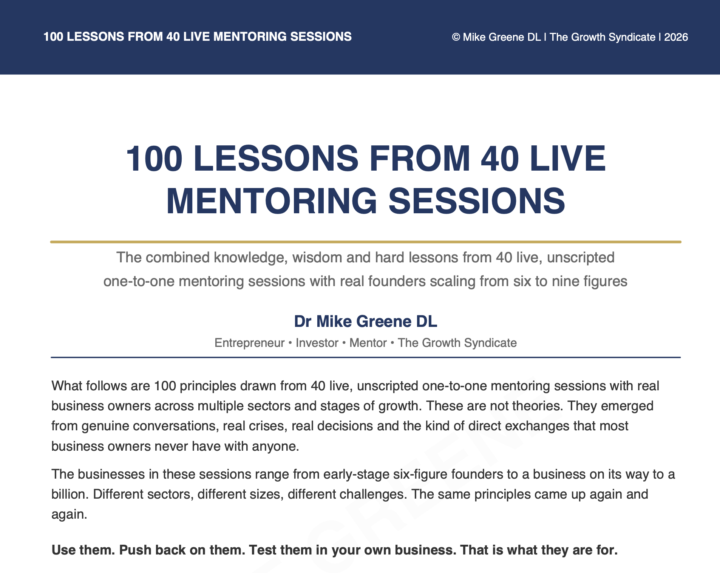
🔴 AVAILABLE NOW - 100 Lessons from 40 Live Mentoring Sessions
Last month I took every one-to-one mentoring session I ran - 40 sessions, real founders, real businesses, real problems - and pulled out 100 lessons. Not theory. Not textbook stuff. Summarised lessons from the actual conversations. The decisions that saved businesses and the ones that nearly broke them. The same problems that come up again and again at every stage - cash flow, people, pricing, growth, exit - and the solutions that actually work when someone finally applies them. Things like: → Why 70% of businesses fail with a full order book → The one question that tells you instantly who needs to go → Why your brand is worth more at exit than your profit ever will be → How to collect a debt from anyone — including a FTSE 100 company → The system that stops you unconsciously killing your own sales → The rule that separates businesses that grow from ones that just stay busy And 94 more lessons/principles. I've turned it into a full advisory document - beautifully laid out, protected, yours to print, adopt and keep. 100 lifechanging, business scaling lessons Its in on Skool available to every member FREE: https://www.skool.com/thegrowthsyndicate/classroom/efdda4a9?md=608ecc68108e4ed7bef73476a4e8a9d0
0 likes • May 11
That's great. Thanks a lot, @Mike Greene - Really appreciate it.
May 9 •
Create a RAZZLE Reel
Most businesses are TERRIBLE at communicating who they really are. Not because they’re not good. But because they explain…Instead of POSITION. I was speaking to someone the other day about creating what I call a “razzle reel”. A fast-moving, high-energy visual reel that quickly communicates: → Who you are. → What you do. → The scale of your business. → Your credibility. → Your experience. → Your team. → Your clients. → Your culture. → Your momentum. → Your story. Not with boring corporate waffle. With energy. Movement.Emotion. Credibility.Identity. Done properly, in 30–90 seconds, people subconsciously start thinking: → “These guys are established.” → “They’ve clearly done a lot.” → “They feel credible.” → “This business has momentum.” → “I’d trust them.” The best ones don’t scream:“Look at me.” They subtly communicate:“This is the world we operate in.” A great razzle reel should include things like: → Team. → Clients. → Events. → Projects. → Behind the scenes. → Results. → Customers. → Travel. → Podcasts. → Press. → Testimonials. → Speaking. → Community. → Brand moments. The structure is usually: → First 5 seconds = attention. → Next 20 seconds = identity. → Next 30 seconds = credibility. → Final section = emotional positioning and call to action. People no longer READ credibility. They absorb it visually in seconds. Especially on: → LinkedIn. → Websites. → Instagram. → TikTok. → Speaker intros. → Sales pages. Most SMEs would massively benefit from one. I’ve attached one of mine as an example. ...and if you want some recommendations of who can do it and costs etc hop on one of our weekly zooms and I will help you

0 likes • May 9
I love this, @Mike Greene - Impactful, and gets lots across in seconds.
1 like • May 9
It's not quite the same, @Mike Greene, but put this 38 second video together for a friend. She had a selection of staged and candid clips taken by her nephew, and a few photos. She send them over to me, and I did this... https://www.linkedin.com/posts/teresalopezdesign_branding-design-teamwork-ugcPost-7416408554364096513-JBZ0
Mar 18 •
Walk. Write. Question Everything.
In a world full of distraction, noise, and constant tech pulling at your attention, most people don’t need more input. They need less. Not another app, not another system, not another “life hack.” Just a few simple disciplines that cut through the chaos and bring you back to clarity. Here are 3 habits worth adopting: First, to quieten the noise, walk. Not exercise. Not with a podcast. Not scrolling or taking calls. Just walk. Every day, for at least 30 minutes. There’s a natural rhythm to walking that brings the brain back into balance. Left, right, left, right. It synchronises in a way that sitting and trying to “think harder” never will. There’s a reason so many of history’s greatest thinkers did their best work on their feet. Second, to sharpen your focus, write by hand. Not your to do list. Not your business plan. A separate notebook. Every morning, before you open any device, write one page. It doesn’t matter what comes out. Stream of consciousness is fine. The power is in the process. Writing by hand slows the mind down and forces it to choose words rather than spray them. The clarity you’re looking for sits in that small gap between thinking and writing. Third, to separate your signal from society’s noise, ask yourself one simple question whenever you feel overwhelmed. “Is this mine?” Most of what you’re carrying isn’t. The pressure, the comparison, the sense that you should be further ahead by now. It’s absorbed. From social media, from other people, from a world that never switches off. The moment you recognise that, it starts to loosen its grip. Try this for seven days. No complexity. No overthinking. Just walk, write, and question what you’re carrying. You might find the clarity you’ve been chasing was never that far away.

2 likes • Mar 18
Great points, @Mike Greene Mike. I have actually been doing some of these during the latter parts of the day, where a 30 minute late evening walk with the dog gets me out into a darker, quieter village, with plenty of thinking time. I do that in preference to the morning, because I like to get up and get started whilst there aren't too many distractions (usually in the shape of family members who have their own agendas, and reasons to moan and groan) And in truth, that "before distractions" approach has largely been behind my lack of Skool presence, because once I get going, and stay going! Plenty of good progress has been made though, so it's all good!
Mar 9 •
Person Not Price
The moment you believe business is won on price, Your profit starts collapsing. And your business is at risk. Because ALL the evidence from more than 50 years of consumer psychology research says something very different (and i built a business tracking these behaviours/triggers across 20 countries. People DO NOT buy primarily on price. They buy on people. Across decades of behavioural and purchasing research the same drivers keep appearing again and again: - Trust. - Connection. - Reputation. - Confidence. - Perceived value. Price usually sits third, fourth, sometimes even lower. Yet when business owners panic about winning work, the first lever they reach for is the wrong one. They cut price. Which quietly destroys margin, weakens positioning, attracts the wrong customers, and starts a race to the bottom that nobody wins. Customers are rarely asking: “Who is the cheapest?” They are asking something far more human. Can I trust this person? Do they understand my problem? Have they helped others like me? Do I feel confident putting this in their hands? That is why two businesses can quote for the same job and one wins comfortably at a higher price. The difference is not the spreadsheet. It is the person: - Their credibility. - Their authority. - Their ability to make the customer feel safe, understood and confident. So the lesson is simple. Stop trying to be cheaper. Start becoming: - More trusted. - Better known - Recommended by third party - Better quality Because in the real world of buying decisions it is almost always: Person first. Price second.

3 likes • Mar 9
Exactly, @Mike Greene "Can this person or business do what they say they can do?" and "How can they help me specifically?" When there is nothing other than price to distinguish one business from another, and nothing to educate potential customers otherwise, then price wins. But "cheap" has hidden costs which don't tend to surface at the point of decision. So earning trust, being recommended (included being recommended by AI in these days of "zero-click" search results) and being transparent is so important.
1-10 of 54

@daron-harvey-5320
Founder of TargaCalc - Developing custom website pricing calculators and bespoke quoting tools for staff, sales teams and business owners.
Active 2d ago
Joined Jan 7, 2026
UK
Powered by