Activity
Mon
Wed
Fri
Sun
Mar
Apr
May
Jun
Jul
Aug
Sep
Oct
Nov
Dec
Jan
Feb
What is this?
Less
More
Memberships
AEO - Get Recommended by AI
1.6k members • Free
10 contributions to AEO - Get Recommended by AI

3d •
Goolge WebMCP
I haven't seen anyone talking about this release last week https://developer.chrome.com/blog/webmcp-epp. Any thoughts?

Dec '25 •
First sale!
Found Perry secret agency plan - read it on the plane home from a podcast yesterday - sold my first $1000 AEO audit today!
2 likes • 17d
That's fantastic! I'm currently negotiating with 3 major OEM's to provide quarterly audits of all their stores. Not what I started off thinking I was going to do, but.....

Jan 20 •
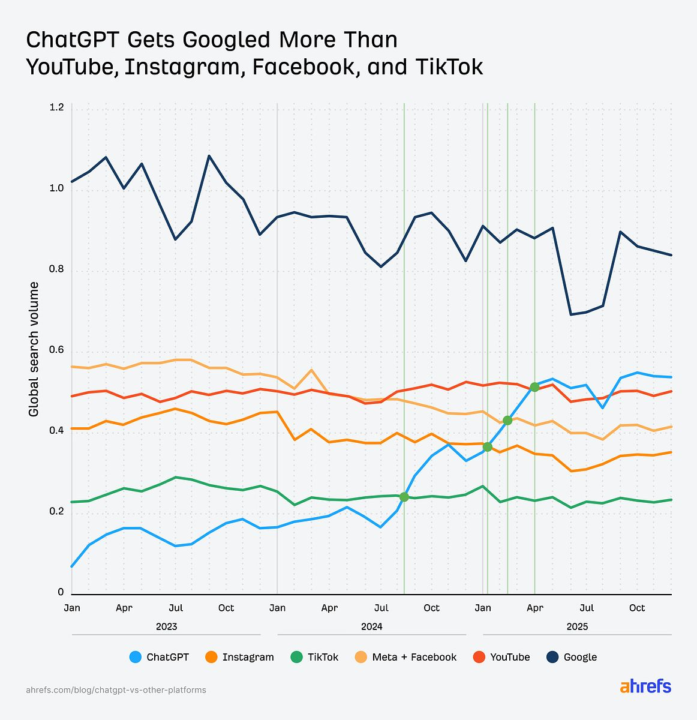
Is ChatGPT Winning on... Search? 🔍
ChatGPT has surpassed major social media and video platforms like YouTube, TikTok, Instagram, and Facebook in global search interest, achieving this milestone in under two and a half years since its launch. According to data from Ahrefs, ChatGPT's monthly search volume overtook YouTube in April 2025 and has since outpaced all other platforms between September 2024 and April 2025. While search volume isn't a perfect measure of usage, it reflects sustained user intent and habit formation. The data also shows that Google still leads in search interest, but the gap has narrowed significantly since early 2023, with projections suggesting ChatGPT could match or even surpass Google’s search volume by 2028–2029 if current trends continue. Source: https://ahrefs.com/blog/chatgpt-vs-other-platforms
1 like • Jan 20
This is such an important post.

Jan 13 •
Steal my new Entity Graph Tracker
1. Question: What do you use to track your entities, @IDs, relationships, etc.? I´m starting with this multi-tab sheet for a major SEO/AEO client for tracking their knowledge graph - entities, @IDs, and relationships, etc., to be maintained collaboratively with my developers. https://docs.google.com/spreadsheets/d/1ftyCPFrGYpH7fgQ7WKXEJZkNxK1da7rROXKiJXqMYPQ/edit?usp=sharing I´m considering moving it to Fusebase as a searchable database because this client´s site is very large and they are already using Fusebase. Any other platform recommendations @Julian Lopez ? Feel free to test it, poke holes in it, improve upon it, or just use as is, of course. Cheers! Heather P.S. For those who are new to schema and thinking "What is an entity??" I´ll put a quick breakdown of what we’re tracking and why in the comments, and of course to REALLY understand and use this, do READ Kasum & Julian´s AEO Book, do the course, and join the calls!
1 like • Jan 20
We’re tackling this by treating entity tracking less like a doc and more like infrastructure. We still start with a collaborative table for modeling and alignment because it’s the fastest way to get SEOs and devs on the same page. But for us that table is just a staging layer, not the source of truth. A few things we’re doing differently as it scales: - Canonical @ids are created once and never edited. If something changes meaningfully, we version or deprecate it instead of overwriting. - Relationships are explicit and directional. We store why two entities are related, not just that they are. - The actual system of record lives in a structured store where IDs, references, and lifecycle states are enforced, not in the sheet itself. The big failure mode we’ve seen is identity drift once multiple people can casually edit entities. Searchability matters, but referential integrity matters way more. We’re also measuring this in a live pilot right now. Instead of just “did we implement schema,” we track whether those entity relationships actually show up consistently in AI answers over time. Fixed query sets, controlled changes, and then watching whether dealer–vehicle–location relationships stabilize or drift. (we are doing this in automotive) So the sheet helps us plan and collaborate, but measurement is what tells us whether the graph is actually working in the wild. Curious how others are handling entity versioning and deprecation once things evolve. That’s been the hardest part for us so far.

Nov '25 •
⭐ The State of AEO 11/27 – The Indexability Protocol
[State of AEO Call Recording] [State of AEO Slide Deck] [State of AEO AEO Indexability Checklist] This session introduced the first major phase of the AEO Blueprint: Indexability. Julian moved beyond general theory to the mechanics of "Machine Access." Before an AI can rank you (Optimization) or recommend you (Answer), it must be able to retrieve and understand your data. We defined Indexability not just as being found, but as the efficiency with which an AI agent can read, categorize, and utilize your business information. 1. 🔐 Access & The "Open Door" Policy We opened with the absolute foundation: If the AI cannot enter, the quality of your content is irrelevant. - The Robots.txt Reality: Many sites unknowingly block critical crawlers (like GPTBot or OAI-SearchBot) via default settings. You must audit your robots.txt file to ensure you aren't slamming the door on the very agents you want to impress. - The Cloudflare Check: For those using Cloudflare, Julian highlighted the "AI Scrape Protection" feature. While useful for blocking bad actors, you must whitelist the "Good Bots" (Perplexity, OpenAI, Anthropic) to ensure you remain visible in the generative web. - The "Energy Efficient" Bot: AI optimizes for energy and speed. If your site blocks access or loads slowly, the retrieval mechanism will skip you to save resources. 2. 🏗️ Structure as Strategy: The "Book" Analogy Website is no longer a brochure; it is a structured database (like a book) that needs a clear index. - Hierarchy is Language: AI reads H-tags (H1, H2, H3) to understand the "plot" of your business. H1 is the title, H2s are chapters. If these are used for design (e.g., using an H1 for "Welcome") rather than structure, you confuse the machine. - The Bitrix24 Case Study: We looked at Bitrix24 as a prime example of "Deep Structure." They don't just have a "Product" page; they fracture their structure into "Solutions," "Integrations," and "Comparisons" (e.g., "Bitrix vs. Monday"). This creates specific landing zones for AI to retrieve exact answers for specific user intents. - The 3-Click Rule: Information buried more than three clicks deep is "expensive" for AI to retrieve. Keep critical entity data near the surface.
1 like • Jan 5
This framing really helped clarify things for me, especially separating “being found” from “being efficiently understood.” One thing I’m still wrestling with though, how much of what’s working right now is structural advantage versus temporary permissiveness? The review / comparison loophole is fascinating, but it also makes me wonder whether we’re seeing a short-term gap in entity resolution rather than a stable strategy. Historically, those gaps tend to close. I’m trying to pressure-test where the line is between smart indexability work (access, hierarchy, identity) and tactics that might create future cleanup once systems get stricter about provenance and ownership. I'm interested in how others are thinking about durability here, not just what’s effective today.
1-10 of 10

@christopher-whitehead-1393
Repeat founder (ex-automotive IPO) focused on Answer Engine Optimization.Here to pressure-test ideas and share evidence-based AEO results.
Active 2d ago
Joined Jan 1, 2026
Powered by