Activity
Mon
Wed
Fri
Sun
Aug
Sep
Oct
Nov
Dec
Jan
Feb
Mar
Apr
May
Jun
Jul
What is this?
Less
More
Memberships
5-Day Lead Gen Challenge
625 members • Free
Castore: Built to Adapt
1.1k members • Free
8 contributions to Castore: Built to Adapt

6d •
Zoom Link For Live Webinar
Zoom Link for Q&A Anthony Castore is inviting you to a scheduled Zoom meeting. Topic: Member's Q&A Time: Jun 30, 2026 12:00 PM Eastern Time (US and Canada) Join Zoom Meeting https://us06web.zoom.us/j/86756226187?pwd=nqDxwUhiuGZxb7PRZ4b9axf7tTwZIg.1 Meeting chat link https://us06web.zoom.us/launch/jc/86756226187 View meeting insights https://us06web.zoom.us/launch/edl?muid=b4525aa9-cf8d-48d0-b47a-d8721da01fc3 Meeting ID: 867 5622 6187 Passcode: 890532 --- One tap mobile +16469313860,,86756226187#,,,,*890532# US +13017158592,,86756226187#,,,,*890532# US (Washington DC) --- Join by SIP • 86756226187@zoomcrc.com Join instructions https://us06web.zoom.us/meetings/86756226187/invitations?signature=3C9V5AyVG-7fUTfVGR80fn8-_pg8Oo4AUjwPWVAQSyQ
1 like • 5d
I missed this unfortunately any replays available ?.
Mar 5 •
Protocol help
Hey gang Wanted to ask advice So I have focused on a protocol to deal with my OID overactive immune disorder) I’ve got hashis and CIRS … lived in mold for years without knowing… now I’m 50 and in peri menopause. I had made some nice improvements but the last few months I hit a roadblock and things have gone sideways. Extreme exhaustion, air hunger, headaches, night sweats, dizziness and wooziness , rapid weight gain, increase in hunger that’s not normal… lots of eye and nose crunchies… I have been using TA1 for like 3 months… Amantadine, rapamycin… I take LDN… I realize many symptoms could be hormonal and peri menopause … I’ve used csm to treat the mild and toxins … I’ve got VIP and am waiting to use it until my recent Marcons re-test comes back … I want to use peptides to assist in repairing mitochondria..Ive researched a decent amount and have read frequently that there’s a peptide stack for peri : 2.5 mo protocol: • Reta - 0.5-1mg/wk • Mots-C. -5-10mg/wk • Bpc157 - 0.5-1mg daily • NAD+ - 15-50mg daily Curious thoughts and suggestions if anything has worked for anyone or your clients. Thanks for any input
1 like • Mar 9
@Gracie Poo getting those checked this week with labs. I suspect mast cell. Although I’m in peri labs don’t point to it being hormonal. I feel hot and flush… heart rate and BP well above normal. Coincidentally I was at my electrophysiologist today. I’m about as healthy as they come cardiovascularly but see him due to crazy palps and svt I had due to mold and toxins. Tomorrow am I’ll do a 4 point saliva test and test neurotransmitters. Thanks for the response and questions it helps to consider all possibilities and test for what might be helpful.
0 likes • Mar 10
@Gracie Poo great question and it’s very likely I did. Went to Hawaii over Christmas and new years and suspect the place had mold, as it’s Hawaii and very common… and I noticed a few things about the place that didn’t sit right with me. Since then things have been off and progressively worse… Although we did remediate I’m also a tad bit concerned our home was remediated properly as well. And I’ve been in a number of hotels as well which I know are very common mold disasters. Good question and good advice on stating on top of it. Appreciate it!
Nov '25 •
How One Tiny Cellular Breakdown Can Collapse Your Entire Musculoskeletal System
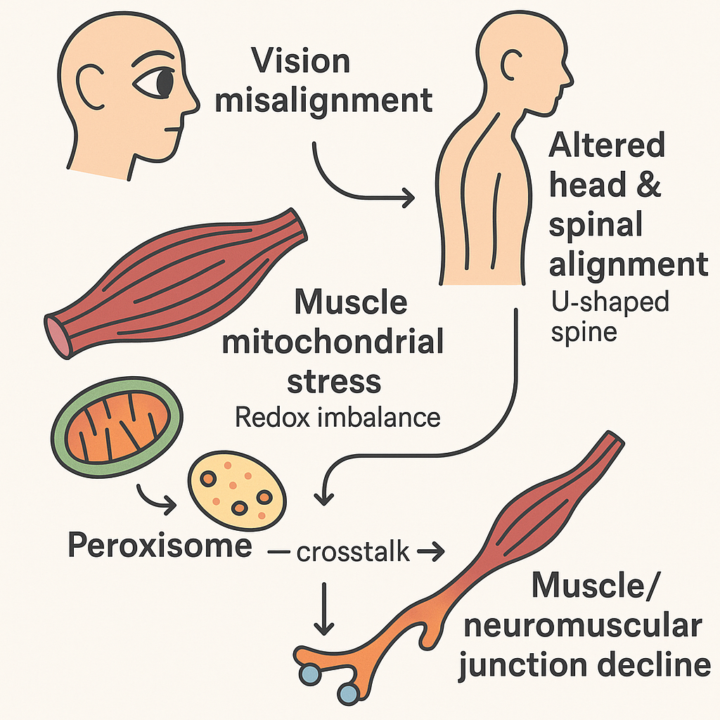
Understanding how the body maintains alignment, strength, and resilience requires going far deeper than muscle fibers and joints. Beneath posture, performance, and even the way your spine organizes itself is a constant conversation between organelles inside your cells. When this conversation is healthy, your muscles contract with precision, your nervous system communicates clearly, and your body adapts to load like it was designed to. When this communication breaks down, you see the earliest signs long before symptoms arise: slower recovery, stiffness, compensation patterns, declining power, creeping fatigue, and eventually structural breakdown. To understand why this happens, and how vision and alignment fit into the equation, you have to understand mitochondria, peroxisomes, and the quality-control systems that keep them synchronized. Imagine mitochondria as the electrical grid of every muscle cell. They convert nutrients into a flow of electrons, and that flow becomes ATP, the energy currency every cell runs on. But just like a power plant depends on transformers, regulators, and maintenance crews, mitochondria depend on other organelles, especially peroxisomes, and on their own internal quality-control systems. Peroxisomes are tiny organelles whose job is to manage specific fats, detoxify harmful metabolites, and assist in shaping the lipid membranes that make mitochondrial structure possible. If mitochondria are the power stations, peroxisomes are both the substation and the fire department. They prepare certain fuels so mitochondria can use them, and they handle the dangerous sparks before a fire spreads. A Nature Communications paper showed what happens in muscle when peroxisomes stop functioning properly. The researchers removed a single protein (Pex5) that allows peroxisomes to import the enzymes they need to do their work. Without that, peroxisomes turn into empty shells peroxisomal ghosts. Even though mitochondria were still present, their structure rapidly began to degrade. Their inner folds, called cristae, lost shape. Fuel processing became inefficient. Lipids that normally would have been handled safely accumulated and created stress signals. Over time, this metabolic and structural stress traveled outward to affect the neuromuscular junction the connection between nerves and muscle fibers and then to the muscle structure itself. The result was weakness, faster aging of the muscle, impaired recovery, and early decline of force production. What this teaches is profound: muscle dysfunction starts long before muscle fibers fail. It begins at the level of organelle-to-organelle cooperation.
3 likes • Nov '25
Best peptides for mitochondrial support? To update you Anthony… I’m currently doing Thymosin alpha 1 and meth blue Doing carb pulsing currently This was after a flush phase of my diet and opening pathways
Sep '25 •
The Hidden Switch: Why Long COVID Lingers and How to Restart the System 5
The final domino in long COVID recovery is integration. By now it is clear that no single pill, peptide, or supplement can resolve the condition. The problem is systemic a stalled cell danger response that traps immune, mitochondrial, vascular, and autonomic systems in alarm mode. The solution is not to throw everything at once but to restore order through a phased, feedback-driven protocol. Sequencing matters more than stacking. Just as you would not rebuild a storm-damaged city by opening shops before fixing power lines, recovery requires careful order: stabilize first, repair second, retrain third. Phase one is the redox reset and immune modulation stage. The goal here is to calm the storm and stabilize energy so the system is ready to heal. This is where Kenetik Pro becomes uniquely powerful. As a ketone monoester, it rapidly raises circulating beta-hydroxybutyrate, giving mitochondria an immediate alternative fuel. Ketones bypass damaged Complex I and glycolysis bottlenecks, providing steady ATP even when glucose metabolism is impaired. This takes pressure off fragile mitochondria, lowers lactate buildup, and gives patients the first taste of metabolic stability. Beyond energy, ketones act as signaling molecules suppressing the NLRP3 inflammasome, reducing oxidative stress, and stimulating mitochondrial biogenesis through PGC-1α. In practice, Kenetik Pro is like plugging in a backup generator during a blackout: the lights come back on, even while the grid is still being repaired. This metabolic cushion makes all other Phase 1 interventions more effective. Alongside Kenetik Pro, mitochondrial-targeted peptides like SS-31 stabilize cardiolipin and reduce electron leak. Thymic peptides such as TA-1 help restore T cell balance. KPV and resolvins modulate mast cells and push inflammation toward resolution. Antioxidant stacks with NAC, glycine, and glutathione rebuild redox buffering. Methylene blue also fits into this phase, but its timing is particularly relevant. While it can act as an electron bridge across damaged complexes, methylene blue also inhibits nitric oxide synthase. That means it can block endothelial nitric oxide production. In situations where NO is excessively high such as during oxidative stress surges, vasoplegia, or inflammatory storms this can be useful to prevent further vascular damage. But nitric oxide is not purely harmful; the immune system requires inducible nitric oxide (iNOS) to kill pathogens and regulate immune responses. If methylene blue is overused or given at the wrong point, it can blunt immune clearance and stall recovery. The art is in using it as a short-term stabilizer, not a continuous intervention. Think of it as temporarily shutting off a fire hydrant when the streets are already flooded, but making sure not to cut water supply to the firefighters who still need it.
2 likes • Sep '25
Love all this. Thank you Anthony !!! Helpful
2 likes • Sep '25
I’m definitely high complexity … working to get all the steps figured out now. Will be using peptides for sure …
Aug '25 •
MOLD, CIRS, VIP and other options. Would love input
Hi I’m carey. Here’s the “ short story”. Hashimotos in 2015. Terrible reaction to the vax in 2021. Didn’t want it but felt forced. Since then health worse and worse. Discovered high mmp9 and htgfb that lead me to test mold. Came back in house and in body. HLA told me I’m double copy reactive to mold, CIRS and endotoxins. Allso double mthfr and slow comt. Currently going cholastyrimine for CIRS/mold. Removed from bad air and remediated. Next is BEG spray as I’m positive for Marcons. Also positive for actinos in skin. It’s a mess. VIP peptides are on the horizon. I’m currently doing bpc 157. Next will be thymosin alpha 1. Wanted to ask about VIP and whatever else I should consider with peptides. Need to assist body in detoxing mold, endotoxins, Marcons… assist mitochondria which has been destroyed. Also curious if there would be a preferred order of taking them or stacking them. Mostly looking at Thymosin Alpha, MOTS, Epitalon, Lorazitide, and VIP. VIP is basically a certainty as it’s part of the shoemaker protocol. Thanks for reading this far! 🙏
1 like • Aug '25
@Anthony Hicks thanks a bunch Anthony !
1 like • Aug '25
@Micalyn McCready that’s fantastic it worked so well for you. That’s definitely on my list of things to check out seriously… thanks for the response
1-8 of 8
Active 5d ago
Joined Aug 1, 2025
Powered by