Activity
Mon
Wed
Fri
Sun
Oct
Nov
Dec
Jan
Feb
Mar
Apr
May
Jun
Jul
Aug
Sep
What is this?
Less
More
The Clarity Circle™
30.4k members • Free
Learn Mandarin by Speaking It!
56 members • Free
Your First $5k Club w/ARLAN
34.1k members • Free
Hustle Academy
1.4k members • Free
Mogul Elite Club
1.8k members • Free
Notary Knowledge Academy
784 members • Free
Loan Signing Agent Training
3.6k members • Free
10 contributions to Japanese Language Learners

Sep '25 •
Yōkoso, Anjin sama!
Your Journey Begins at Anjin Level 🚢 The word Anjin (按針) means pilot or navigator in Japanese. It’s also what the Japanese called John Blackthorne in Shōgun — the English sailor who washed up on an unknown shore and began a completely new life. That’s exactly what this level represents for you: you’ve just arrived in a new land — the land of our community. Everything is fresh and unfamiliar, but you’re ready to explore and learn. Inside our Skool, your rank is based on your engagement — posting, commenting, joining calls, completing challenges — not on your test scores. But the actions that earn you higher ranks are the same actions that make you a stronger Japanese learner. In other words: by climbing the ladder, you’ll probably notice your Japanese skills growing, too. Here’s the path ahead: Anjin (Pilot/Navigator) – Your landing point. You’re exploring the community, mastering the basics of our system and beginning your Japanese journey. Samurai (Warrior) – Regular participation. You’re attending calls, sharing practice, helping others. At this stage you’re starting to use Japanese more confidently. Hatamoto (Flag-Bearer) – A trusted voice in the community. You support new members, contribute insights and can handle basic Japanese exchanges with ease. Daimyō (Feudal Lord) – A regional leader. You’re deeply engaged in discussions, events and study groups, and your Japanese reading and conversation skills reflect your effort. Taikō (Regent) – Highly active and supportive; you’re reading and speaking widely, modelling best practice for others. Shōgun (Supreme Commander) – Community mastery. You lead by example, guide new members and your Japanese is approaching real fluency. Beyond (Mecha Shōgun/Seiyajin) – Elite stages for those at the highest level of engagement and skill; special access to immersion trips and advanced study. Each step is a milestone in your engagement journey inside our Skool. As you progress, you’ll not only unlock community perks but also set yourself up for bigger wins in your Japanese learning.


3 likes • Oct '25
@Joe Bennett Anxiously, awaiting the course.
Sep '25 •
今日のクイズ (Kyō no Kuizu – Today’s Quiz)
Focus: Polite です (desu) vs casual だ (da) Question: Which of these is the most appropriate way to say “I am a teacher” politely to someone you’ve just met? a) 私は先生です。 (Watashi wa sensei desu.) b) わたしは先生だ。 (Watashi wa sensei da.) c) 先生に私です。 (Sensei ni watashi desu.) --- Beginner task: Vote for the answer you think is correct. Intermediate task: Write two sentences about yourself, one with です (desu) and one with だ (da). Example: わたしはがくせいです。(Watashi wa gakusei desu.) — polite ぼくはがくせいだ。(Boku wa gakusei da.) — casual Advanced task: Practise writing a short self-introduction with both styles by hand, take a photo and upload it in the comments. Bonus: briefly explain in Japanese why you chose です or だ.
Poll
8 members have voted
2 likes • Oct '25
@Joe Bennett Would it written like this? Watashi wa amerikahito desu. Buko wa amerikahito da.
Sep '25 •
今日のクイズ (Kyō no Kuizu – Today’s Quiz)
Focus: Expressing “don’t like” with 好きじゃない (suki janai) Question: Which of these is the correct way to say “I don’t like sushi” in Japanese? a) 私はすしが好きじゃないです。 (Watashi wa sushi ga suki janai desu.) b) 私はすしを好きじゃないです。 (Watashi wa sushi o suki janai desu.) c) 私は好きじゃないすしです。 (Watashi wa suki janai sushi desu.) --- Beginner task: Vote for the answer you think is correct. Intermediate task: Write your own sentence using the pattern: 「わたしは___がすきじゃないです。」 (Watashi wa ___ ga suki janai desu.) Advanced task: Practise writing the kanji 私 and the phrase 好きじゃない by hand. Take a photo of your handwritten sentence and upload it in the comments.
Poll
11 members have voted
1 like • Oct '25
Watashi wa momo ga suki janai desu.
Sep '25 •
今日のクイズ (Kyō no kuizu – Today’s Quiz)
Focus Kanji: 私 (Watashi) — “I / me” --- Question: Which of these sentences correctly uses 私 to say “I am a student” in Japanese? a) 私は学生じゃないです。 (Watashi wa gakusei janai desu.) b) 私は学生です。 (Watashi wa gakusei desu.) c) 学生は私です。 (Gakusei wa watashi desu.) --- Beginner task: Vote for the answer you think is correct. Intermediate task: Write your own sentence using 私 (watashi) + a simple noun, e.g. 私は先生です。(Watashi wa sensei desu.) — I am a teacher. 私はオーストラリアじんです。(Watashi wa Ōsutoraria-jin desu.) — I am Australian. 私はコーヒーが好きです。(Watashi wa kōhī ga suki desu.) — I like coffee. Advanced task: Practise writing the kanji 私 by hand, take a photo of your handwritten kanji or your full sentence, and upload it in the comments.
Poll
9 members have voted
2 likes • Oct '25
Watashi wa hahaoyadesu Watashi wa amerikahitodesu Watashi wa ocha ga sukidesu
0 likes • Oct '25
@Joe Bennett Green tea is my favorite but I drink both.
Oct '25 •
Top 5 Useful Phrases for Travelling in Japan
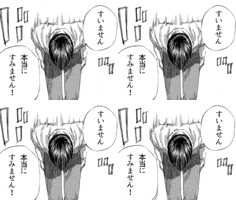
We all run into little challenges when travelling. While I was in Japan, I once got caught in a sudden downpour. I was completely drenched, standing among a crowd of commuters with umbrellas. I felt embarrassed and miserable. Then, out of nowhere, a kind lady stepped forward and handed me a small towel to dry myself. I was so moved by her kind gesture. I said thank you very much and she insisted I keep the towel. That’s the kind of considerate kindness you’ll often find in Japan. But even with that kindness, you’ll still need a few key phrases to survive and get around smoothly. Here are my Top 5 Travel Phrases: --- 1. すみません (Sumimasen) This single phrase covers excuse me, sorry and thank you. You’ll use it everywhere: when calling a waiter in a restaurant, when trying to get past someone on a crowded train or when apologising for bumping into someone. What isn't mentioned often is that Japanese people even say sumimasen for thank you, especially when receiving gifts. --- 2. これはいくらですか (Kore wa ikura desu ka?) “How much is this?” Essential for shopping in local markets, souvenir stores, or even small cafés where prices aren’t always clear. Just point to the item and ask — it’s polite and effective. Learning the numbers so you understand the answer would be the next step. :) --- 3. 駅はどこですか (Eki wa doko desu ka?) “Where is the station?” Train stations are everywhere, but they’re not always obvious, especially in big cities. You can replace 駅 (eki, station) with other places: コンビニ (konbini, convenience store), トイレ (toire, toilet), ホテル (hoteru, hotel). --- 4. 英語のメニューはありますか (Eigo no menyū wa arimasu ka?) “Do you have an English menu?” Many restaurants will, especially in tourist spots, but not always. Asking politely with this phrase can make the experience smoother — and sometimes they’ll even walk you through the menu kindly if no English version exists. These days however most restaurants have picture or touch screen menus making it even easier.
1 like • Oct '25
I'd probably use numbers 5, 4 and 2. In that order 😊
1-10 of 10
Active 9h ago
Joined Sep 24, 2025
Powered by