Activity
Mon
Wed
Fri
Sun
Nov
Dec
Jan
Feb
Mar
Apr
May
Jun
Jul
Aug
Sep
Oct
What is this?
Less
More
Regenerative Gardening
244
Free
Bedrock Nation
177
Free
23 contributions to Bedrock Nation

17d •
🍂 12 Ancestral Fall Comfort Foods
🍂 Paleo, Keto & Carnivore-Leaning There is something about the first cooler mornings that makes me immediately want to trade salads and cold plates for roasts, soups, browned butter, herbs, bone broth and something simmering on the stove. And fortunately, “comfort food” does not have to mean pasta, bread, sugar and a carb coma. Traditional fall food was actually pretty simple: 🥩 Meat 🥕 Root vegetables 🧈 Animal fats 🥚 Eggs 🥣 Broth 🌿 Herbs and spices 🍎 Seasonal produce In other words… real food. So here are 12 cozy fall meals that stay ancestral, protein-forward and easily adaptable for Paleo, keto or carnivore households. 🍖 1. Mississippi-Style Pot Roast Chuck roast slow-cooked until it falls apart with: - beef broth - butter or ghee - pepperoncini - garlic - onion - salt + pepper Skip the conventional seasoning packets—they usually contain fillers, sugar, maltodextrin and questionable oils. Serve over mashed cauliflower, roasted vegetables, or just eat the beef and broth in a bowl. Keto ✔️ | Carnivore-ish ✔️ | Paleo with ghee ✔️ 🥣 2. Creamy Chicken & “Wild Rice” Soup Make the traditional fall soup without the rice. Use: - shredded chicken - chicken bone broth - celery - carrots - mushrooms - onion - garlic - thyme - heavy cream or coconut cream For extra texture, add finely chopped cauliflower. This is one of those meals that tastes even better the next day. Paleo adaptable ✔️ | Keto ✔️ 🥩 3. Cottage Pie With Cauliflower Mash Brown ground beef with onion, mushrooms, carrots and herbs, then cover it with buttery mashed cauliflower and bake until golden. You can also add: - Worcestershire - beef broth - peas if your carb tolerance allows - shredded cheddar on top for keto Basically shepherd’s pie without the potato mountain. Paleo adaptable ✔️ | Keto ✔️ 🍗 4. Garlic Butter Chicken Thighs With Mushrooms Chicken thighs are one of the cheapest, easiest comfort-food proteins. Brown them in butter, ghee or tallow and add: - mushrooms - garlic - thyme - rosemary - a splash of broth


0 likes • 3d
Chicken potpie with biscuits on top and tomato soup with grilled cheese. Trying to avoid cheese.
Mar 29 •
Corns & Calluses
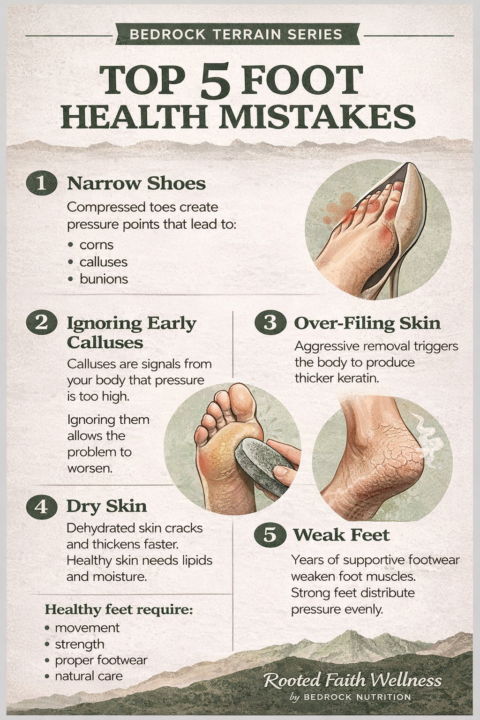
What they are, why they form, and how modern footwear contributes Most people think of corns and calluses as cosmetic annoyances. In reality, they are a protective biological response. Your skin is incredibly intelligent. When it experiences repeated pressure, friction, or mechanical stress, it responds by thickening the outer layer (keratin) to protect deeper tissue. This thickening is what we call: • Calluses – broader areas of thickened skin • Corns – smaller, concentrated areas of hardened skin with a central core Both are forms of hyperkeratosis, meaning the skin produces extra keratin in response to mechanical stress. They are signals from the body that something about your movement, posture, or footwear is creating excessive pressure. The Difference Between Corns and Calluses Calluses are generally protective. Corns tend to form when pressure becomes concentrated in a very small area. Why Corns and Calluses Develop The root cause is almost always mechanical stress on the foot. Common contributors include: 1. Tight or Narrow Shoes Shoes that compress the toes force the foot into unnatural shapes. This creates pressure points where the skin begins to thicken. 2. Elevated Heels Even small heels shift body weight forward onto the ball of the foot, increasing friction. 3. Toe Spring Many modern shoes lift the toes upward. This prevents normal toe engagement and increases pressure on the forefoot. 4. Limited Toe Box Traditional shoes narrow at the front, compressing the toes. This leads to friction between toes and between toes and the shoe. 5. Abnormal Foot Mechanics Examples include: • flat feet• high arches• overpronation• bunions• hammertoes These alter pressure distribution during walking. 6. Reduced Foot Mobility Weak intrinsic foot muscles or limited ankle mobility can shift load to small areas of the foot. Why Modern Shoes Make the Problem Worse The human foot contains: • 26 bones• 33 joints• over 100 muscles, tendons, and ligaments It was designed to spread, flex, and grip the ground.
1 like • Aug 31
@Leanna Cappucci barefoot socks witha big toe box?
1 like • 7d
@Leanna Cappucci I just ordered these Xero shoes. Hoping to get maryjanes and hsf11 for Christmas
Jan 3 •
Bedrock Reboot Course Discussion Post
This post will be a place where those participating in the Bedrock Reboot Classroom, can post their journal entries, as well as their assignments, including their day 34 before and after "wins."
1 like • Jan 24
@Leanna Cappucci the course is really good. Soooo much good, practical processes in so many areas of life. So much I want to do but I keep telling myself a few changes at the time and keep moving forward. Making some changes this time and more changes when we do it again. Unfortunately, we have been dealing with James' Momma having an adverse reaction to a medication which lead to a hospital stay this week and now she is at a rehab center. So extra stress on top of the stress that goes with caring for a family member with dementia. And now add ontop of that the stress of this winter storm. We are supposed to get 8-14 inch s of snow. One day at a time, I keep telling myself. But the course is very good. We will do it again and learn more each time.
1 like • Aug 19
Doing this again. We started last Saturday and started fasting at 8pm Sunday night. Tomorrow we will break our fast around 10:30 am with bone broth, 4 oz ground beef and 1 boiled egg. Then for dinner we will have beef bowl with ground beef and fried eggs. We will start the detox box tomorrow also. Been going for a 10 walk earlier evening.
Feb 1 •
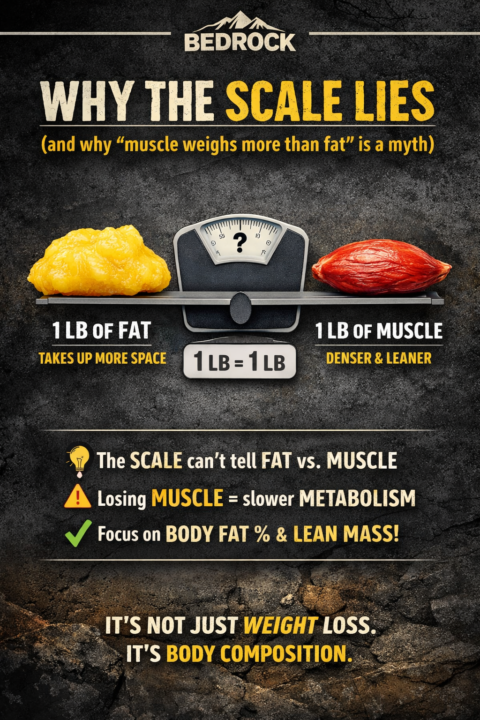
Why the Scale Lies (and the “Muscle Weighs More Than Fat” Myth Needs to Die)
If you’ve ever stepped on the scale after a week of “doing everything right” and thought, What is happening? — you’re not crazy. The scale is one tool… but it’s a limited tool. And first, we need to bust the myth that keeps people confused: Myth: “Muscle weighs more than fat.” Truth: 1 pound of muscle weighs the same as 1 pound of fat. A pound is a pound. The real difference is density. Muscle is denser than fat, which means pound-for-pound it takes up less space. That’s why two people can weigh the same and look completely different — and why you can “not lose weight” but still get noticeably leaner. What the Scale Actually Measures (and What It Doesn’t) Your scale measures total body mass. It does not tell you how much of that mass is: - fat - muscle - water - glycogen (stored carbs) - inflammation - food volume in your digestive tract So the scale can go up because: - you slept poorly - you’re under stress (hello cortisol + water retention) - you ate more sodium - you trained hard (muscle inflammation + fluid shifts) - hormones are shifting - you’re constipated or simply holding more food volume None of those automatically mean “you gained fat.” Why “Weight Loss” Can Make You Worse Off Most people think progress = scale down. So they: - cut calories harder - do more cardio - skip resistance training - under-eat protein The scale may drop quickly at first — but here’s the problem: If you lose weight fast, a meaningful chunk often comes from water + muscle, not fat. And losing muscle is a big deal because muscle is not just “for looks.” Muscle is metabolic armor. It helps with: - resting metabolic rate (burning more energy at baseline) - glucose disposal and insulin sensitivity - resilience as you age - strength, stability, joint support - recovery and stress tolerance So if the scale says you’re lighter, but you’re losing muscle, you may end up: - softer-looking at a lower weight - more fatigued - weaker in workouts - stalled with fat loss later - regaining weight more easily
0 likes • Aug 10
Ordered a pod ... Can't wait to start using it as a tool.
Aug 4 •
What Are Peptides—and What is the Bedrock Take on Them?
You may have heard the word peptides everywhere lately. They are being discussed in relation to metabolism, tissue repair, muscle development, sleep, cognitive performance, immune function, healthy aging, sexual wellness, and more. But what exactly are they—and where do they fit within the Bedrock approach? What are peptides? Peptides are short chains of amino acids. You can think of amino acids as individual letters and peptides as short words created from those letters. Proteins are the much longer sentences and paragraphs. Your body naturally produces thousands of peptides. Many act as biological messengers, helping cells communicate with one another and coordinating processes such as: • Hormone signaling • Immune activity • Inflammatory responses • Tissue repair • Metabolism • Sleep and circadian rhythms • Cognitive function • Growth and recovery In other words, peptides do not simply “make” the body perform a particular function. They often work by delivering a message. That distinction is important because it aligns with something we have always taught at Bedrock: The body already knows what to do. Our job is to identify what may be interfering with that communication and provide the body with the raw materials, environment, and appropriate signals it needs to do its work. What does “buccal” mean? Buccal refers to the inner lining of the cheek. With buccal delivery, a dissolving strip is placed inside the mouth so its ingredients can potentially pass through the oral mucosa rather than first traveling through the entire digestive tract. This is different from simply swallowing a capsule. Peptides can be difficult to deliver orally because digestive enzymes may break them apart and their larger molecular structures can limit absorption. The oral mucosa provides another possible route, with access to a blood-rich tissue surface and partial avoidance of gastrointestinal degradation and first-pass metabolism. However, absorption can still vary substantially depending on the specific peptide, its molecular properties, the formulation, the dose, the delivery technology, and the individual using it.

2 likes • Aug 5
Also the third one for James, the metabolic one.
1 like • Aug 5
@Leanna Cappucci We can do 6:30 pm or after Monday 8/10.
1-10 of 23
Active 3d ago
Joined Nov 7, 2025