Activity
Mon
Wed
Fri
Sun
Jun
Jul
Aug
Sep
Oct
Nov
Dec
Jan
Feb
Mar
Apr
What is this?
Less
More
Memberships
Electrical Connexions
231 members • Free
Off Grid Academy
50 members • Free
Elektrikal Skool
39 members • Free
The Electricity Lab
199 members • Free
Dissertation Help Community
3.6k members • Free
Programa Dev
140 members • Free
Python Developers
1.2k members • Free
Prometheus Code
102 members • Free
MARDOX
1.2k members • Free
27 contributions to The Energy Data Scientist

16d •
Energy Report
I'd like to share a short report I wrote some time ago. It's a brief overview of the Turkish energy market and its key players. I'd be happy to hear your thoughts and comments.
0 likes • 16d
Thank you dear Professor Karaman for sharing this solid professional summary, and I appreciate that it links energy policy to industrial competitiveness. That connection will become even more important as European carbon rules push exporters toward cleaner power and lower-emission production. Can I suggest if you may - one additional angle worth expanding is energy efficiency, because saving energy is often cheaper than building new supply. Including that would make the transition story even more complete. Can we expect some slides at some point ? thank you frankly for this work and your desire to share .

Mar 13 •
Interview question
I share a recent interview question asked by Baringa (this is a consulting company focused strongly on energy, utilities, and the energy transition). From a student forum / database (for internship). The question was: 'Why do some renewable power plants continue generating electricity even when electricity prices turn negative? and when do prices become negative ? do you know any example? '
1 like • Mar 14
@Lara Cagigal Tomico Yes indeed. Especially regarding how contractual and subsidy structures shield developers from market volatility. Another key reason plants keep running is technical constraints. Eg some older wind or solar assets lack the sophisticated control systems needed for rapid curtailment, or the owners fear that frequent cycling could increase mechanical wear and tear. Also, in some markets, renewable operators must stay online to provide ancillary services (like frequency response) to maintain grid stability, which can be more valuable than the loss taken on the energy price itself.

Mar 13 •
New report: Energy Security & Nuclear Power
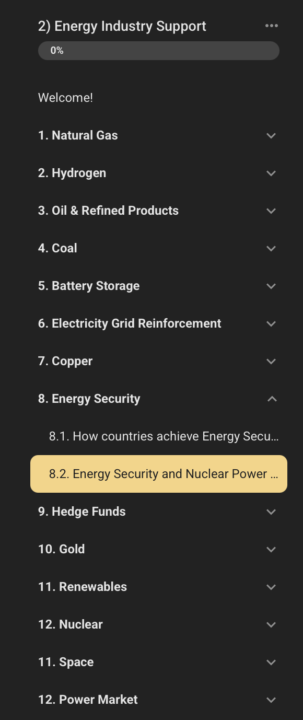
A new report on this topic has now been published in Classroom, at the very end under “Energy Industry Support” ( a special section featuring reports that explain the current status and key trends in the energy sector). The report explains how energy crises and conflict, especially around the Strait of Hormuz, have renewed interest in nuclear power as a more secure long-term source of electricity. Dependence on imported oil and gas can quickly drive up prices and threaten electricity supply, while nuclear energy offers stable output and fuel that can be stored for years. There is therefore growing investment in nuclear fuel and advanced reactor technologies. But nuclear is a long-term solution rather than a quick fix. The report is written in simple language, includes illustrative graphs , and shares official sources ( Financial Times, Bloomberg, Wall Street Journal, The Economist, Forbes, and Investors Chronicle). This report can be freely used in your projects, work, or studies. It can be useful for interviews, presentations, networking, etc, so it is strongly recommended to read it & download it for your use. See the attached screenshots.
0 likes • Mar 13
I like the way the report connects nuclear policy with AI demand. That link feels especially relevant now. The IEA says global data-centre electricity use is on track to double to around 945 TWh by 2030.
Feb 4 •
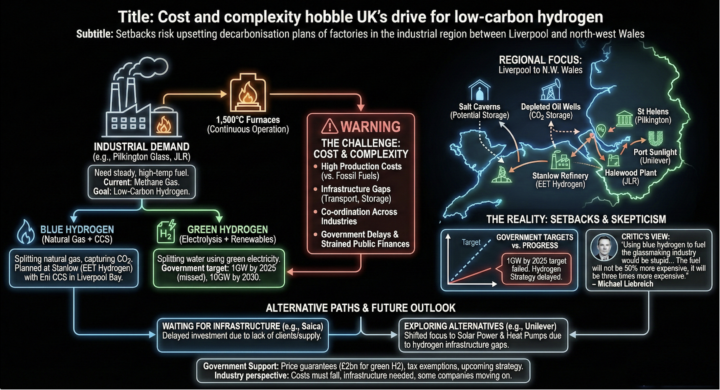
An illustration about Hydrogen
Here is a plot about hydrogen in the United Kingdom. The plot shows that energy factories need steady, very high temperature heat, around 1500°C, running continuously, and today they mainly burn methane gas. Their plan is to switch to low carbon hydrogen, either ‘blue hydrogen’ made from natural gas with carbon capture and storage or ‘green hydrogen’ made by splitting water using renewable electricity. But the central barrier is cost and complexity: hydrogen is still expensive to produce, transport and store, and it requires coordinated investment across multiple industries and public infrastructure.
0 likes • Feb 4
The UK and other markets slowed down in 2025 for sure.

Dec '25 •
How do we define the "Energy Data Scientist" ?
The term 'Energy Data Scientist' means more than just a Data Scientist who works in an Energy Company. Given the skills that this Skool community teaches, what jobs does the Energy Data Scientist cover?
1 like • Jan 30
@Raheema Rahman Hello , I would like to add that interviews in the energy sector are very easy and the secret is to create a portfolio of a few software engineering/data science projects related to energy. Simply copy paste the code in the Classroom , and change it slightly and make a realistic study ; seek feedback here. Eg post results. Then you will have a portfolio eg your website, or your Github, with projects. Ideally make a publication (they offer some tips here). Generally energy pays well and once you're in they won't fire you just like it happens in tech all the time .
0 likes • Jan 30
@Raheema Rahman They advertise here roles. Or you can just look around e.g. linkedin etc. There are hundreds of roles.
1-10 of 27

@a-khan-9461
PhD candidate in energy finance / derivatives
Active 16d ago
Joined Nov 2, 2025
ISFJ
Pakistan