Activity
Mon
Wed
Fri
Sun
Aug
Sep
Oct
Nov
Dec
Jan
Feb
Mar
Apr
May
Jun
Jul
What is this?
Less
More
Memberships
Let's Master English
6.9k members • Free
31 contributions to Let's Master English
🔥
Jun 8 •
Good News Sharing
Hi my dear buddies. I'd like to share good news with you: After 2 weeks' high pressure and a ton of hours overtime, today I received the final result of my training: I ACHIEVED the target and I'm QUALIFIED on this toughest task! Plus, I'm the UNIQUE qualified trainer for this task and I was nominated as the 1st GLOBAL TRAINER by our CLIENT and our team. I'm so proud of this as I will be responsible to deliver the training to other global centers and provide troubleshooting and auditing for them. The most excited part is my client said "Mariel's spoken English is better and GOOD ENOUGH to deliver this tough task to global centers and she will be competent to play the role of global trainer." I'm so excited that I received the recognation on my English from my US CLIENT, even though I know they may be tolerant to Chinese team. Anyway, this is good news I think!!! In the following weeks and months, STILL, I'll be busy on this project until Oct per the current plan. But, I can balance some time on my assignments practice after work every day cuz I assumed there would be not too many days I need to overtime to 11:30pm as the past 2 weeks. Lol...First of all, I will watch some owed class videos. Okay! See you! 🤗

2 likes • Jun 11
Omggggg😍..... I'm soooo Jealousssss🙈 !! Great job🙌 !!
⭐
🔥
Feb 19 •
🕌✨START HERE: Daily Check-In. Say HI! Thursday, Feb 19th💃🕺
Who is here e x p a n d i n g their English knowledge today? Are you NEW? Go HERE NOW!! LIVE Classes TODAY? Go HERE NOW!! Ready for our Newest Speaking and LIstening lessons? Go HERE NOW!! What are the different LIVE classes? Go HERE NOW!! Which lesson are you working on today? Did you/will you join a LIVE class today? Do you have a question? Put it below. EVERYONE--give a thumbs-up to this CHECK-IN and make sure you THUMB UP everyone's comments.
6 likes • Feb 19
Let'sssss try !🙂

Feb 18 •
Pardon My French (I Can't Help It!) 🥖🤷♂️💬
The Sunday Times in 1994 had launched a competition to see who could write the best story with the most French words.This is a delightful anecdote! This text is a classic example of British linguistic humor. It ironically highlights that while France sought to "purify" French of Anglicisms (via the Toubon Law in 1994), English, for its part, would find itself quite unprepared if it were to give back to Molière what belongs to him. Here is a short text taken from this competition "He had a "rendez-vous" with a "blonde" "divorcee" in a "cul-de-sac". He sat on a "banquette" in a "cafe" sipping an "aperitif". She arrived looking "chic" in a"beige" "ensemble". There was a "soupcon" of "romanc"e in the "air", but she had a "blasé" "attitude", a "certain" "je ne sais quoi" that "suggested" a f"aux pas "was "mminent." (Miles Kington ) It's quite fascinating to see that if you removed all French from English, only words for very basic things (eat, sleep, land) would remain, while the entire culture and administration would disappear! Why is it "brillian"t? The strength of this text lies in three points that the Sunday Times wanted to highlight: 1. "Omnipresence": It is "estimated" that nearly 30% to 45% of English words are of French or Latin "origin" via French. 2." Prestige": Without these words, English loses its entire vocabulary related to cuisine, fashion, diplomacy, and refined social interactions. 3. The absurdity of protectionism: The newspaper wanted to show that languages enrich each other and that trying to "clean them up" is a losing battle (and somewhat ridiculous). "So, as you can see, @Shane Peterson @Mila Zinoveva @Gulistan Asan @Andrzej Zieliński @Serge Gray even when I speak English... I’m still technically speaking French. À bientôt !"🍷✨
2 likes • Feb 19
What an "anecdote " ! I like it ! 😂

🔥
Feb 8 •
✍️ Dictation Sunday No. 6 🎧 February 8 The Video! ▶️
@Ute Delsing @Ralph Essers @George Gubaidulin @Cao QiaoLan @Linus Z @Natalie Cosmopolitan @Eve Eve @Fulya Acun @Evelyne Vincent @Jenny Zheng @公用 学员账号 @Shirley Lee @Sara Li @Mina Min @Donesh Pawara @Ryo Takayama @Sherry Zhan @Massouda Mhamdi @Gee Nat @Pedro Lustosa @Xinxin Zhang @Maximilian Miasnikov @Soooda Feng @Jackie Li @Frank Wang @Pika Bu @Rory Yuan @Steven Jiang WE DID IT— thank you all! Huge thanks to everyone who joined today’s class! We went through all the pronunciation drills and we've done all 4 parts of dictation! AREN’T WE SOMETHING? 😁 The energy was awesome, and your participation really brings these sessions to life. It makes the whole experience more fun and meaningful for me and today was no exception. Special thanks to our Mentor @Gulistan Asan for all the support and assistance — truly appreciated.🙏 And thank you all for showing up and being part of it. Looking forward to practicing together again very soon! 🙌

7 likes • Feb 8
I have a question, please. Is it possible to download the video so I can have it quickly on my device?”
3 likes • Feb 8
@Serge Gray Thxxxxx coach !
🔥
Feb 7 •
✍️ Dictation Sunday No.6 🎧 February 8
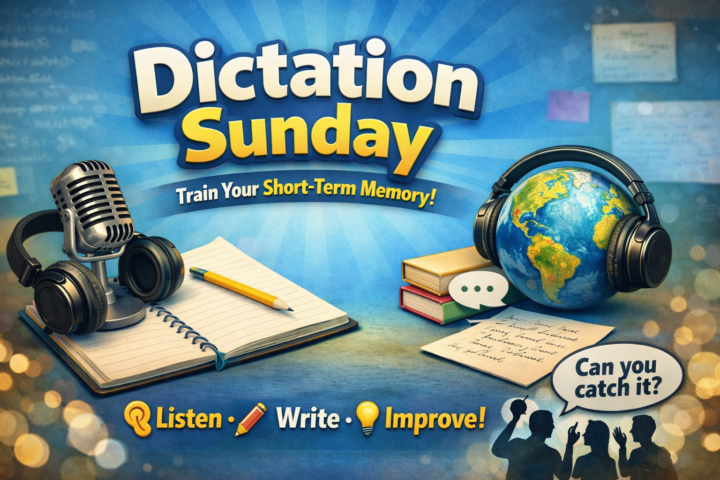
Hey guys! Quick announcement 🙂 This Sunday, we’ll be doing Dictation Sunday again ✍️🎧 The class is already on the CALENDAR — just wanted to give you a heads-up and remind everyone to join. The idea is to train our short-term memory. I’ll pick one of our ‘old’ DDM VIP or PIRF VIP assignments and read some paragraphs sentence by sentence. You’re supposed to write down what you hear and post your answers in the chatroom. Then we compare your answers with the original script. After that, one of you could read another paragraph, and the rest of us, including me, will try to catch it 👀. Since we are all from different countries and have different accents, this will also help improve our listening comprehension 🌎. Plus, by reading the assignment, we can focus on our pronunciation and learn some vocabulary so we can discuss it afterwards 💬. LISTEN TO IT 🎧 • WRITE IT ✏️ • MASTER IT 🚀
5 likes • Feb 7
Actually fixing👨🔧 alll my programssss😂
1-10 of 31
Active 27d ago
Joined Dec 28, 2025
Powered by