Activity
Mon
Wed
Fri
Sun
Sep
Oct
Nov
Dec
Jan
Feb
Mar
Apr
May
Jun
Jul
Aug
What is this?
Less
More
Owned by Sterling
This group is designed for the discussion of the Vagus Nerve, techniques to stimulate it, and the benefits of doing so.
Ultra School is a repository for information published by Sterling Cooley, as an online training platform for using Ultrasound.
Start My AI
279 members • Free
TerreScience Academy
4 members • $9/month
Skoolers
161.7k members • Free
Synthesizer
46.5k members • Free
Accelerator
9k members • Free
451 contributions to Vagus School

5d •
How To Reset Your Nervous System In 90 Seconds Without Electronics
The internal geometry of a 3D-printed conduit, such as the Nemuri Pendant, modulates respiratory resistance to induce a parasympathetic shift without electronic intervention. By adding calibrated resistance to the airway, the device facilitates a reduction in respiratory rate to the 4–6 breaths per minute range. This specific frequency optimizes heart rate variability and maximizes vagal tone by extending the exhalation phase. The mechanism relies on fluid dynamics rather than firmware. As the user breathes through the tuned internal channel, the added load engages the diaphragm and throat muscles more deliberately. This engagement, combined with soft pressure feedback, triggers the diving reflex to lower the heart rate and suppress sympathetic arousal. Physical markers of this vagal activation typically manifest within 90 seconds. Users observe a softening of the periorbital muscles and a release of tension in the trapezius and levator scapulae. The shift is a direct result of lengthening the expiratory phase, which enhances the inhibitory influence of the vagal efferents on the sinoatrial node. A rhythm of 4-second inhalations and 6-second exhalations through this resistance provides a structured method for retraining baseline breathing patterns. Because the device requires no batteries or apps, it serves as a permanent analog interface for nervous system regulation. It is a tool for immediate recovery after high-cortisol events or for maintaining autonomic balance during daily transitions. https://www.frontiersin.org/articles/10.3389/fnhum.2018.00353/full https://pubmed.ncbi.nlm.nih.gov/21939457/ https://vagushub.com/nemuri


20d •
Anybody experience with US VNS and thyroid nodules?
I've been doing a 5 minute US application on the left side of my neck for about ten days now. But I also have a thyroid nodule on the left side. I've been staying above the nodule, but I was wondering if anybody has any experience with US vagus nerve stimulation and thyroid nodules...
1 like • 6d
Great question, Vanessa — and smart that you’re staying above the nodule rather than putting the head right on it. Short version: I don’t have a big pile of published “US VNS + thyroid nodules” case series to hand you, and I’m not your doctor — so this isn’t medical advice. But here’s the useful framing, plus what I’d do in your shoes. 1. Diagnostic ultrasound over the thyroid is considered very safe Imaging ultrasound of the thyroid/neck is routine for nodules and uses non-ionizing sound waves (no radiation). That’s a different use-case than what we’re doing for vagus work, but it’s why “ultrasound near the thyroid” isn’t automatically a red flag the way heat/radiation would be: https://my.clevelandclinic.org/health/diagnostics/thyroid-ultrasound 2. “Therapeutic ultrasound on purpose for nodules” is a different animal There is a whole clinical world of ultrasound-guided treatments aimed at thyroid nodules (thermal ablation / HIFU, etc.) — those are higher-energy, clinician-delivered procedures meant to shrink tissue. That’s not what low-intensity US VNS is trying to do. So we shouldn’t casually aim stim energy into a known nodule “to treat it,” and we also shouldn’t assume our coaching protocols are the same as ablation settings. 3. Anatomy helps your instinct The cervical vagus you’re targeting sits more in the carotid sheath territory (side of the neck). The thyroid sits more central/anterior. So your approach — left side, short sessions, staying superior to / clear of the nodule — is the right kind of caution. 4. What I’d recommend practically - Keep doing what you’re doing: don’t place the transducer on the nodule itself. Stay above / clear of it. - Keep sessions short (your ~5 min is reasonable), and stay in the low-intensity / non-heating feel — no deep warmth, no pain, no pressure sensations that feel “off.” - Loop in the clinician who already follows your nodule (endo / whoever ordered your imaging). Show them exactly where you’re placing it and for how long. They’re the ones who know your nodule’s size, type, and follow-up plan. - If anything local changes (new neck pain, voice change, swelling, swallowing weirdness, or thyroid labs shifting), pause and get checked.

0 likes • 6d
Go here: I agree sometimes the emails can be a lot, this is really a Skool specific control you can manage here: https://www.skool.com/settings?t=notifications
15d •
Intro + first experience with US VNS
Hi! I haven't introduced myself here yet. I'm a physical therapist and I mostly work with women who have all kinds of chronic health issues. As I have some health issues myself, from the beginning on I've been trying to find a natural way to heal them. I found a lot of good things, but I noticed that the most dominant thing for me now, and for a lot of the women that I see in my practice, is stress and the vagus nerve. So the past years I've been adding VNS techniques to my toolbox. As a PT I also own a ultrasound device, and I had been wondering what else I could be doing with it. So, it's no coincidence that I ended up here in the Vagus School. I'm looking forward to learning and experimenting more! The thing I noticed since I've been using the US VNS for the past 2 weeks, is maybe just a small thing for some, but for me it's quite remarcable. Due to my thyroid issues and chronic fatigue I've always been a very sound sleeper. Nothing wakes me up at night or in the morning ;-) , and often I've been hesitant in going to bed because I wasn't sure if I would wake up on time. So I had a lot of sleep issues because of this when I was a student, especially around my exams. Since I've been using the US VNS, most days I've been waking up 15-20 minutes before my alarm is supposed to go off! For me that's a big milestone. Recently I bought an alarm especially for the hard of hearing with a vibrating pod to put underneath your pillow, and now I might not have a use for it anymore :-) Kind regards, Vanessa
1 like • 6d
Wow!! That's phenomenal, Vanessa!!!! Waking up 15–20 minutes before your alarm — after years of being such a deep sleeper that nothing could pull you out — is a big deal. That kind of shift is exactly what we look for as a sign the system is settling into better autonomic balance overnight. What you’re describing lines up with a key distinction: there’s “being asleep,” and there’s restorative sleep. When sympathetic overdrive stays high overnight, you can still be out cold… but the body isn’t doing the repair work. Vagus nerve activation supports parasympathetic tone, which is what lets sleep actually restore you — so waking feels clearer, earlier, and more natural instead of like fighting your way out of a fog. There’s a growing clinical literature on non-invasive vagus nerve stimulation and sleep quality. A few useful ones: - Randomized trial: taVNS improved sleep quality in chronic insomnia vs sham (JAMA Network Open): https://jamanetwork.com/journals/jamanetworkopen/fullarticle/2828072 - Overview of tVNS in sleep disorders (Frontiers): https://www.frontiersin.org/journals/pain-research/articles/10.3389/fpain.2026.1772166/full - High-altitude insomnia RCT where tVNS shortened sleep latency and increased deep sleep: https://www.mdpi.com/2076-3425/13/6/985 (Different delivery method than ultrasound VNS, same nerve system — and the sleep-quality signal keeps showing up.) Huge congrats on two weeks in and already noticing something this concrete. Keep going with it, and watch what else shifts as your body gets more of that restorative overnight window. Excited for you — and welcome, so glad you’re here :D — Sterling
Mar 12 •
🚨 The #1 Question I Get: "What's the Best Ultrasound Device to Buy?" (My Official Answer + Regional Guide)
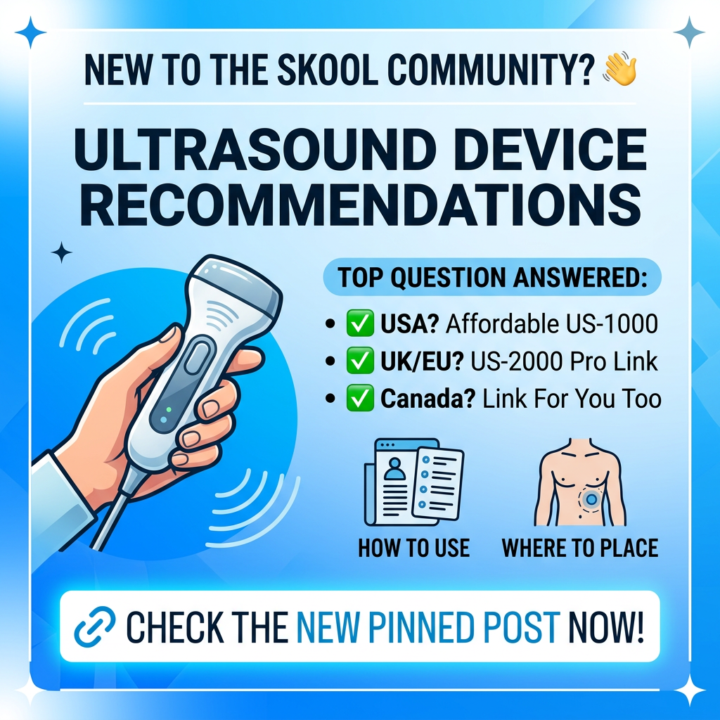
Welcome to the group! I know the first few modules are in the Classroom: Skool.com/vagus/classroom available to read right now - but I always see the same question pop up immediately: "What device should I buy?" Instead of *I guess* hoping you will make use of the Classroom which already has the answer, or hoping you would use the Search feature at the top of the site, I wanted to put the answer front and center. This post will be pinned at the top, so you can reference it anytime. The goal is to get you started with the right tool for your region. Let's break it down: USA: If you are in the USA: The US-1000 is your go-to. It’s affordable, incredibly effective, and the perfect entry point for Vagus Nerve Stimulation. For around $54 USD, it’s one of the most accessible biohacks you can invest in. The benefits—from reduced inflammation and deeper sleep to a calmer nervous system—are tremendous for the price. - 👉 Click for Module 2: How to Buy an Ultrasound - 👉 Click for Module 3: How to Use & Place Ultrasound 🌍 If you are in Canada: Great news, the US-1000 is also easily available. - Canada Supplier: Link EU: If you are in the EU or UK: The Rules are a Little Different Due to regulations and availability, the US-1000 isn't sold here. You’ll be looking at the US-2000 Pro class of device. Don't let the "Pro" name intimidate you! It simply means these units produce a higher power output and offer more focused stimulation. You don't really have a choice in the matter, but honestly, you're getting a slightly more powerful unit out of the gate.
0 likes • 28d
@Tracey Weiss Ah, okay, cool. Yeah, honestly, I googled it and that's I couldn't find it. That looks like a US-1000 clone. Like, I could almost guarantee you, I would bet money that if you opened up the manual and you compared it to a US 1000, the intensity and frequencies would be almost exactly the same. So yeah, you have, you basically can use US 1000 data, or like, you know, lesson plans and use that.
0 likes • 7d
@Jacqueline Simon mm, sorry I don’t know about Brazil ! But you can search ultrasound handheld device on websites or google or w/e and I’m sure you can find it. At worst the same US distribution center will ship DHL to Brazil no problemo
1-10 of 451

@sterling-cooley
Vagus Nerve Stimulation Specialist
Admin of Ultra School
Active 3h ago
Joined Oct 15, 2020
ENTP
Seattle, Washington
Powered by