User
Write something
What's the ONE survival skill you wish you'd learned sooner?
I'll go first: Fire by friction. When I was going through Green Beret training, I thought I had fire figured out. Lighters, matches, ferro rods—easy. But the first time I had to make fire with nothing but wood and determination? Humbling doesn't even cover it. It took me hours. My hands were blistered. My ego was bruised. But when that coal finally formed and I got flame... man, that changed everything. Not just because I could make fire—but because I proved to myself that I could do hard things when it mattered most. That's what real survival skills do. They don't just prepare you for the wilderness. They build the kind of confidence that carries into every part of your life. So here's my question for you: What's ONE skill you've been putting off learning? Fire? Shelter building? Knife sharpening? Navigation? Drop it in the comments below. And if you've already learned it—tell us what finally pushed you to take action. Let's learn from each other. That's what this community is all about. 🔥 P.S. — If fire by friction is on your list, I just dropped a free guide that breaks down the exact method I teach. Comment "FIRE" and I'll send it your way.
The 5 Survival Skills Every Green Beret Masters (And Why You Should Too)
I spent years as a Green Beret Engineer and Intelligence NCO. Deployed to some of the harshest environments on the planet. And here's what I learned: Survival isn't about having the fanciest gear. It's about mastering the fundamentals that keep you alive when everything goes wrong. These are the 5 core skills every Green Beret is expected to master – and the same skills I teach civilians who want to be truly prepared, not just "survival enthusiasts." 1. FIRECRAFT – The Non-Negotiable Why it matters: Fire is life. Warmth, water purification, signaling, morale. Lose your ability to make fire, and your survival timeline collapses fast. What Green Berets know: -Multiple ignition methods (ferro rod, friction fire, magnification, chemical) -Fire in ANY weather (rain, snow, wind, wet conditions) -Tinder identification and prep (natural and man-made) -Fire lay structures for different purposes (cooking, warmth, signaling) The skill that separates amateurs from pros: Hand drill friction fire. If you can make fire with nothing but wood and your hands, you're never truly without fire. What you should practice: -Master your primary method (ferro rod) until you can do it in the dark, in the rain, with numb hands -Learn one primitive method (bow drill or hand drill) -Build a tinder bundle that catches on the first ember -Practice fire-making in bad weather – that's when you'll actually need it 2. SHELTERCRAFT – Your First Line of Defense Why it matters: Exposure kills faster than hunger or thirst. Hypothermia can set in within hours. Your shelter is your survival priority after immediate threats. What Green Berets know: -Site selection (drainage, wind protection, hazards, resources) -Insulation principles (ground insulation is critical – cold ground -steals body heat) -Natural shelter construction (debris huts, lean-tos, snow shelters) -Improvised materials (tarps, ponchos, emergency blankets) The skill that separates amateurs from pros: Building a debris hut that actually keeps you warm. Most people build shelters that look good but don't retain heat.
The 5 Survival Skills Every Green Beret Masters (And Why You Should Too)
Thanks Pat and your team.
Looking forward to be a part of this journey. I appreciate your patience in sharing your experiences and knowledge with us and our “skool”
Compass
A compass, something we are all told to carry, only tells you one thing. The direction of Magnetic North. Everything else you have to know or learn. Your primary compass should be the best compass you can afford. I carry a Suunto MC2 or a Brenton Ranger. I recommend a compass with a mirror sighting system attached to the base plate. The hazel should be graduated in degrees azimuth as contrasted with bearings. The circle is divided in quadrants for the bearing system with each quadrant divided into 90 degrees. Used by land surveyors and people such as conservation land monitors, the bearing system is better suited to survey plans but not general navigation. Other components of this type of compass are the dog house or Orienteering Arrow which is inside the rotating bazel ring. The other static arrow on the base plate is the Direction of Travel Arrow. There are many great resources to learn more. Find them and learn them. Got to run, Jennie said time for dinner and I am very happy to have her cooking again. Out.
0
0
Compass
Grab & Go Pack
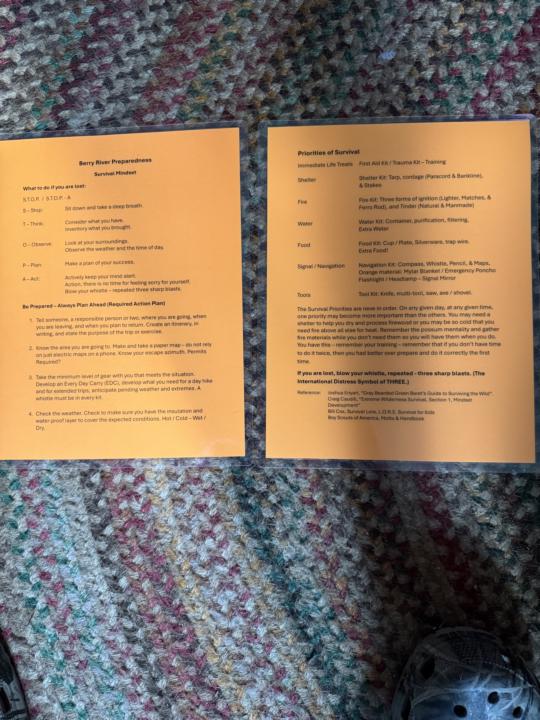
I had this 90% written, got medications and breakfast for my wife, and gone. Take two. I think there is a lesson there as well. In 2020 during the beginning of Covid 19, I built a bug-out-bag based in the GB2 method using a Mystery Ranch Scree 32 black pack. I used it for some adventures and was very impressed. So much so I bought a green version to replace my hiking pack. At the time, working from home and other factors, it was very difficult to get out in the woods. I developed an expedited method of communicating my plans, which I will cover in a separate post, and set this bag up so it was ready at all times. Thus Grab & Go. Water, food, and day hike equipment. If you know me or follow my posts elsewhere, I am a huge proponent of going out prepared. It is set up weather and first aid heavy. As lower limb injuries are the most common, I have a SAM Splint and Ace Bandge along with a well equipped IFAC. Not a trauma kit but heavy general. The shelter kit includes a 5x7 blue Outdoor Products tarp, rapid ridge line, six tent stakes, and contractor bags. A Mylar tube tent snuck its way into the kit. I think perhaps I couldn’t find a Mylar blanket at Wally World. I did discover that the shelter kit was NOT pre-staged very well which has been fixed and I need to go back and replace some waxed twine with #36 bankline. But still serviceable. I am carrying a middle of the road poncho. Something to sleep in, something to sleep on, and something to sleep under. Right now it would be a cold night so hope I have made good clothing choices. I didn’t do a flat layout and empty the pack but what is not shown is the compass in the hip belt pocket, a Suunto MC2 or the SAM Splint kit. There is a knife and multitool that live in the pack along with a small saw. I was also carrying my Leatherman Wave and Mora Garburg on my belt. What are your thoughts on place-holder tools in your rigs? My grandson states that I definitely have a knife problem but there could be worse addictions! For containers I have the smart water type bottle and a small metal cup. This may be a little light and if you have any suggestions to use on an open fire that would be appreciated.
0
0
Grab & Go Pack
1-12 of 12
powered by
Wilderness Mastery School
skool.com/wilderness-mastery-school-3134
Wilderness Mastery School: Real-world survival training that builds skill, confidence, and resilience in every environment.
Build your own community
Bring people together around your passion and get paid.
Powered by