Activity
Mon
Wed
Fri
Sun
Sep
Oct
Nov
Dec
Jan
Feb
Mar
Apr
May
Jun
Jul
Aug
What is this?
Less
More
Owned by Patrick
Wilderness Mastery School: Green Beret-led survival training. Fire, shelter, water, navigation, first aid. Weekly challenges.
49 contributions to Wilderness Mastery School
May 4 •
Bush bag IFAKs
What do you folks put in your bushcraft bag IFAKs? I’m not looking to have a standard ifak in my bush bag, just something more practical

2 likes • May 5
Remember: try to think in terms of bleeding, breathing, fractures, and shock. Those are the main ones that will kill you, that you can prepare for. Then the rest is just boo boo stuff to help you be more comfortable and/or take care of the annoying things: Life threats - Tourniquet (1) - Compressed gauze - Pressure bandage - Hemostatic gauze (optional) Wounds & burns - Steri-Strips / butterfly closures - Non-stick pads - Burn gel / hydrogel dressing - Knuckle + fingertip bandages - Medical tape Blisters & small issues - Leukotape or moleskin - Alcohol prep pads - Tweezers / tick remover - Small saline (eye flush) Stabilization - SAM splint (or improvise) - Ace wrap / elastic bandage Meds & sustainment - Ibuprofen / Tylenol - Benadryl - Electrolyte packets - Imodium - Water purification tabs Tools & extras - Nitrile gloves - Trauma shears or small cutter - Duct tape (flat wrapped) - Space blanket - Headlamp / micro light - Sharpie Goal: stop bleeding, stabilize the injury, and keep yourself moving.
Apr 23 •
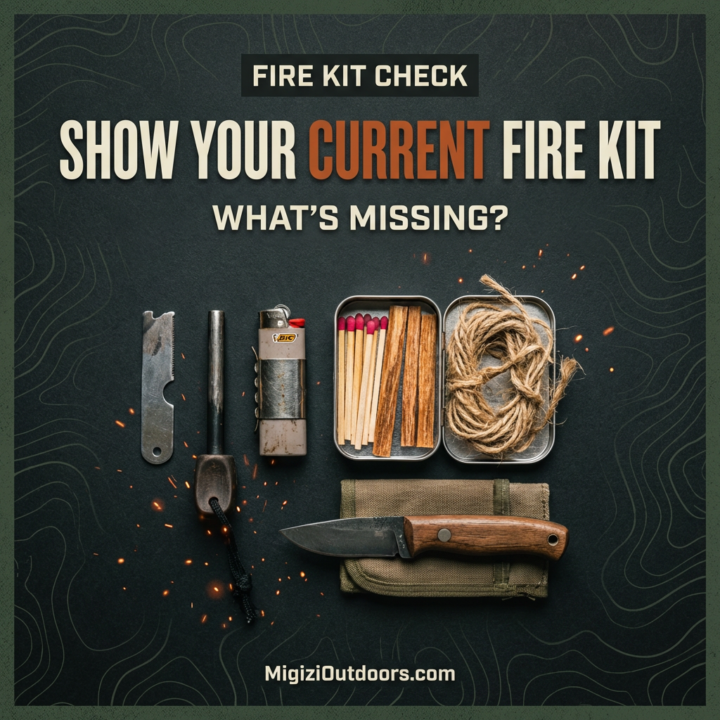
FIRE KIT REALITY CHECK
MISSION:Lay out your current fire kit. STANDARD:Primary + backup ignition. Tinder strategy. Weather consideration. OUTPUT:Photo + short explanation of gaps. REMEMBER:If your fire kit fails, nothing else matters. Prove it.
Apr 12 •
What do you do?
Battery dies at 1700. Overcast. Mixed hardwood forest. You have 90 minutes of daylight. What are your first three priorities — in order — and why?
1 like • Apr 13
@Kenneth Berry just making my rounds ;)
1 like • Apr 13
@Kenneth Berry there’s some new people so I was hoping they’d come on
Apr 9 •
5-Minute Boil - Crawl and Walk - NO Run
Collected birch bark and spruce kindling, prepared some birch wood chips and curls, and readied the Migizi Wanderer Stove. I had two cups of water and needed 1 and 1/2 cups for rehydrating the Mountain House meal. If you’re going to boil water, make coffee or food, one or the other. I shaved some magnesium dust from the block with the Migizi Companion and collected it on a piece of birch bark and some birch curls. I need practice with the magnesium because I had trouble keeping it under control. I sparked the pile with the included ferro rod using the Companion. It quickly caught the birch bark and curls which I used to get the stove going. I poured one cup of water into the canteen cup, SRO SS, and just as it was about to boil - I knocked it off the stove onto the plywood and delay of lunch. I replaced the water, made more chips, and boiled it again. Made and ate lunch. I set up the hammock and tarp just for exercise. Practice points: Magnesium dust control, size of the fuel for the stove, control of a canteen cup. The spilled boiling water could have been much more serious and control of the stove and canteen cup is critical. It was also a waste of materials and time. I need to get the fuel size and firing of the stove down. I tend to try to use fuel chips that are too small and starve it of air too large and beyond the capabilities of the stove. I find I have to tend it constantly - that may be the nature of the beast. Good thing today was not a timed event. I got fire with the appointed tools. I boiled water and ate lunch. Probably an hour late by my wife’s estimate. I was outside in the sun, thinking about results and using tools I carry. OK - Having fun.

1 like • Apr 12
@Kenneth Berry Great AAR. On twig stoves, fuel size is everything. Most issues come from jumping to sticks that are too big too soon. They do need a little “teasing” at the start, but once you build a coal bed, it should settle down. If you’re constantly feeding it, you’re chasing flame instead of building coals. That stove/cup setup is solid, just low margin for error—your spill proves it. Stable ground and handle discipline go a long way. Pocket bellows? Yep, useful—especially for getting things going or reviving coals. Just don’t rely on it to fix fuel prep. Overall—you got fire, boiled water, and learned something. That’s a win.
1 like • Apr 13
@Kenneth Berry I lower profile pot will heat up better, but for a 5 minute fire, that stove may be pushing it. I recommend building a fire for the 5 minute drill and introducing the cup of water.
Apr 6 •
Sleeping system
Hey all, Wanted to ask what you could all recommend for a sleeping system, what are the pros/cons between a sleeping bag versus camping blanket, what brand or specifics should I look for when shopping around for one, etc. Thanks in advance
1 like • Apr 8
@Kenneth Berry it’s been with me from Alaska in the winter to Afghanistan. That thing is proven. I refuse to try anything else lol
1 like • Apr 11
@Kenneth Berry I bought mine from a surplus near Fort Campbell and I want to say it was between $150-$200 for the whole system. Worth every penny in my opinion.
1-10 of 49

@patrick-russell-6223
Wilderness Mastery School: Real-world survival training that builds skill, confidence, and resilience in every environment.
Active 65d ago
Joined Oct 19, 2025