

Feb 17 •
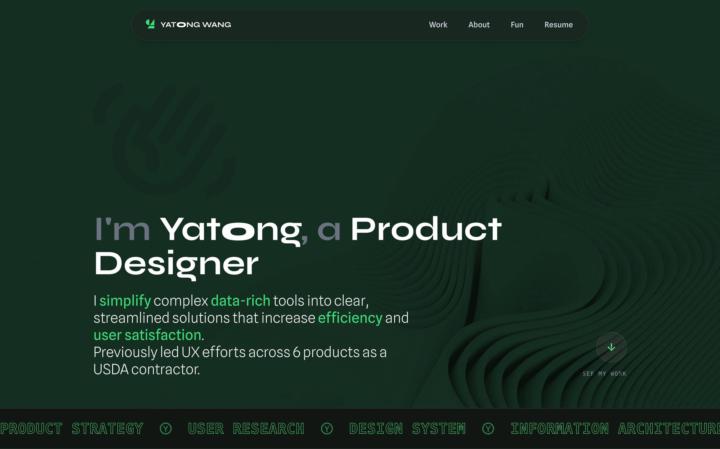
Sneak peek of my new portfolio site (WIP)
I'm in the process of rebuiding my portfolio using AI-powered design and coding workflows. I've completed the homepage and wanted to release it early as a build-in-public project: https://lab.yatongwang.com. ### Tools I Use - **Design:** Stitch with Google, Figma, Pencil - **Primary IDE:** Cursor - **Version Control:** GitHub - **Deployment:** Netlify (CI/CD from `main` branch) - **Coding & Engineering Guidance:** Claude, ChatGPT (for minor coding problem assistance, Git/GitHub best practices, repo architecture, version control workflows, etc.) Feel free to let me know what you think!

Feb 8 •
Non-Violent, Clean Communication for Agentic AI
Was just playing around with some thoughts in chat GPT. ==== A practical guide to building agents that collaborate without burning energy Agentic AI systems fail for the same reasons human teams do: over-context, unclear boundaries, moralized directives, and hidden agendas. The fix isn’t more intelligence—it’s clean interfaces. Here’s how to apply Non-Violent, Clean Communication (NVCC) to agentic AI so emergence can happen without stalls, loops, or energy loss. === The Core Principle === Give each agent enough context to act—no more, no less. Too little → failure. Too much → paralysis. Clean communication is not cold. It’s non-violent because it avoids coercion, overload, and implicit control. === The 4 Rules of NVCC for Agents === 1. Separate Observation from Interpretation Bad: “Agent A is failing to prioritize correctly.” Clean: “Agent A returned output X after input Y in 3.2s.” Agents should receive facts, not judgments. Interpretation creates hidden pressure and cascading corrections. 2. State the Need, Not the Narrative Bad: “We need better results because the system looks unreliable.” Clean: “Goal: reduce error rate from 12% to <5% on task Z.” Narratives add noise. Needs create direction. 3. Make Requests, Not Commands Bad: “Fix this immediately and coordinate with all other agents.” Clean: “Attempt solution A. Do not consult other agents unless confidence <0.6.” Requests preserve autonomy. Autonomy enables emergence. 4. Explicitly Bound Responsibility Bad: “Handle the issue end-to-end.” Clean: “Your scope ends at generating options. Do not execute.” Unbounded responsibility causes agents (and humans) to overreach, loop, or stall. === Why This Works === Clean interfaces prevent: - Recursive awareness (“What are the other agents thinking?”) - Moral load (“I must fix everything.”) - Energy leakage (over-coordination) They enable: - Faster alignment - Faster detection of non-alignment - Emergent solutions no one pre-designed
0
0

Dec '25 •
Airborne w/AI
While airborne on my way to my holiday destination, instead of watching Home Alone, I used the time to explore a festive idea as a design exercise. I’m sharing the result below, nothing fancy, just a joyful little experiment. I hope you all are enjoying your holiday season https://sparkle-path-plan.lovable.app
Jan 7 •
How to talk about AI - Interview Cheat Sheet
In the support call @Danny Setiawan mentioned the following video: https://www.youtube.com/watch?v=fyHnGHxGuhI about "Why Andrej Karpathy Feels "Behind". I realized it has a very strong framework for how we can talk and think about AI. I put the video transcript into GPT and was playing around it with, I asked it to summarize the concepts, and also apply them to the UX role. I also did some quick fire rounds on AI interview questions. The Cheatsheet: https://docs.google.com/document/d/1hTPZPahta5v6lz0dLz-CWMdTV4nth9fol_xaiqhz81c/edit?usp=sharing Full Convo w/GPT https://chatgpt.com/share/695e7327-6bfc-8002-a4fa-c8fff57c187f
1-4 of 4

Suggested communities
Powered by