
Write something

18d •
The question that opens everything
In narrative interviews, most of the work happens before you sit down with anyone. It happens when you write the opening question. That one question, the eliciting question, determines whether someone tells you a real story or gives you a polished summary. Whether they reach back into memory or stay safely on the surface. Whether the conversation goes somewhere unexpected, or confirms what you already thought you knew. Getting it right matters more than almost anything else in the process. A good eliciting question does one thing: it points someone toward a specific experience they actually lived through.Not an opinion. Not a general impression. A moment. “What do you think about collaboration in your team?” invites a verdict. “Can you tell me about a time when collaboration in your team really worked or really didn’t?” invites a memory. That difference is everything. Memories have texture. They have people in them, and weather and things that were said. Verdicts are already cleaned up. The “mess” has been removed. And the mess is usually where the meaning lives. The trap of the question that sounds good. Here is the uncomfortable truth: a question can sound perfect and still produce nothing. You test it on yourself and it feels open, neutral, inviting. Then you sit across from a real person and they stare at you for three seconds and say “I’m not sure what you mean exactly.” Or they answer a completely different question than the one you thought you asked. Or everyone gives you the same kind of story, and you realise later the question was quietly steering them there all along. This is why testing matters. Not as a formality. As genuine research. How to test your eliciting question? Ask it to at least five people before you use it in a real session. Not colleagues who know your project. People who are close enough to the world you are researching to give a real answer, but far enough from your thinking that they bring no assumptions with them. After each conversation, ask yourself three things.
0
0
Jun 14 •
My lessons identified
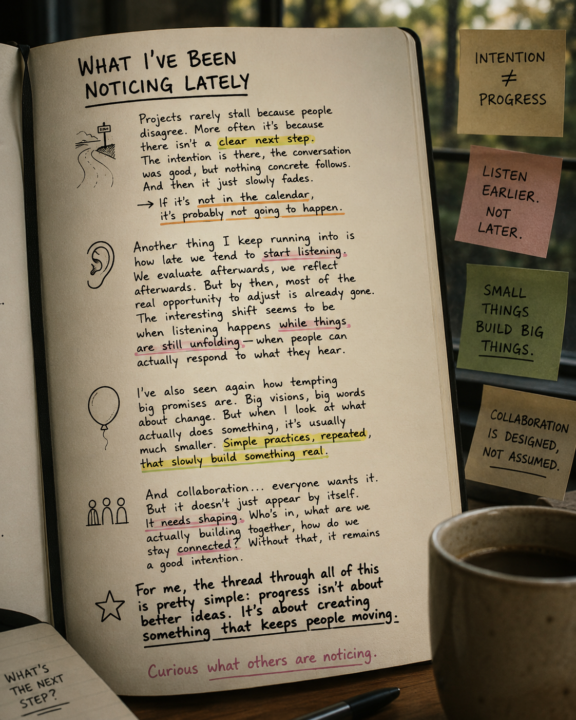
What I’ve been noticing lately. Over the past month I’ve been paying attention to where things move forward in my work—and where they just… stop. What strikes me is that projects rarely stall because people disagree. More often it’s because there isn’t a clear next step. The intention is there, the conversation was good, but nothing concrete follows. And then it just slowly fades. I’m starting to catch that earlier. If it’s not in the calendar, it’s probably not going to happen. Another thing I keep running into is how late we tend to start listening. We evaluate afterwards, we reflect afterwards. But by then, most of the real opportunity to adjust is already gone. The interesting shift seems to be when listening happens while things are still unfolding—when people can actually respond to what they hear. I’ve also seen again how tempting big promises are. Big visions, big words about change. But when I look at what actually does something, it’s usually much smaller. Simple practices, repeated, that slowly build something real. And collaboration… everyone wants it. But it doesn’t just appear by itself. It needs shaping. Who’s in, what are we actually building together, how do we stay connected? Without that, it remains a good intention. For me, the thread through all of this is pretty simple: progress isn’t about better ideas. It’s about creating something that keeps people moving. Curious what others are noticing.
0
0
May 17 •
The story of Amsterdam
What happens when we stop reducing people to numbers and start truly listening to their stories? This film offers an inspiring look at how stories can transform the evaluation of neighbourhood teams in Amsterdam. Instead of focusing only on statistics and reports, it explores what really matters in people’s daily lives: experiences, relationships, trust, struggles, and small moments of change that often remain invisible in traditional evaluations. For anyone interested in community work, social impact, participation, or meaningful evaluation, this film is deeply worth watching. It shows how story-based approaches can create richer understanding, stronger connections, and more humane ways of learning and improving together. Especially in complex neighbourhoods and social care settings, stories reveal nuances that numbers alone can never capture. This film demonstrates the power of listening — not just to collect information, but to genuinely understand people and communities. If you care about social change, neighbourhood support, or innovative evaluation methods, this film will give you fresh inspiration and practical insight. Watch the film and discover how stories can help communities learn, grow, and connect in a more human way. https://youtu.be/nmAkaK0PYfY
0
0
Mar 8 •
More than research: PNI
# PNI: three letters that permanently change the way you think about knowledge Some abbreviations come and go. Others stay with you — not because they are easy, but because they name something you already sensed but couldn’t quite articulate. PNI is that kind of abbreviation. Three letters. Three words. And if you take them seriously, three fundamentally different ways of thinking about research, about people, and about where knowledge actually lives. PNI stands for **Participatory Narrative Inquiry**. It was developed and pioneered by **Cynthia Kurtz**, whose groundbreaking work has shaped how researchers, organisations and communities around the world think about stories, participation and sense-making. Her book *Working with Stories* remains one of the most generous and rigorous contributions to the field — freely shared with the world, which in itself says something about her philosophy. Let’s walk through the three letters one by one. P — Participatory This is the heart of it. The letter everything else revolves around, and the letter that deserves the most space — not because the other two matter less, but because *participatory* is at once the most overused, most misunderstood and most promising word in the research world. And I’ll be honest: it is the letter that matters most to me personally. In most research approaches, knowledge sits with the researcher. The researcher designs the questions, defines the categories, interprets the answers and draws the conclusions. Participants are a source — valuable, certainly — but it is the researcher and their instruments that transform raw data into insight. The people being studied are, in a sense, the material. The researcher is the one who makes sense of it. Participatory Narrative Inquiry turns that around completely. In PNI, knowledge does not reside with the researcher. It resides with the people involved. They are not sources of data to be extracted and translated — they are carriers of meaning. The task of the researcher is not to mine that meaning, but to create a space in which it can become visible: to the participants themselves, and to the community they are part of.
Dec '25 •
Building a Safer Church – Insights from a “Quick Dive”
How do we create a church where everyone feels welcome, heard, and safe? In our congregation, we explored that question through a short but powerful initiative: a “Quick Dive” into social safety. We formed a small team focused on recognizing complexity and launched a storytelling brigade. Over just a few weeks, we gathered personal stories from members—stories of comfort and unease, of feeling embraced and feeling overlooked. Not statistics, but lived experiences. Not judgment, but deep listening. Four key insights emerged: - 🧭 Connection thrives where people feel seen and known. - 🛟 Trust grows when concerns are taken seriously. - 🕯️ Space matters—both physical and relational. - 🌱 Healing begins with acknowledging what hurts. These insights led to tangible steps: a clear point of contact for concerns, more intentional moments of connection, and open conversations about difficult experiences. But more importantly, we’ve sparked a culture of listening and learning. “We are not just a church—we are a community that learns through each other’s stories.” This Quick Dive wasn’t the end—it was a beginning. A call to every congregation: dare to listen. Because within the stories of our people lies the key to a safer, more welcoming church.
1-16 of 16
powered by
skool.com/the-story-commons-community-9565
Learn in 4 weeks how to work with stories to better understand people, uncover patterns, and design meaningful change.
Suggested communities
Powered by