
Write something

Apr 17 •
Day 7: The Invitation
Seven days ago I committed to showing up here every day. Here’s what I learned: 1. Consistency is the engine of production. It’s easy to be great for one day; it’s much harder to be disciplined for seven. I’ve realized that showing up consistently doesn't just build an audience, it builds the momentum that drives real results. 2. People respond to the story behind the curtain. You don’t want another generic, business-centric post about finances. You want to see the gears turning. The messages I received this week proved that people are hungry for the "How," the reality of the work, and the tangible ways they can benefit from it. 3. This mission is bigger than a status update. Even without consistent posting, my business will excel—but it’s about more than that. It’s about sharing my passion for helping families not just survive, but thrive. I love that every time I sit down with a family, the integrity and care I provide through Vantage elevates them, empowering them with the knowledge to improve their quality of life. This wasn’t a marketing exercise. It was a disciplined one. Showing up, sharing the real work, letting people see what this actually looks like from the inside . If anything I posted this week made you curious, whether about AI in financial services, about what we’re building at Vantage, or about whether this path might be for you, I’m an open book. The door is open. You just have to walk through it. Day 7 of 7. But I’m not stopping. #VLIFE #VantageFinancialAlliance #FinancialServices #Opportunity #WorkSmarter #Consistency #Scale #FinancialEmpowerment
Apr 15 •
Day 5: Behind the Scenes
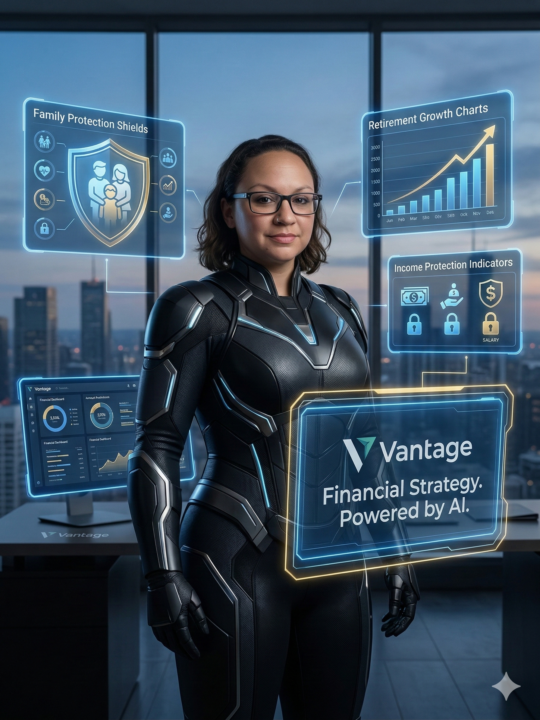
People ask how I actually use AI in my business. It’s not about robots; it’s about reclaiming time. The 'Old Way' of financial services: An hour of prep, a cold call, 30 pages of paperwork, and a 3-week wait for a medical exam. The New Way: · Spot the need: I noticed a post from someone in my network announcing their countdown to retirement and anxiety around the major change. · Prep the strategy: (AI in 10 seconds) I used Gemini to help me pivot from "congrats on the milestone" to "let's make sure your retirement income is protected." · Make the offer: (Personalized & Human) Sent a quick note acknowledging their hard work and offering a 5-minute look at how to lock in their legacy. · Close the gap: (Instant decision tech) They applied from their iPad while relaxing in their backyard. No needles. No endless paperwork. I just protected a family in less than a week without either of us having to leave our homes. If your workflow doesn't look like this, you’re working too hard. The best part? By letting AI enhance my preparation, I was able to offer a level of empathy and personalization that made my friend feel "seen," not "sold." This isn't about AI replacing the advisor; it's about AI elevating the entire advisor-client relationship. Day 5 of 7. #VLIFE #VantageFinancialAlliance #BehindTheScenes #AITools #WorkSmarter
2
0

Apr 13 •
Day 4: The Family Behind the Work
I don’t talk about this enough. I sat down with a client recently who was referred to me by a dear friend. From the second we started talking, I could feel the weight she was carrying. She was stressed! Not just "math" stressed, but deeply anxious. · Is the market volatility going to wipe out everything I’ve worked for? · Will I run out of money in my 80’s? · What happens to my son if I get sick? She was terrified of the physical, emotional, and financial burden he would have to carry; the reality of him potentially having to quit his job or drain his own savings to provide the 24/7 care she might need. After just a few sessions, the transformation was visible. We didn't just move numbers around; we built a fortress. She realized that no matter how long she lives, she will never run out of money. She has protection that covers formal in-home care or a nursing facility if she needs it, ensuring her son can remain her son, not her full-time unpaid caregiver. The moment she realized she’d never have to go back to work and her son’s future was protected, her entire posture changed. That clarity is why I do this. That’s what this business is at its core, helping families have conversations they’ve been avoiding and building protection around the people who matter most. Every appointment, every follow-up, every late-night learning something new, it’s for moments like that. Day 4 of 7. #VLIFE #VantageFinancialAlliance #HelpingFamilies
2
0

Apr 12 •
Day 3: What AI Changed for Me
I used to spend 4 hours every week manually typing up client data and building presentations. I was crunching numbers by hand to calculate financial independence targets, including the complex impact of inflation over 20 and 30-year horizons. It was a massive manual undertaking to ensure "future dollars" would actually cover a family's needs. This last month, I shifted my approach. I’ve been leveraging AI to streamline that data processing and instantly model different inflation scenarios, creating a neat presentation with each person's unique situation, desires, and goals to ensure their protection is as individual as they are. It now takes me 20 minutes instead of 4 hours. But here’s what actually mattered: I’ve walked into every meeting this month with more accurate, stress-tested data than ever before. Instead of being drained by hours of spreadsheet formulas, I am fully focused on the human being in front of me. AI isn’t replacing the advisor. It’s removing the manual "grunt work" so we can focus on the heart of this business: protecting families against the realities of tomorrow. Day 3 of 7. #VLIFE #VantageFinancialAlliance #AIinFinance #FinancialPlanning #InflationProtection #PersonalFinance
3
0

Apr 11 •
Day 2: A Staggering Statistic
Here’s something that keeps me up at night: 56% of families with children would face financial hardship within just 6 months if the primary earner died. That’s not just a statistic. That’s the family next door. That’s the couple at soccer practice. That’s my brother’s family. The reality is that for most of us, the "single-income household" is a thing of the past. It takes two salaries just to cover the basics: mortgage, groceries, and childcare. If one of those paychecks disappears, the math simply stops working. For years, the excuses were: “I don’t need life insurance,” or “It takes too long. Too many forms. I don’t want a stranger coming to my house for a blood draw.” Those excuses are officially gone. The "I don't need it" myth disappears the moment you realize how much we rely on both partners just to keep the lights on. And the "it’s too hard" myth? I work with a platform where a family can apply and get a decision in 5 minutes. · No medical exams. · No 8-week waiting periods. · Smart Logic: If the first option isn't a fit, the system automatically pivots to find another one. · Zero Risk: If nothing works, there is no record of the attempt, no "mark" against your insurability. The gap isn’t about access anymore. It’s about awareness. People simply don’t know it’s this easy now. That’s what I’m here to fix. Day 2 of 7. #VLIFE #VantageFinancialAlliance #FinancialPlanning #ProtectYourFamily

1-20 of 20
powered by

skool.com/the-prosperity-project-9756
Built to empower you to not only take charge of your personal finances, but to grow a community focused on lifestyle, family, faith, & future.
Suggested communities
Powered by