
Write something
Pinned
Jan 25 •
Welcome to The Plant-Powered Women’s Gym
Welcome — I’m really glad you’re here. This space is for women who want to lift heavy, fuel with plants, and build strength without restriction or extremes. You don’t need to be “in shape.” You don’t need to know what you’re doing yet. You just need to be open to learning and showing up. 🚫 This is not a challenge 🚫 Not a reset ✅ A place to build habits that last 👇 Introduce yourself below: Your name What brought you here One thing you want more of (strength, confidence, consistency, etc.)
Apr 27 •
🏋️♀️ Let's talk about the deadlift — and specifically, why your grip might be the thing quietly holding you back.
The deadlift is a hip hinge movement where you pick a loaded barbell up off the floor and stand all the way up with it. It works your glutes, hamstrings, entire back, core, and traps all at once — making it one of the most efficient exercises you can do for building a strong, powerful body. If you're not deadlifting yet, you're leaving serious gains on the table. 💚 Here's what inevitably happens as you get stronger: your posterior chain — your glutes, hamstrings, and back — will outpace your grip. Your legs and back will be ready to pull far more weight than your hands can hold onto. That's not a weakness, that's just physics. Which is exactly why knowing your grip options matters. 𝗣𝗿𝗼𝗻𝗮𝘁𝗲𝗱 (𝗗𝗼𝘂𝗯𝗹𝗲 𝗢𝘃𝗲𝗿𝗵𝗮𝗻𝗱) — Both palms face toward you. This is the most natural starting point and the best grip for building raw grip strength because the bar will challenge your hands on every single rep. The downside is that as the weight gets heavier, your grip will give out before your legs and back do. I use this grip for all my warm-up and lighter sets specifically to keep developing my grip — but I don't let it be the ceiling on my heavy work. 𝗠𝗶𝘅𝗲𝗱 𝗚𝗿𝗶𝗽 (𝗢𝘃𝗲𝗿/𝗨𝗻𝗱𝗲𝗿) — One palm faces toward you, one faces away. The opposing hand positions prevent the bar from rolling, allowing you to lift significantly more than with a double overhand grip. It works — but it comes with two real risks that don't get talked about enough. First, the supinated (underhand) arm is in a vulnerable position under heavy loads and can lead to bicep strain or even a torn bicep tendon. Second, using the same hand in the same position every set can create muscle imbalances in the lats, traps, and lower back over time. If you use mixed grip, always alternate which hand is supinated from set to set. 𝗦𝘁𝗿𝗮𝗽𝘀 𝗮𝗻𝗱 𝗪𝗿𝗶𝘀𝘁 𝗪𝗿𝗮𝗽𝘀 — These are two completely different tools that constantly get confused with each other. Lifting straps loop around your wrist and wrap around the bar, connecting you to it so grip is no longer the limiting factor. They allow you to pull in a double overhand position — keeping both shoulders loaded symmetrically — while letting your posterior chain work to its full potential. Wrist wraps on the other hand provide compression and stability to the wrist joint, and are primarily useful for pressing movements like bench press and overhead press. Straps save your grip on pulls. Wrist wraps protect your wrists on presses. Both deserve a spot in your gym bag — they just do completely different jobs.
1
0
Apr 21 •
💪 WHY REST DAYS ARE ACTUALLY BUILDING YOUR MUSCLE (AND SKIPPING THEM IS HOLDING YOU BACK)
If you've ever felt guilty for taking a rest day, this post is going to change the way you think about recovery forever. Here's the truth that most fitness content won't tell you: muscle is not built in the gym. It's built during recovery. The gym is simply where you create the stimulus. Everything that actually makes you stronger, leaner, and more capable happens in the hours and days after you train. What actually happens when you work out When you lift weights or perform resistance training, you're creating microscopic tears in your muscle fibers — a process called exercise-induced muscle damage. This sounds alarming, but it's entirely normal and necessary. These small tears trigger an inflammatory response that signals your body to repair and rebuild the damaged tissue, and crucially, to rebuild it slightly stronger and larger than it was before. This repair process is called muscle protein synthesis, and it is the literal mechanism by which you build muscle. Here's the key detail: muscle protein synthesis is most elevated in the 24–48 hours following a training session. That means the day after your workout — your rest day — is arguably one of the most productive days of your entire training week. What happens when you don't rest enough When you train hard without adequate recovery, a few things go wrong: You accumulate fatigue faster than you can dissipate it. This leads to a state called overreaching, where performance actually declines despite continued training effort. If left unaddressed, this can progress to overtraining syndrome — a more serious condition characterized by persistent fatigue, mood disturbances, disrupted sleep, and plateaued or regressed strength. Cortisol stays elevated. Intense exercise is a physical stressor that raises cortisol, your body's primary stress hormone. In short bursts this is normal and even helpful. But chronically elevated cortisol actively breaks down muscle tissue, suppresses immune function, disrupts sleep quality, and can interfere with hormonal balance — something women are particularly sensitive to given the relationship between cortisol and estrogen.
Apr 20 •
🌿 THE MUSCLE RECOVERY NUTRIENT MOST PLANT-BASED WOMEN ARE MISSING — AND HOW TO FIX IT
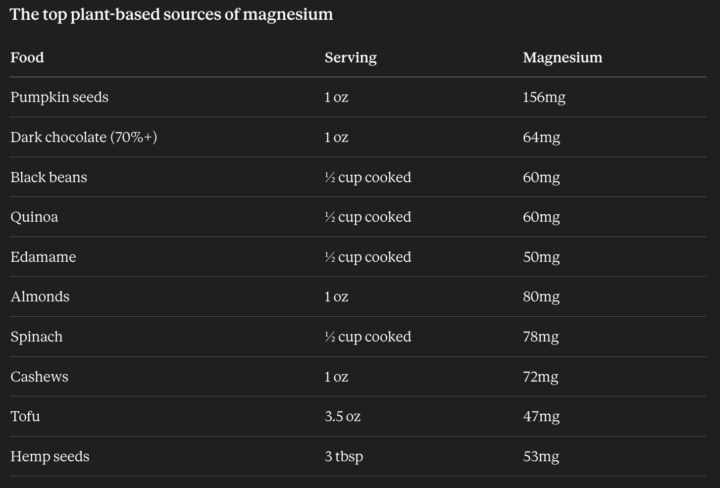
You're training hard, hitting your protein goals, and eating your plants. So why do your muscles still feel sore for days after a workout? Why does recovery feel slower than it should? The answer might come down to one underrated mineral: magnesium. What is magnesium and why does it matter for muscle recovery? Magnesium is the fourth most abundant mineral in the human body and is involved in over 300 biochemical reactions — including many that are directly tied to exercise performance and muscle recovery. Here's what magnesium does specifically for women who train: - Reduces muscle soreness — magnesium helps regulate neuromuscular signals, meaning it directly affects how your muscles contract and relax after exercise - Supports protein synthesis — without adequate magnesium, your body cannot efficiently build new muscle tissue even when protein intake is sufficient - May help regulate cortisol — intense exercise raises cortisol (your stress hormone), and research suggests magnesium may help bring it back down, supporting recovery and sleep - Improves sleep quality — magnesium supports the nervous system's ability to wind down, helping your body enter the deep, restorative sleep where the majority of muscle repair actually happens - May help reduce inflammation — post-workout inflammation is normal and necessary, but chronic low-grade inflammation slows recovery significantly, and magnesium has been shown in research to help keep it in check - Are plant-based women at risk of magnesium deficiency? Here's where it gets interesting. Plant foods are actually some of the richest sources of magnesium on the planet — so in theory, a well-planned plant-based diet should cover your needs easily. However, there are a few factors that make magnesium deficiency surprisingly common even among women eating plenty of plants: - Phytates and absorption. Many high-magnesium plant foods like legumes, whole grains, and seeds also contain phytates — compounds that can bind to magnesium and reduce how much your body actually absorbs. Soaking, sprouting, and fermenting these foods significantly improves absorption.
1
0
Apr 19 •
🌿 CAN WE TALK ABOUT PERFECTIONISM FOR A SECOND?
Because I think it's quietly holding a lot of us back — and I don't want that for you anymore. Here's something I want you to really sit with today: the pursuit of a perfect diet and a perfect workout routine has stopped more women from making progress than any missed meal or skipped gym session ever could. Read that again if you need to. 💚 The all-or-nothing trap So many women in this community — and honestly, women everywhere — fall into what I call the all-or-nothing trap. It sounds like this: "I missed my workout on Tuesday so I'll just start fresh on Monday." "I didn't hit my protein goal today so the whole day is ruined." "I ate something off-plan so I may as well give up for the rest of the week." Does any of that sound familiar? If it does, I want you to know — you are not alone, and there is absolutely nothing wrong with you. Perfectionism is something so many of us were taught, often without even realizing it. But it is not serving you, and today we are gently setting it down. Here's the truth about progress Progress is not a straight line. It never has been and it never will be. Real, lasting transformation is built in the messy middle — in the weeks where you only made it to the gym twice, in the days where lunch was whatever you could throw together in five minutes, in the moments where you showed up even though you really didn't feel like it. Those imperfect moments? They count. They count just as much as the perfectly tracked days and the flawlessly executed workouts. Actually, I'd argue they count more — because showing up imperfectly takes far more courage than showing up when everything is going smoothly. What to do instead of starting over Next time life throws a wrench in your plan — and it will, because that's just life — I want you to try something different. Instead of waiting for a fresh start, just take the very next right action. Didn't hit your protein goal today? Add a handful of edamame to your next snack. Missed your workout? Take a 20-minute walk tonight. Ate off-plan? Drink a big glass of water and make your next meal a nourishing one.
1-30 of 36
powered by
skool.com/the-plant-powered-womens-gym-7033
Women lifting heavy and fueling with plants. Build muscle, lose fat, and create healthy habits—without restriction or extremes.
Suggested communities
Powered by