
Write something
9d •
Pattern Recognition — The Skill We Don’t Coach Enough
https://shura.shu.ac.uk/36336/2/Strafford%20et%20al.%20%282026%29.pdf I recently read a research paper on snooker (yes… snooker 😅), and one idea really stood out. It wasn’t about technique.It wasn’t about repetition. It was about pattern recognition. The best snooker players don’t just strike the ball better —they recognise patterns earlier and can plan several shots ahead. ⚽️ Why this matters for coaching When you think about it, this applies directly to almost every sport: - In football → spotting space and movement - In rugby → recognising overlaps or defensive shapes - In cricket → reading the field, bowler, and scoring options The best players aren’t just better technically…👉 they see the game differently. 🧠 The problem A lot of coaching still looks like this: - drills - repetition - isolated technique But in games, players don’t just execute — they: 1. See (what’s happening) 2. Decide (what to do) 3. Do (execute the skill) Most sessions only train step 3. 🎯 What we should be doing more of If we want to develop better players, we need to design sessions that: - expose players to repeated game situations - encourage scanning and decision-making - reward good choices, not just good technique This is where gamification comes in. Simple tweaks can make a big difference: - Bonus points for recognising space early - Extra scores for choosing the right option - Challenges where players have to call what they see 🚀 Coaching takeaway Don’t just coach the action. Coach what happens before the action. 💬 Over to you How are you helping players develop their ability to see the game? Drop ideas, games, or examples below — would be great to share what’s working 👇
0
0
13d •
🧤 The Sweeper Keeper: Are We Coaching It… or Avoiding It?
I’ve been watching Manuel Neuer’s performance against Algeria in the 2014 World Cup again. It’s often described as one of the greatest goalkeeping performances of all time. But here’s what stands out when you really watch it closely… 👉 He barely made a save. Instead, what he did was: - sprint 30–40 yards off his line to clear danger - intercept through balls before attackers could get there - dominate space outside the box - start attacks with long, accurate passes He didn’t just react to the game. 👉 He controlled it. ⚽ The Evolution of the Goalkeeper The traditional goalkeeper role was simple: - stay on your line - make saves - deal with crosses Everything was reactive. But the modern game has changed. Teams now: - press higher - play through lines - look to exploit space in behind Which means the goalkeeper has become: 👉 a defender👉 a decision-maker👉 a key part of build-up play 🚨 The Problem at Youth Level Here’s the uncomfortable question: 👉 Are we actually developing sweeper keepers in youth football? Or are we unintentionally coaching it out of them? Because the reality is… The sweeper-keeper role comes with risk. - Come too early → you get beaten - Come too late → you look hesitant - Get it wrong → it’s often a goal And when that happens: - coaches react - parents react - players lose confidence So what do we hear instead? - “Stay on your line” - “Don’t take risks” - “Just make the save” 🤔 What Are We Really Teaching? When we remove those moments, we might be protecting the team in the short term… But what are we doing to the goalkeeper long term? Are we: - reducing their ability to read the game? - limiting their decision-making? - creating reactive players instead of proactive ones? 🧠 Decision-Making > Technique The sweeper-keeper isn’t just about technique. It’s about: - perception - timing - anticipation - courage These are things that can’t be learned through drills alone. They need:
0
0

Apr 3 •
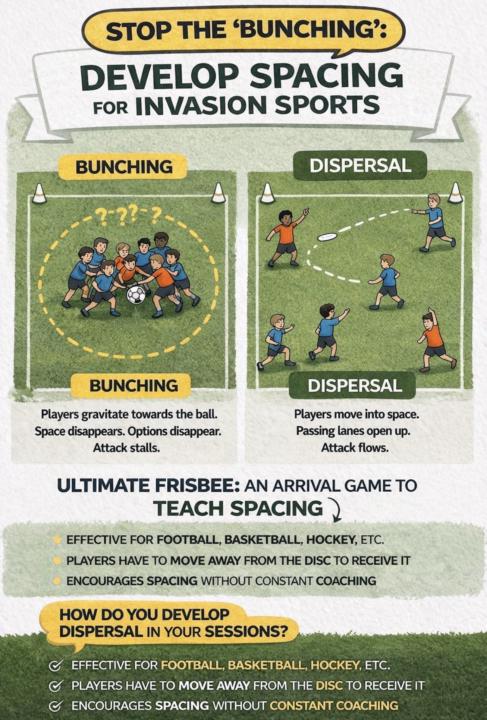
Bunching in invasion games!
One of the biggest challenges in invasion games like football, basketball and hockey? 👉 Dispersal. Or more commonly… 👉 Everyone bunching around the ball. One of the best arrival activities I use to address this is Ultimate Frisbee. What makes it so effective? The game demands dispersal. If you stand too close to the disc: - you become redundant - you take away space - you limit options There’s no dribbling. No running with the ball. So players quickly realise: 👉 “If I don’t move into space… I don’t get the disc.” What I like most is that this learning happens without constant coaching. The game itself teaches: - spacing - movement off the ball - creating passing lanes - decision-making All transferable to: ⚽ football 🏀 basketball 🏑 hockey Instead of telling players to “spread out” (which rarely works), Ultimate Frisbee designs the problem for them to solve. It’s become a really effective arrival activity for me because: - it engages immediately - it reduces bunching - it sets the tone for the session - and it builds understanding of space early Shoutout to UK Ultimate — a great example of a sport where spacing and movement are built into the game itself. Curious to hear: What activities do you use to develop dispersal in your sessions?
Mar 17 •
👉 “You need to specialise early.”
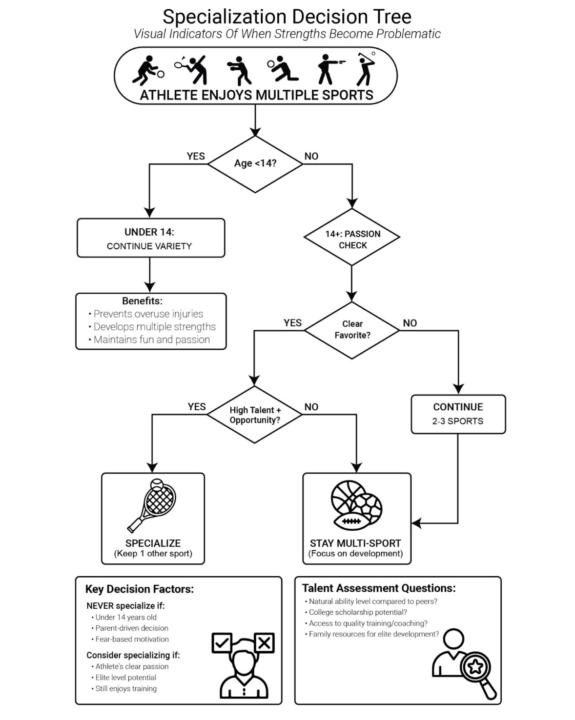
I’ve heard more and more stories recently of young athletes being told: 👉 “You need to specialise early.” Often it’s linked to the idea of the “10,000-hour rule” — the belief that the earlier you focus on one sport, the more likely you are to succeed. But the reality is far more complex. Some of the world’s best athletes didn’t specialise early. Roger Federer played multiple sports growing up. Many elite athletes develop through variety, not early restriction. This graphic highlights something important: 👉 Under 14 = continue variety Why? Because early specialisation can: • increase risk of overuse injuries • reduce overall athletic development • lead to burnout • and remove the element of fun At younger ages, development isn’t linear. Children grow at different rates: - physically - emotionally - cognitively So early performance often reflects maturity, not long-term potential. What’s interesting is that many elite systems are now moving away from early specialisation — not towards it. Because the goal isn’t just to create early performers. It’s to develop adaptable, resilient, intelligent athletes. Maybe the question shouldn’t be: 👉 “How early can we specialise?” But: 👉 “How long can we keep young people exposed to variety?” Because variety doesn’t limit development. It builds it. Curious to hear from others: Have you seen young athletes pushed into early specialisation — and what were the outcomes?
1
0
Mar 13 •
Balancing exams & sports/activity
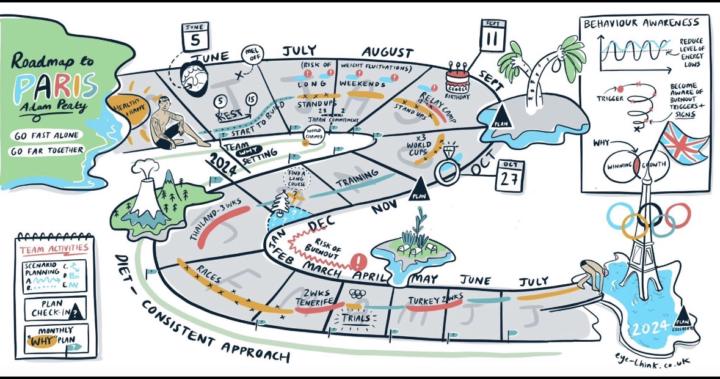
With GCSE and A-level exam season approaching, this visual from Adam Peaty’s journey to the Paris Olympics offers an interesting reminder about planning. Even at the highest level of sport, preparation isn’t just about training harder — it’s about managing energy, workload and recovery over time. Elite athletes map out their year carefully: - periods of intense work - moments to step back - risks of burnout - and time to reset Students preparing for exams face a similar challenge. Revision and exams require huge mental effort, so it’s important that young people are given the space to prioritise their studies when needed. But that doesn’t mean activity should disappear entirely. Physical activity during exam periods can: • reduce stress • improve concentration • support sleep and recovery • maintain routine One practical idea is encouraging students to map their own “exam roadmap”, identifying: - heavy revision periods - exam dates - opportunities to reduce training load - and moments where light activity or movement could help them recharge. The goal isn’t to stop activity — it’s to balance it intelligently. Sometimes the best preparation isn’t doing more, but doing the right things at the right time.
0
0
1-30 of 34
powered by
skool.com/the-gamified-coach-8582
🎮The Gamified Coach
Bringing the fun back into football and sport through gamified learning.
🚀Join us if you love coaching fun & engaging sessions
Suggested communities
Powered by