Activity
Mon
Wed
Fri
Sun
Sep
Oct
Nov
Dec
Jan
Feb
Mar
Apr
May
Jun
Jul
Aug
What is this?
Less
More
Owned by Daniel
🎮The Gamified Coach Bringing the fun back into football and sport through gamified learning. 🚀Join us if you love coaching fun & engaging sessions
Coaching the Parent Project
99 members • Free
Skoolers
161.8k members • Free
39 contributions to The Gamified Coach

22d •
Today football lost one of its true greats.
Franco Baresi has passed away at the age of 66. I’ve always loved this clip of AC Milan retiring his number 6 shirt. Not because of the ceremony, but because of Baresi’s reaction. You can see what it means to him. In an era where changing clubs is normal, Baresi spent his entire professional career at AC Milan. Twenty seasons. Over 700 appearances. Six league titles. Three European Cups. When he retired, Milan retired his number 6 shirt too—a tribute reserved for only the most iconic figures in the club’s history. It got me thinking… As coaches, players or leaders, trophies eventually become memories. The real legacy is how people remember you. Were you loyal? Did you make those around you better? Did you leave your club in a stronger place than when you arrived? Franco Baresi did. Rest in peace, Capitano.

26d •
Can every player handle honesty?
I was listening to Ben Youngs talking about Eddie Jones and Richard Cockerill. One thing really stood out. He said he loved how honest they were. If they wanted X, Y and Z from you, that’s exactly what they told you. You knew what was expected and you knew where you stood. There wasn’t any grey area. Personally, I like that. I think players deserve clarity. But Ben then admitted something really interesting. He said not everyone can cope with that level of honesty. That got me thinking. As coaches we’re always told to “be honest”. I agree. But does that mean being honest in exactly the same way with every player? Some players will take a blunt conversation and use it as motivation. Others might lose confidence completely. The feedback is the same, but the person receiving it isn’t. So where’s the balance? Should we adapt how we communicate depending on the player, or should honesty always come first? I’d be really interested to hear how others approach this. Have you ever changed the way you give feedback because of the individual in front of you? Or do you believe everyone should get the same level of honesty?

Jun 29 •
Guy Roux Didn’t Build a Great Football Club. He Built a Great Environment.
When coaches talk about successful football clubs, the conversation usually turns to money. Big budgets. Big academies. Big signings. Guy Roux proved there was another way. For over four decades, he managed AJ Auxerre—a club from a town of around 35,000 people in rural France. On paper, they shouldn’t have been competing with clubs like Marseille, Monaco or PSG. Yet they consistently did. His greatest achievement wasn’t winning trophies. It was building a system that kept producing them. Under Roux, Auxerre became known as one of Europe’s best talent factories. Players such as Eric Cantona, Laurent Blanc, Basile Boli, Djibril Cissé, Philippe Mexès and Bacary Sagna all developed through the club before going on to achieve success at the highest level. That doesn’t happen by accident. The academy came before the superstar. One story perfectly captures Roux’s philosophy. Rather than signing an established international striker, Auxerre invested in building a modern youth academy. At the time, it probably seemed like the less exciting decision. Looking back, it may have been the most important decision in the club’s history. Infrastructure over instant gratification. Development over recruitment. Long-term thinking over short-term headlines. Culture wasn’t something they talked about. It was something they lived. Roux became famous for his frugal approach. He offered to mow the pitches. He sourced fertiliser from local farmers. He volunteered to chop wood for the changing rooms. At first glance, these sound like amusing stories. But they reveal something much deeper. Leadership by example. No entitlement. Everyone contributes. Culture wasn’t written on a wall. It was demonstrated every day. The biggest lesson? Too many clubs think success starts with resources. Guy Roux showed that success starts with standards. Money helps. Facilities help. But neither replaces: - Clear values - Patience - Great coaching - Consistency - Belief in young players - Long-term leadership

1 like • Jul 1
@Alan Proudfoot I’ve just looked at website of Burnham…looks like a great club
Jun 19 •
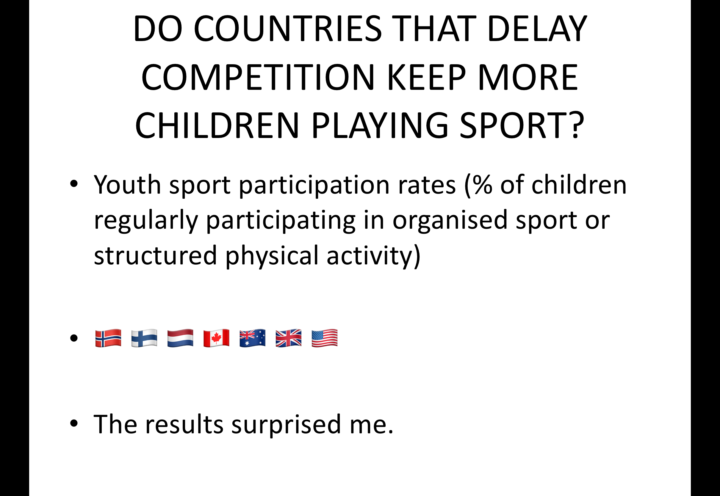
Do Countries That Delay Competition Keep More Children Playing Sport?
I came across some participation figures recently that made me stop and think. Youth sport participation rates: 🇳🇴 Norway – 93% 🇫🇮 Finland – 90% 🇳🇱 Netherlands – 75% 🇨🇦 Canada – 74% 🇦🇺 Australia – 73% 🇺🇸 USA – 50% 🇬🇧 England – 47% Now, participation figures are always messy. Different countries measure them differently and correlation doesn’t equal causation. But what interested me wasn’t just the percentages. It was the philosophy behind them. Different Approaches to Youth Sport Countries such as Norway, Finland and Canada tend to place a strong emphasis on: ✅ Fun ✅ Participation ✅ Development ✅ Multi-sport experiences Competition still exists. Children still compete. But winning isn’t the primary focus during childhood. The emphasis is on keeping young people involved. By contrast, countries such as England and the USA often introduce competitive structures much earlier through: • Leagues • Rankings • Representative teams • Talent pathways • Academy systems Again, this isn’t inherently wrong. Competition can be motivating. It can develop resilience, ambition and commitment. But it raises an important question. What Are Children Actually Looking For? Research consistently suggests that younger children participate in sport primarily because of: • Fun • Friends • Enjoyment • Learning new skills • Feeling competent • Being part of a group Very few 8-year-olds are genuinely motivated by scholarship opportunities, talent pathways or professional careers. Those are often adult priorities. As children move into adolescence, motivation begins to change. Identity, belonging, achievement and mastery become more important. But for many younger children, enjoyment remains the foundation. The Participation Problem One of the biggest challenges facing youth sport is retention. We often celebrate the players who make it. We rarely talk about the players who leave. The question isn’t simply: “How do we produce better athletes?” It’s also: “How do we keep more children active?” Because if young people stop enjoying sport at 12 or 13, the opportunity for lifelong participation may be lost.
May 2 •
Pattern Recognition — The Skill We Don’t Coach Enough
https://shura.shu.ac.uk/36336/2/Strafford%20et%20al.%20%282026%29.pdf I recently read a research paper on snooker (yes… snooker 😅), and one idea really stood out. It wasn’t about technique.It wasn’t about repetition. It was about pattern recognition. The best snooker players don’t just strike the ball better —they recognise patterns earlier and can plan several shots ahead. ⚽️ Why this matters for coaching When you think about it, this applies directly to almost every sport: - In football → spotting space and movement - In rugby → recognising overlaps or defensive shapes - In cricket → reading the field, bowler, and scoring options The best players aren’t just better technically…👉 they see the game differently. 🧠 The problem A lot of coaching still looks like this: - drills - repetition - isolated technique But in games, players don’t just execute — they: 1. See (what’s happening) 2. Decide (what to do) 3. Do (execute the skill) Most sessions only train step 3. 🎯 What we should be doing more of If we want to develop better players, we need to design sessions that: - expose players to repeated game situations - encourage scanning and decision-making - reward good choices, not just good technique This is where gamification comes in. Simple tweaks can make a big difference: - Bonus points for recognising space early - Extra scores for choosing the right option - Challenges where players have to call what they see 🚀 Coaching takeaway Don’t just coach the action. Coach what happens before the action. 💬 Over to you How are you helping players develop their ability to see the game? Drop ideas, games, or examples below — would be great to share what’s working 👇
0 likes • Jun 18
@James Barraclough thank you!
1-10 of 39

@daniel-snadden-7813
I’m a sports coach and educator on a mission to make learning fun again. With a Master’s in Sports Coaching and over a decade of
experience.
Active 18d ago
Joined Nov 3, 2025
London