
Write something

Aug '25 •
Draft Edge for Our Members 🏆
I partnered with 4for4 to hook us up with 25% off their plans this season. Their projections, rankings, and draft tools pair perfectly with our strategies here. Use code: CONCIERGE at checkout (4for4.com) to lock in the discount.
0
0

Aug '25 •
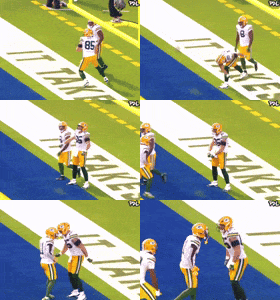
Why TE Tucker Kraft is a Value Pick at His ADP This Season
TL;DR Tucker Kraft checks the exact boxes we want in a late-round tight end: athletic after the catch, attached to an ascending quarterback, used in high-leverage red-zone and play-action concepts, and priced like a bench flier. You’re paying TE2 dollars for a real shot at weekly TE1 outputs—especially if his route share nudges up. The Case for Kraft 1) Role that creates cheap fantasy points Matt LaFleur’s offense heavily features tight ends on play-action, boot, leak, and crossers—routes that manufacture YAC without demanding a massive target share. Kraft’s strength is turning short throws into chunk gains. That’s exactly the profile that turns four to six targets into 60 yards and a TD on any given week. 2) Red-zone utility on an ascending offense Jordan Love has shown comfort ripping throws between the numbers and on designed rollouts. Kraft’s frame and hands keep him on the field inside the 20, where one catch can swing a fantasy matchup. He doesn’t need 8–10 targets; he needs 2–3 high-leverage looks. 3) Proven plug-and-play production when snaps rise When injuries/thin depth pushed him into heavier usage in the past, the production followed—routes up, fantasy points up. That’s the signal we chase late: a player who has already flashed when given opportunity. 4) Pathways to more routes (and a breakout) - Two-TE formations remain a staple, keeping Kraft involved even with competition at the position. - Any missed time by teammates or a subtle scheme tweak toward heavier play-action/12 personnel spikes his route rate. - He’s good enough after the catch to earn more designed touches as the season progresses. Why the ADP is Wrong - Market bakes in timeshare fear but over-penalizes it compared to Kraft’s explosive efficiency per route. - Tight end scoring is spiky; you want players who can create 20-point weeks, not 6-target floor plays at the same cost. - Late-season upside wins titles. Kraft’s profile lends itself to post-bye expansions in usage as coaches lean into what works.
0
0
Aug '25 •
Justin Fields Is Undervalued at His 2025 ADP — Here’s Why
TL;DR Fields’ rushing (“Konami code”) gives him a weekly floor few pass-only QBs can match, and his current mid/late-round ADP prices in the risk but not the ceiling. If you miss the elite tier, he’s the cheapest path to QB1 outcomes. 1) The Market Price is Wrong Multiple outlets have Fields going outside the top-12 QBs (Round 10–12 range): CBS recently tagged him QB13 around pick ~107–110, while FTN flagged him as QB17 in Round 11—both calling him a value versus their ranks. That’s classic arbitrage. 2) Rushing = Fantasy Cheat Code Fields owns league-winning ground production: - 1,143 rushing yards & 8 TDs in 2022 (second-most rush yards by a QB in NFL history). - In 2024 he started six games and still logged 289 rush yards and 5 rush TDs—a QB-best on the Steelers. Those scores tilt matchups. Why it matters: rushing yards are worth more than passing yards in most formats (10 rush yards = 1 pt vs. 25 pass yards = 1 pt), and total TDs (pass + rush) correlate strongest with fantasy QB scoring. Dual-threat profiles simply give you more paths to points. 3) Situation Upgrade & Play Volume Fields now heads the Jets, where beat coverage and national outlets expect a fresh offense and OL emphasis; even skeptics concede his legs create fantasy utility. If the Jets lean into RPO/play-action with Garrett Wilson and a healthy run game, Fields’ designed rushes + scrambles can buoy weekly totals while the passing grows. The league’s own fantasy desk just listed Fields as a 2025 breakout candidate, reinforcing the upside case at a depressed cost. 4) Ceiling Proof of Concept We’re not projecting in a vacuum—Fields has already produced elite fantasy stretches. Across his Chicago run (and spot starts since), he posted spike weeks fueled by rushing volume. Even in a modest 2024 passing sample (1,106 yards, 5 TD, 1 INT), the rushing TDs kept him streamable and often startable. 5) Counterpoints (and Why the ADP Bakes Them In) Concerns about processing and pressure handling remain (coaches ranked him in the Tier-3/4 fringe). That uncertainty explains the discount. But fantasy rewards rushing and TDs more than pristine pocket traits; at Round 10–12, you’re buying asymmetric upside with an easy out (stream or cut) if it doesn’t click.
0
0

Aug '25 •
Why QB Jordan Love is Undervalued this Year
1) Proven ceiling (2023) + acceptable 2024 floor - In his first full year as a starter, Love threw 32 TDs, 4,159 yards with a 96.1 rating and finished top-5 in total fantasy points among QBs in 2023. - 2024 dipped (injuries, run-heavy tilt), yet he still logged 25 TDs, 96.7 rating in 15 games—roughly mid-QB2 in points per game. 2) Market discount = upside leverage - Current ADP hovers around QB16, ~129 overall—the mid/late rounds—despite top-10 upside already demonstrated. 3) Weapons are deeper than ever - Green Bay returns Jayden Reed, Romeo Doubs, Christian Watson, adds 1st-round WR Matthew Golden, and has a two-TE punch (Tucker Kraft, Luke Musgrave) with Josh Jacobs in the backfield. Depth chart + camp notes point to a loaded supporting cast. 4) Scheme/outlook argue for passing bounce-back - DraftSharks’ 2025 preview flags less run-heavy expectations after last year's ground lean; a modest bump in attempts re-unlocks his 2023 TD rate path. 5) Talent indicators remain positive - ESPN’s traits piece ranks Love top-10 in arm strength, underscoring playmaking potential when protected and healthy. What happened in 2024 (and why it’s fixable) - Love played through lower-body injuries; from his return (Weeks 4–17) he was QB14 in PPG, i.e., serviceable even while banged up. FantasyPros notes the injuries and still pegs him as a viable rebound candidate. - Packers skewed unusually run-heavy with Jacobs; analysts expect reversion toward balance, which helps Love’s volume/TDs. Price vs. payoff - ADP QB16 places him squarely in the “wait on QB” zone many analysts endorse; you can build elite RB/WR depth, then take Love for upside (and pair with a safe streamer). Risks to note (and how to hedge) - Schedule projects on the tougher side; consider drafting a second QB with early favorable matchups. - Health/consistency: if camp reports trend negative, be ready with a late pivot. Draft plan (how to play it)
0
0

Aug '25 •
From Basement Scorekeeping to Billion-Dollar Obsession: The Story of Fantasy Football
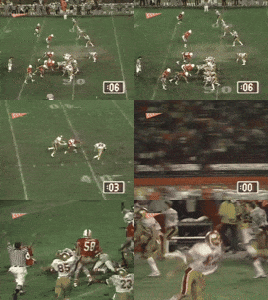
Chapter 1: A Game Before the Internet The year was 1962. The Beatles weren’t famous yet. The first Super Bowl was still years away. And in a smoky Manhattan hotel, a small group of football diehards invented something that would change the way fans experienced the sport forever. Wilfred “Bill” Winkenbach—a part-owner of the Oakland Raiders—was traveling with two friends, Scotty Stirling (an Oakland Tribune reporter) and Bill Tunnel (Raiders PR man). Between games, they began crafting rules for what they called the Greater Oakland Professional Pigskin Prognosticators League (GOPPPL). The concept was simple but groundbreaking: - Team “owners” drafted real NFL players. - Each week, the owner’s team scored points based on those players’ real-life performances. - The league crowned a champion at season’s end. Back then, every stat was tracked by hand. Owners pored over newspapers, scribbling rushing yards and touchdowns into notebooks. There were no instant replays, no live scoring apps—just camaraderie, competition, and bragging rights. Chapter 2: The Slow Burn (1970s–1980s) Throughout the 1970s and ’80s, fantasy football remained a niche hobby—usually for small circles of friends, journalists, and diehard fans.Scoring was basic (yards, touchdowns) and lineups were small. The challenge wasn’t so much who you drafted, but whether you had the patience to keep score all season. The turning point came with Rotisserie Baseball in the late ’70s, which introduced the “fantasy sports” idea to a wider audience. Football lagged behind—after all, it was harder to track stats in a pre-internet world—but the seeds were planted. Chapter 3: The Internet Era Changes Everything (1990s–2000s) In the mid-’90s, fantasy football experienced its first real explosion.The reason? The internet. ESPN, Yahoo!, and NFL.com began offering free online leagues—complete with automated scoring. No more tracking by hand. No more waiting for Monday’s newspaper. Suddenly, you could:
0
0
1-12 of 12
powered by
skool.com/the-draft-concierge-7352
Expert fantasy football consulting for all levels—draft prep, lineup help, and high-stakes strategy in one premium experience.
Suggested communities
Powered by