
Write something
8h •
Noseybonk
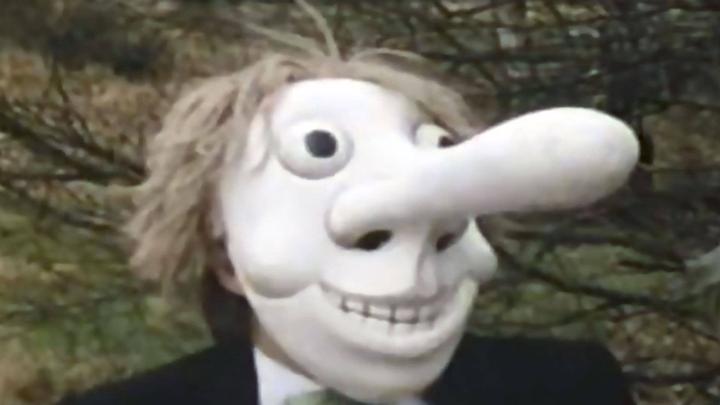
Mr Noseybonk belongs to that peculiarly British cabinet of televised horrors: not monsters designed to frighten, but those perfectly well-meaning creations that somehow slipped through a crack in the national psyche. He arrived courtesy of Jigsaw, a programme devoted to games, puzzles and gentle education, yet moved through it with the unnerving confidence of something that had wandered in from an altogether darker production. His costume was simplicity itself: dinner jacket, white gloves, an alabaster mask fixed in a grotesque rictus, and that extraordinary nose, jutting forward like a baleful compass needle. He never spoke. He never needed to. Silence can be infinitely more eloquent than menace. There is something profoundly unsettling about a figure whose only apparent motivation is boundless, wordless delight. He materialised in parks, shopping precincts and village greens with the inevitability of bad weather, observing the world through expressionless eyes while that impossible grin remained forever unchanged. Janet Ellis seemed unconcerned, but then she’s made of sterner stuff than most. What lingers is not terror in the conventional sense, but the uncanny. British children’s television once possessed an enviable confidence that young audiences could withstand oddness, melancholy and the occasional brush with the macabre. Nobody convened focus groups to determine whether Noseybonk might haunt impressionable minds. He was simply accepted as another eccentric visitor, as much a fixture of the landscape as milk floats, red telephone boxes or the Shipping Forecast. Perhaps that explains his remarkable afterlife. He endures not because he was overtly horrific, but because he resisted explanation. Like some smiling relic unearthed from the back room of a forgotten museum, he occupies that delicious territory where nostalgia shades imperceptibly into dread. We remember him with laughter, certainly—but there remains the faint, irrational temptation to glance over one’s shoulder, just in case that white face and grotesque smile are waiting patiently beyond the hedge, while he assembles an improvised nosegay.
0
0
1d •
By Napoleon’s Cats!
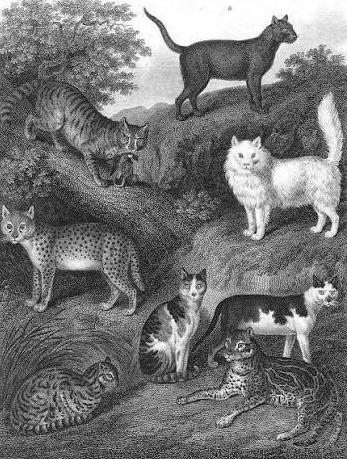
Following Napoleon’s exile to the island of Saint Helena, handbills began appearing in the UK with an irresistible proposition. The island, they claimed, had become overrun with rats. Salvation, naturally, lay in cats, and generous payment awaited anyone prepared to deliver a healthy mouser to the authorities. It was exactly the sort of story that seemed just plausible enough to silence doubt. After all, ships carried rats. Islands suffered infestations. Napoleon was still a figure of endless fascination. Why shouldn’t there be a market for cats? And so they came. People arrived at British ports with cats of every description, expecting honest payment for their patriotic contribution. Instead, they found no grateful officials, no official scheme and, presumably, a growing suspicion that they had been made the victims of a remarkably elaborate joke. Whether every detail unfolded exactly as later retellings suggest is difficult to establish. What is beyond dispute is that the tale spread rapidly and became one of Britain’s best-loved newspaper hoaxes. Modern historians regard it as an elaborate (and not very funny) practical joke rather than a forgotten government initiative. The episode offers a gentle reminder that misinformation did not begin with the internet. Long before viral posts and online scams, a cleverly worded notice, a convincing premise and a willingness to believe could send perfectly sensible people across town carrying a cat, all in the expectation that history required their assistance. The cats are the real victims here, of course. Still, I imagine UK ports were vermin-free for a while afterwards…
3d •
The House that Jack Built
Modern Ripperology has become a peculiar form of historical obesity. It no longer feeds on evidence; it gorges itself on speculation, coincidence and the sort of feverish pattern-seeking that would embarrass a conspiracy theorist. What began as an attempt to understand one of history's most notorious unsolved crimes has swollen into an industry that mistakes imagination for research and certainty for scholarship. Every few months another 'definitive' suspect staggers onto the stage, introduced with all the fanfare of a royal birth and roughly the same level of credibility. An artist. A doctor. A lawyer. A sailor. A member of the aristocracy. Someone whose second cousin once walked through Whitechapel on a Tuesday. The supporting evidence is invariably assembled backwards: decide upon the culprit first, then bully the facts into submission. Contradictions become mysteries, gaps become clues, and complete absences of evidence are hailed as the cleverest evidence of all. The result is less historical investigation than intellectual taxidermy. Dead facts are stuffed with fresh assumptions until they resemble something alive. Every new theory promises to end the debate forever, yet somehow only succeeds in spawning three more books, half a dozen podcasts and another battalion of enthusiasts convinced they've cracked a code that somehow escaped every police officer, journalist and historian for the last century and a half. Meanwhile, the women themselves disappear beneath the avalanche of nonsense. Their lives are eclipsed by an endless parade of increasingly exotic suspects, each promoted with evangelical certainty before quietly joining yesterday's discarded revelations. The mystery has become a marketplace, where ambiguity is bad for business and doubt is treated as professional failure. Perhaps the greatest triumph of modern Ripperology is not solving the murders. It is proving that an unsolved crime can be kept alive indefinitely simply by refusing to let the evidence have the last word.

4d •
It Came From the Skies…
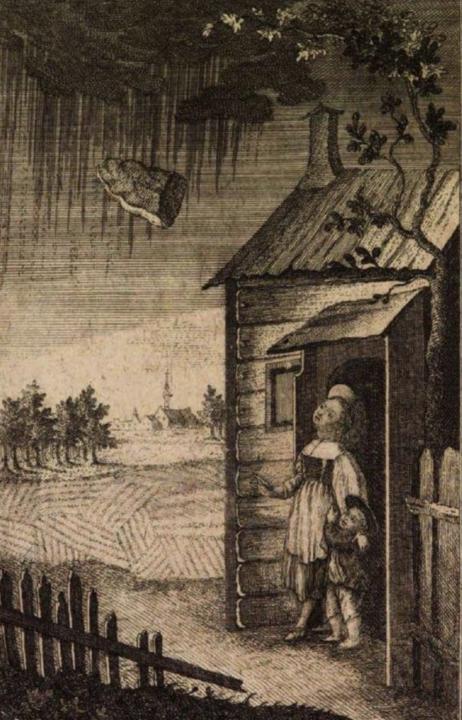
There are moments in history when the ordinary fabric of English life appears to split, if only for an instant, and something profoundly unsettling slips through. Such a moment came in December 1795, near the Yorkshire village of Wold Cottage. Without warning, a tremendous detonation shattered the winter quiet. Witnesses reported an explosion powerful enough to alarm the surrounding countryside before a great stone, descending from the heavens, buried itself deep in the earth and flung soil across the frozen fields. To modern eyes the event is remarkable enough. To those who stood beneath that December sky, it was almost beyond comprehension. The accepted wisdom of the age held that stones simply did not fall from the heavens. Learned opinion tended to dismiss such reports as superstition, misunderstanding or rustic invention. Yet here was a physical object, recovered from the ground it had violently entered, examined by credible observers and impossible to explain away. The impact left a substantial hole and scattered earth over a wide area, tangible evidence that something extraordinary had occurred. The stone itself became the focus of careful investigation rather than fearful legend. Its significance reached well beyond a single Yorkshire field. Cases like the Wold Cottage meteorite gradually persuaded natural philosophers that reports of rocks falling from the sky deserved serious attention. There is something quietly uncanny in that transformation. The terror of startled villagers gave way to sober enquiry, and a mystery once dismissed as folklore became accepted fact. Sometimes the most unsettling stories are the ones that require no embellishment at all.
7d •
Little Shop of Horrors
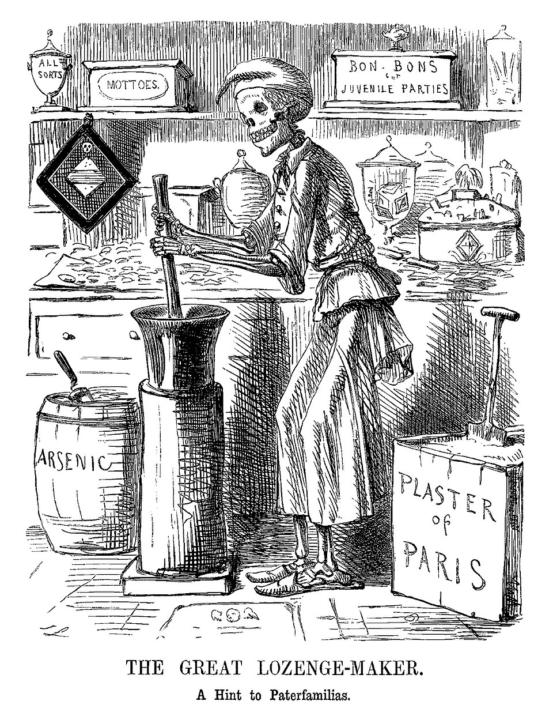
On the evening of the 30th of October 1858, nothing seemed particularly unusual about the little sweet shop in Bradford. Customers drifted in for humbugs and peppermint lozenges, children clutched pennies in gloved hands, and confectionery disappeared into paper bags exactly as it had the day before. Within hours, however, those same sweets had become the centre of one of Victorian Britain's most extraordinary public health disasters. People began falling ill across the city. First came violent sickness, then agonising stomach pains, convulsions and collapse. Families watched in disbelief as relatives who had appeared perfectly healthy only moments earlier deteriorated with alarming speed. Before the night was over, the death toll was rising, and no one seemed to understand why. The explanation, when it came, was almost as shocking as the tragedy itself. Victorian confectioners commonly mixed their sweets with daff—a cheap powdered form of gypsum used to bulk out sugar. When the supplier ran out, an assistant was mistakenly given arsenic trioxide, another fine white powder, from the premises of a local chemist. The resemblance was close enough, and the checks lax enough, that more than forty pounds of poisoned sweets were made and sold before anyone realised the error. Twenty-one people died. More than two hundred others became seriously ill. The Bradford sweets poisoning was not the work of a criminal mastermind, but of a chain of ordinary assumptions, inadequate safeguards and a system that placed remarkably few controls on either food production or the sale of dangerous substances. Public outrage was immense. The tragedy intensified calls for reform, strengthening campaigns against food adulteration and adding pressure for stricter regulation of poisons. Although change came gradually rather than overnight, the disaster became one of the defining episodes that helped shape Victorian food safety and consumer protection.
1-30 of 184
powered by
skool.com/the-black-archive-5417
Exploring Britain’s hidden history, dark mysteries, forgotten places, strange crimes, weird folklore, haunted locations and unexplained events.
Suggested communities
Powered by