
Write something
Pinned

9h •
🧠⚡ Faster Decisions with AI: Turning Ambiguity Into Options in 10 Minutes
Most delays are not execution delays. They are decision delays. When a team is stuck, it is often because we cannot see the options clearly, we cannot agree on criteria, or we are afraid of choosing wrong. The result is time-to-decision stretching from days into weeks, and every downstream task waits. AI does not replace judgment, but it can compress the work required to reach judgment. It can produce options, criteria, risks, and a recommendation quickly enough that we stop delaying the first conversation. That is how we shrink cycle time. ------------- Why Decisions Drag ------------- Decisions drag when we try to be certain before we begin. We want the perfect answer, so we keep researching. Or we want consensus, so we keep socializing. Or we fear blame, so we avoid committing. But decisions rarely become easier with time. They become costlier. The longer we wait, the more dependencies pile up. The more dependencies pile up, the more expensive the decision becomes, and the harder it feels to make. This is how time-to-decision turns into a compounding tax. AI can break this by making the first pass cheap. We do not need to be right immediately. We need to be clear enough to evaluate. ------------- Insight 1: Options Create Motion ------------- A decision without options is not a decision, it is a wish. The first job is to externalize 2 to 3 viable paths. AI can generate these quickly. We can provide the context and ask: “Propose three options, each with pros, cons, cost, timeline, and risks.” Now the team has a starting point. Even if we reject all three, we have moved from zero to something discussable. Time outcome: reduced time-to-first-discussion and faster convergence. ------------- Insight 2: Criteria Turn Debates Into Evaluations ------------- Most decision meetings turn into debates because criteria are implicit. People argue from values they never named. AI can help us propose criteria. For example: speed, cost, risk, scalability, customer impact, and maintainability. Then we select what matters for this decision. Once criteria are explicit, the conversation becomes an evaluation, not an opinion contest.

Pinned

3d •
Nobody really cares...
Let me tell you something that might free you up a little. People don’t care about what you’re doing as much as you think they do. They’re not sitting around analyzing your moves. They’re not replaying your mistakes. They’re not judging you nearly as hard as you’re judging yourself. They’re thinking about their own lives. And yet so many of us hold back because we’re afraid of looking stupid. Afraid of failing publicly. Afraid it won’t go perfectly. But embarrassed in front of who? The real tragedy isn’t trying and falling short. The real tragedy is getting to the end of your life and realizing you played small. You had ideas and kept them safe. You had dreams and negotiated them down. You waited for the “right time” that never came. That’s the part that should scare you. You don’t get to run this life back. So if there’s something on your heart... a business to start, a move to make, a conversation to have... Do it. Not because it’s guaranteed to work. But because missing your shot is heavier than failing at it. What’s the bold move you’ve been overthinking?
Pinned
3d •
How to Switch from ChatGPT to Claude (Without Losing Anything!)
In this video, I show you how to quickly and easily switch from ChatGPT (or any other LLM provider) over to Claude without losing all those precious memories you've built up. Give it a watch if you're one of the many making the switch to Claude! Enjoy :)

1h •
What Happens When Sales Tracking Runs Itself?
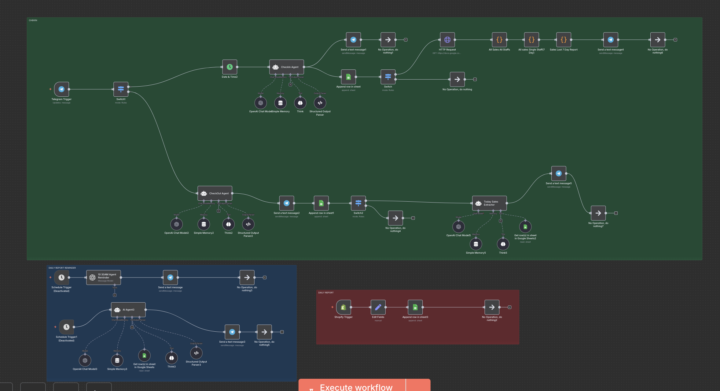
Ever noticed how much time businesses lose just tracking what already happened? Sales come in, someone exports data, another person updates a sheet, someone else prepares a report, and by the time the numbers are ready they are already outdated. I was looking at this workflow earlier and it’s a good example of how a few connected automations can remove most of that manual work. The flow captures events like new sales, processes the information, stores it in a sheet, and then automatically generates summaries and notifications. Instead of someone manually checking dashboards or compiling daily reports, the system simply pushes the information where it needs to go. What I find interesting is how this kind of setup isn’t limited to one type of company. Ecommerce stores could use something similar to track daily revenue. Agencies could automate client performance updates. Consultants or SaaS teams could automatically summarize activity and send internal reports without touching spreadsheets. The biggest lesson I keep seeing with automation is that the real value often comes from small things. Automating a simple reporting process or notification can easily save hours every week and also remove the risk of human error. Curious to hear from others here. What is the most repetitive task in your business that you wish could just run automatically in the background? 🤔

🔥
18h •
Intro Suggestion
Hi Admins @AI Advantage Team @Dean Graziosi @Tony Robbins and Dean Graziosi @Igor Pogany Just a suggestion to make things much more organized here. Maybe it would be better to have a single thread where all the newcomers will post their introductions. On other groups that im also active in, this is the standard procedure instead of each individual doing a separate post. Basically when they join, they should be redirected to that thread and do their introductions there instead of starting a new post themselves. One introduction comment in that thread then people can just reply to welcome that person. No need to do a new post everytime. That way the feed will be more organized for AI related topics instead of juggling between intro posts and news and other info posts.
1-30 of 11,752

skool.com/the-ai-advantage
Founded by Tony Robbins, Dean Graziosi & Igor Pogany - AI Advantage is your go-to hub to simplify AI and confidently unlock real & repeatable results
Leaderboard (30-day)
1

+163
2

+157
3
🔥
+146
4

+133
5

+126
Powered by