

6h •
LIVE SESSION: Pass the CSCS Exam in 2026
Hey everyone we're going live at 2:30 pm PST today. Topics covered: 1. How to pass the CSCS exam this year 2. Live CSCS question breakdowns Typically, live sessions are only open to paid members, but today's live session will be open to ALL members. I hope to see you there!
21d •
Biomechanics Concepts: Mechanical Advantage
Definition: Mechanical advantage describes how effectively a muscle or external load can produce torque around a joint, based largely on moment arm length. In resistance training: - When a muscle’s internal moment arm is large relative to the external moment arm, the muscle has a mechanical advantage and can produce force more efficiently. - When the external moment arm is large, the muscle is at a mechanical disadvantage and must produce more force to move the load. Example: At the bottom of a squat, changes in hip and knee moment arms can shift mechanical advantage between the glutes, quadriceps, and spinal extensors, influencing which muscles are stressed most. Why This Matters for Coaches - Explains why exercises feel harder at certain joint angles - Guides exercise selection and modification - Helps manage joint stress and tissue loading - Clarifies how changes in stance, grip, or range of motion alter difficulty without changing load So when you change body position or setup, you’re changing mechanical advantage and how much force the muscle must generate. This—along with individual anthropometric variation—is one reason why certain variations of a lift are harder or easier for various athletes. Question: What are some exercise variations or setups you use to alter mechanical advantage for yourself or your athletes?
13d •
CSCS Accelerator Cohort #3 Dates Announced
Course opens: 2/20/26 at 11:59 pm First Live Session: 2/23/26 at 8:30 am Weekly Schedule: Mondays, 8:30-9:30 am - Rotating CSCS Topic Lectures Fridays at 2:30-4:00 pm - Live Q&A Let me know if you have questions about the course in the discussion!
21d •
Biomechanics Conceps: Moment Arm
Moment Arm In the context of strength and conditioning, a moment arm explains why an exercise feels harder or easier at certain joint angles, because it determines how much torque the muscle must produce to move or control a load. It is tightly related to concepts of lever classes and, in part, helps to determine the sticking point of an exercise. Definition: The moment arm is the perpendicular distance between a force’s line of action and the axis of rotation at a joint. In resistance training: - It determines how much torque (rotational force) is produced at a joint. - A longer moment arm = more torque required from the muscle. - A shorter moment arm = less torque required. Example: During a biceps curl, the moment arm of the external load is greatest when the forearm is around 90° of elbow flexion, which is why the lift feels hardest there. Lock this concept in with your own training. When an exercise feels harder at certain joint angles or through a specific ROM, it’s likely because the moment arm is larger and the muscle has to produce more force. Question: Have you ever tried or prescribed targeted isometric or partial ROM work at the sticking point of a lift? For example, pause squats, pause at the knee deadlifts or cleans, spoto press, etc.?
22d •
New Detailed Content Outline (DCO)
Back in the summer of 2025, the CSCS exam got a major update. This may be old news to some of you but I thought I'd share it because it isn’t just a minor tweak. It’s a shift in what the NSCA believes entry-level competence actually looks like. The exam is now less about memorization and more about application.Fewer trivia questions. More “what would you do with this athlete, in this context?” This is GREAT for coaches with an exercise science background and plenty of in the trenches experience. It's difficult for the textbook jockeys who want the letters without the sweat, or the coaches without a formal exercise science background. Some big themes I’m seeing in the new DCO: - Nutrition questions dropped, but the remaining ones are more applied and performance-focused - Exercise technique matters, but program design and decision-making matter more - Coaches are expected to explain why they do things, not just spot bad lifts - Research literacy is now a real requirement - Mental health and athlete well-being are being addressed - Data collection is secondary to data implementation The bottom line is that the exam is moving away from “can you recall this?” and toward “can you actually coach?” Curious how others see it—does this better reflect the real job of a strength coach, or does it raise the bar too high for entry-level candidates? Here is a link to the CSCS handbook in case you want to read the DCO for yourself.
Poll
5 members have voted
1-7 of 7
skool.com/cscs-accelerator-community
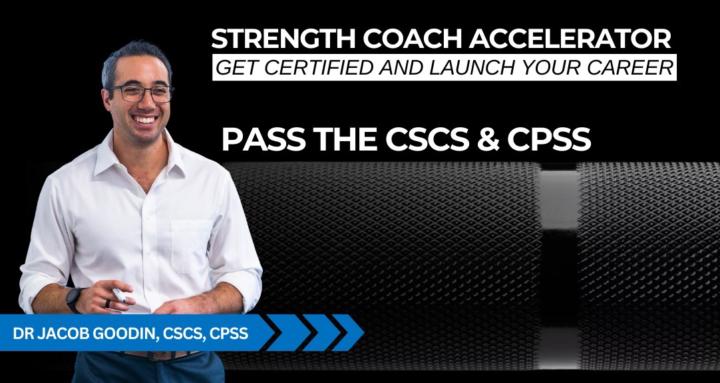
Pass the CSCS & CPSS and launch your strength and conditioning career. Study smarter and get certified with expert mentorship, quizzes, and lectures.
Leaderboard (30-day)
1

+12
2

+10
3

+6
4

+6
5
+4
Powered by