
Write something

May 11 •
☀️ Elevating Summer Training Together
Summer is the best time to transform your game, but the secret isn't just working harder, as @Stephen Coxon has often shared, it’s about working smarter. Opening the floor for our community to share what truly helps players move from busy training and random runs to target-driven results. - Players: What specific skill or habit actually made you feel ready to perform so you can be recruited? - Parents: What was the best investment you made in your player’s training that got them noticed? - Coaches: What is the one attribute a player brings to the field that makes you think this player is ready to play at the next level? For all of your responses, I will respond with tips, tricks, hacks, and anything else to help you get to where you want to be! 🚩 THE ACTION ITEM Share your lightbulb moment in the comments. I would love for everyone to learn from these experiences and maximize their training to increase their recruiting ROI. 👇
1
0


Mar 29 •
We’ve known how to stop ACL tears for 20 years, so why is the rate for girls still 8x higher than boys?
The NYT dropped a massive deep dive on the 'ACL Epidemic.' Here are the 3 things every parent in this group needs to know about , fatigue, hormones, and the 'FIFA 11+' program..." Summarized "Why Are So Many Teen Girls Still Tearing Their A.C.L.s?" by Craig Welch (published Feb 26, 2026), is a deep dive into what is being called a "public health crisis" in youth sports.| The "Why" Behind the Crisis: Key Findings 1. The "Still" Problem Researchers have known about this disparity since the 1990s, yet the injury rates for girls have not improved in over 20 years. In fact, in sports like soccer, girls are 2 to 8 times more likely to tear an ACL than boys.| 2. The Devastating "Double" - The Year-Long Gap: For a high school athlete, an ACL tear isn't just a physical injury; it's a social and emotional "erasure" from their community for 9–12 months. - The Re-Injury Trap: Girls have up to a 1 in 3 chance of tearing an ACL a second time within a year of returning to their sport. 3. It’s Not Just Anatomy (The Social Gap) The article moves past the old "wide hips" theory and looks at how we raise athletes: - The Strength Deficit: Boys are often encouraged to lift weights and build muscle early on. Girls are frequently trained "as if they are boys" but without the foundational strength training that protects the joints. - Movement Literacy: Modern kids are more sedentary than previous generations. They lack the "movement literacy" (jumping, landing, and falling correctly) that used to be developed through free play. 4. The Biomechanical Differences - Quad Dominance: Females tend to be "quad dominant," meaning their hamstrings aren't strong enough to counterbalance the pull on the knee during a hard plant. - Valgus Collapse: Girls are more likely to land with their knees caving inward—a high-risk position for a non-contact tear. 5. The Hormonal Factor The article highlights emerging research on the menstrual cycle. Fluctuations in estrogen and progesterone (particularly in the pre-ovulatory phase) can increase ligament laxity and decrease neuromuscular reaction time.
Feb 8 •
Why the Best Athletes Don’t Always Get the Most Attention
(But High School and College Coaches Always Notice Them) By Coach Dave There’s something I see every year in youth sports and it’s something I also hear about directly from high school and college coaches across the country. Some athletes are loud with their effort.Some are emotional.Some need constant reminders, motivation, or correction. And then there are the athletes who quietly show up every day, do their job, and compete the right way. Ironically, those athletes often get less attention early on. Not because they aren’t good, but because they’re reliable. When an athlete brings consistent effort, a steady attitude, and handles adversity without drama, coaches don’t worry about them. They don’t have to manage them. They don’t have to guess who is going to show up. And that’s exactly what coaches value most. What Coaches Actually Look For Through my conversations with coaches at every level, one message comes up over and over: “We want athletes we can trust.” College coaches aren’t just recruiting talent.They’re recruiting predictability. They ask questions like: - Will this athlete show up the same way every day? - How do they respond when they’re not playing well? - How do they handle coaching? - Do they stay composed when things don’t go their way? Talent gets you noticed.Consistency gets you playing time and recruited. The Difference Between Inconsistent and Game-Ready Athletes Most young athletes aren’t inconsistent because they don’t care.They’re inconsistent because they haven’t trained the mental side of their game yet. One day they’re locked in.The next day they’re frustrated. One game they respond well to mistakes.The next game they spiral. Coaches see this immediately. A game-ready athlete isn’t perfect.They’re dependable. - Their effort doesn’t swing with emotion - Their body language doesn’t collapse - Their response to adversity is steady That’s not personality. That’s mental performance training. Why “Boring” Is Actually a Compliment in Recruiting
Jan 27 •
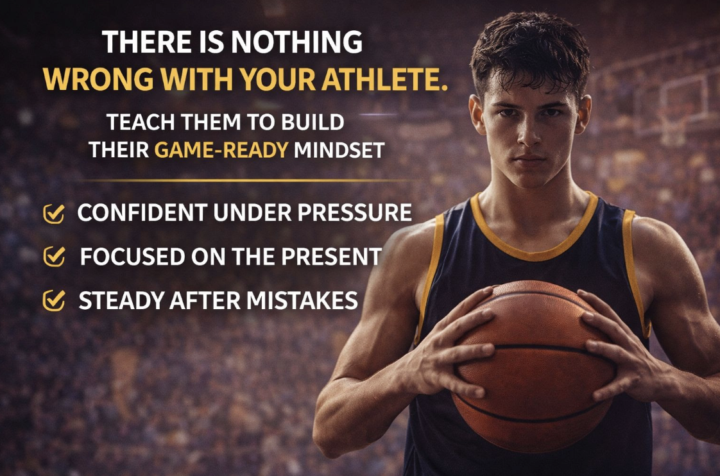
There’s Nothing Wrong with Your Athlete — They Just Haven’t Been Taught This Yet
By Coach Dave As a parent, you’ve probably heard your child say something like: - “I don’t know why I get so nervous.” - “I mess things up when it matters.” - “Other kids don’t struggle like I do.” And quietly, many young athletes start to believe something is wrong with them. This is one of the biggest misunderstandings in youth sports today. Mental performance challenges are not a flaw.They are not a weakness.And they do not mean your child is broken. In fact, they mean your child is human. Why Young Athletes Think Something Is Wrong Most young athletes are taught how to train their bodies: - Strength - Speed - Skill - Conditioning But very few are taught how to train their mind. So when emotions show up—nerves, frustration, fear, self-doubt—athletes assume they’re doing something wrong. They believe confidence should just appear. That toughness means never feeling stress. That elite athletes don’t struggle mentally. None of that is true. The problem isn’t that your athlete feels pressure.The problem is that no one has taught them what to do with it. Why Elite Athletes Train Their Mind Mental performance training exists because pressure never goes away—it increases. That’s why professional athletes and teams openly invest in mental performance coaches: - NBA teams employ full-time mental performance staff - NFL quarterbacks work with sports psychologists on focus and emotional control - Olympic athletes train visualization, breathwork, and mental routines as seriously as physical ones - MLB hitters work on failure management because they fail more than they succeed Elite athletes don’t train mentally because they’re weak. They train mentally because the margins are thin. At the highest level, everyone is skilled.The difference is who stays composed, confident, and present when things get hard. Mental Toughness Is Not What Most People Think Many parents grew up believing mental toughness meant: - “Push through it” - “Don’t think about it” - “Just be confident” - “Shake it off”
Jan 12 •
Winter Training as an Athlete
The winter off-season is where college roster spots are earned ❄️⚽️, but only if you are training correctly. Too many players spend these months on machines designed for aesthetics rather than athletic performance. It can be enticing to chase those abs or bigger quads, but I would argue that doesn't get you where you want to go 🤔. To prepare for the spring, prioritize strength training that offers a high return on investment for the pitch 📈: • 🔄 Swap the Leg Extension for Squats and Deadlifts to build power that translates directly to the game. • 🔄 Swap the Leg Press for Bulgarian Split Squats to produce force one leg at a time, mimicking the demands of running, shooting, and cutting. HUGE MASTER TIP • Decide on your reps guided by your weak leg. If your left isn't as strong, start the sets with that leg. If you can do 8 with the left and 12 with the right, don't force the left into 12. Instead, bring the right to 8 until they are balanced and equal. Remember, your goal is to be an explosive athlete on the field, not just the strongest person in the gym. Train for the game, not the mirror 🏆🪞. Best of luck, and let me know your thoughts! 👋
1-18 of 18
powered by

skool.com/steve-coxon-soccer-network-4997
Navigate the college soccer recruiting journey: Build a clear plan, generate coach interest in 6 months, and avoid costly mistakes.
Suggested communities
Powered by