
Write something
7d •
The Body as Landscape / El cuerpo como paisaje.
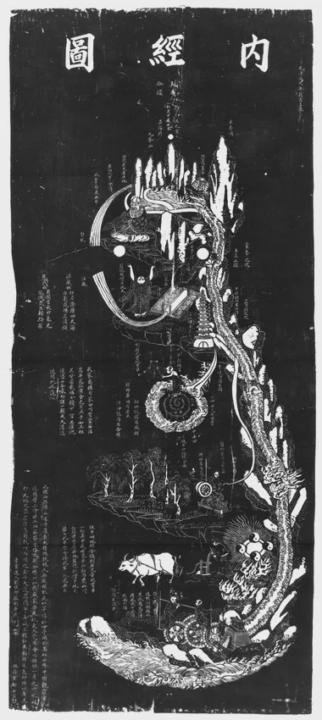
Imagine for a moment that you belong to a culture where touching a lifeless body is the worst of profanations. There are no dissections or anatomical explorations. Opening a corpse to study its organs is unthinkable. However, disease exists, and you need to teach medicine; you must pass on how the human body works to the next generations. How do you solve that problem? In ancient China, the answer was to turn the body into the entire universe. Confucian thought made it clear: the body—every inch of skin, every hair, every nail—was a sacred inheritance from the ancestors. Mutilating it, even after death, was considered a grievous moral offense. Unable to look beneath the skin, physicians and sages had to imagine and represent the interior in a completely different way. That necessity gave rise to one of the most extraordinary works in the history of medicine: the Neijing Tu (內經圖), or "Diagram of the Internal Landscape." This 1886 engraving, which the Taoist tradition perfected over centuries, completely dispenses with muscles, bones, or nerve networks. Instead, it presents the interior of the human torso as a living, mountainous landscape. In this anatomical map, the spine rises like a steep mountain range, and the head becomes the mythical Mount Kunlun. The brain is not gray matter, but a celestial palace inhabited by gods. Further down, the stomach is represented by a peasant tirelessly plowing his field, the lungs are lush forests of white trees, and the urinary tracts flow like mighty rivers seeking the sea. Behind this apparent fantasy lies a flawless philosophical message: the human being is not a machine made of isolated parts, but a microcosm that reflects the vast geography of the natural world. What happens inside us is a mirror of nature. The flow of energy through the meridians obeys the same universal laws that govern the water of rivers or the wind between the mountains. It is easy to make the mistake of seeing this diagram as something primitive or anatomically "incorrect." But it is not. It was a sophisticated and coherent answer to the great question of what we are and how we function.
1
0
1-1 of 1
skool.com/representar-la-anatomia
A multidisciplinary community dedicated to exploring anatomy, art, technology, and aesthetics. illuminating the dark architecture of the flesh.
Powered by