
Write something

11h •
open router models
does the choice of models update on their own or do you have to physically go in an add them to the list? There is a model named Owl Alpha that is free on Openrouter.Ai. can that be added?

6d •
wordcrafter pro
I was in wcp, when I hit a key and it took me to wordcrafter pro portal, um what did I do? It doesn't accept my login for wcp, is there a separate one ... if this part of wcp?
12d •
PWS
Newyby here. going into the program and was reading about the binder. I have all that physically in office, and some hand written some digital for the first book of each series. Before I start the 2nd book, do I need to put the first book in as if were an going through this or start with 2nd book? It's a lot of work because I write scifi/romance ... each has it own world and even universe. Or can I copy it and the AI will post for me from the documents?

🔥
Apr 7 •
Unlimited Genre Packs.
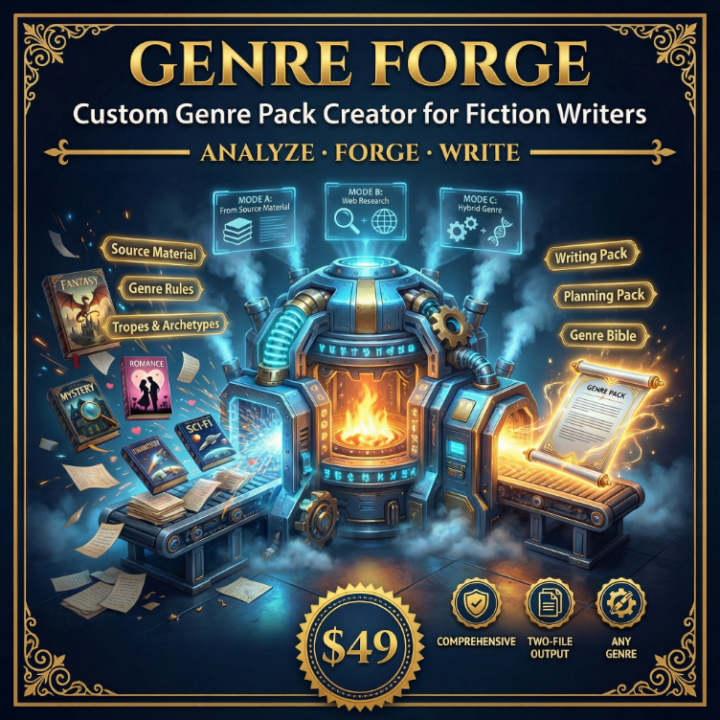
So its really hard for me to stay focused on getting things posted when I see something interesting that sparks a new idea. I promise I will start getting all of the parts of the PWS posted for use. Today I was looking at the genre-packs. Currently there are 33 Genres listed below along with the Specialist Persona's you can talk with. You can combine genre's which is why these are fairly generic. I've tested a few, and mixed a few with some pretty interesting results, but what if you had a tool that could create your own specific niche genre to add in or share with the class? So today I added the Genre-Forge.skill! It began as an easier way to update the 33 skills below from version 7 to version 9 as much has changed in the PWS in that time and it evolved into its own Animal. It has 3 modes: Mode A — New genre from source material You have a how-to-write guide, sample novels, PDFs, or URLs for a specific genre. I'll extract from your material and supplement with web research. Mode B — New genre, no source material You name the genre and I build entirely from web research. Solid output, but a Mode A re-run with good source material will always produce a stronger pack. Mode C — Hybrid or invented genre You provide mixed source materials from different genres, or describe a mashup you've invented. I'll identify the synthesized genre's DNA, propose a name for it, and build the pack. This creates such a detailed environment form the genre that I had to split it up into pieces to keep context down. The Story Development Room gets the biggest piece for creating your world and environment. The Character Creator now gets genre archetypes to work from when creating characters or create your own truly unique individuals, and the writes room gets a part to keep them in the right mindset for your genre. This requires updates across the board. Those of you who are with me and stick with me will see all this before we really open up and go live. Please comment and throw suggestions in. I'm going to concentrate on getting the actual skills up and rolling and then I will update all of the packs below and start adding more from my research and your suggestions.
🔥
Apr 6 •
You’re Not Running Out of Claude. You’re Just Burning It Wrong.
This is today's substack post. Still tryign to figure out how to link everything up: A writer’s guide to getting more out of every session I used to think Claude was broken. Somewhere around message twenty-five, it would start getting weird. Shorter answers. Stranger suggestions. I’d be mid-scene, building real momentum, and suddenly my AI writing partner had the attention span of a golden retriever at a squirrel convention. A very expensive, very confused golden retriever. I blamed the tool. Classic mistake — right up there with blaming the pan when you burn the toast. Then I actually looked at what was happening under the hood. Every message you send, Claude re-reads the entire conversation from the top. Message one costs one unit of processing. Message ten costs fifty-five. Message thirty? Nine hundred and sixty-one. The cost doesn’t climb in a straight line — it compounds like a credit card you forgot existed. By the time you’re deep in a session, ninety-eight percent of your token budget is spent re-reading old context. Your actual question gets one and a half percent of the available brain. No wonder it starts writing your villain like a slightly confused golden retriever. Here’s the thing nobody tells you when you first start using AI for your writing: long conversations are expensive. Not just in the “you’ll hit a limit” sense, but in the “you’re getting progressively worse output” sense. You’re not unlocking some hidden depth by going deeper into a single chat. You’re usually making it worse — like stirring a bowl of soup until it’s just warm beige sadness. So. What do you actually do about it? 1. Start fresh more often than feels right. Writers hate this because it feels like losing progress. You’re not losing anything. Copy Claude’s last output — the scene it drafted, the outline it built, the character notes — and paste it as the opening context of a new chat. “Here’s where we left off. Now let’s do the next scene.” You carry the work forward without dragging the entire conversation history behind you like a suitcase full of every draft you’ve ever written. 2. Front-load everything that matters. Before you write a single creative prompt, drop in your story context: genre, tone, protagonist, where you are in the story, what you need this session to accomplish. One block, upfront. Then ask your question. Claude doesn’t need to be reminded ten messages in who your main character is if you told it clearly at the start. It’s not goldfish-brained. It’s just expensive. 3. Be specific about what you want back. “Write the next scene” is an open invitation for Claude to go wherever its circuits feel like going. “Write a 600-word scene where Mara confronts her sister in the kitchen, present tense, third person limited, ending on unresolved tension” gives it a target. Specific prompts get specific results. One attempt instead of three — which is also how you get better scenes and preserve your sanity simultaneously. 4. Phase your work across sessions. Don’t try to do research, outlining, character development, and drafting in one marathon chat. That’s how you end up with a conversation eating its own tail while you stare at your screen questioning your life choices. Research session. Outline session. Draft session. Each one short, purposeful, and cheap. The handoff is just copying the output from one phase into the opening of the next. 5. Save the heavy lifting for when you’re sharp. Your Claude budget and your own brain work exactly the same way. Complex creative work — building a plot structure, working through a character’s arc, drafting a difficult scene — costs more than simple tasks like reformatting your notes or generating a chapter summary. Do the hard stuff first. Push the light maintenance work to later in the day when you’re running on fumes and your best creative decision is choosing which snack to eat.
1-12 of 12
skool.com/pws-community-for-writers-8447
The Home for AI-Powered Authors. Master story,prose, and marketing with expert AI personas to finish and sell your book fast. Never write alone again
Leaderboard (30-day)
1

🔥
+431
2

🔥
+379
3

+325
4

+282
5

🔥
+254
Powered by