
Write something

11h •
Ovagen: The Ovarian Bioregulator Reshaping Female Hormonal Longevity Research
❇️ Of all the biological clocks that tick in the female body, the ovarian clock is arguably the most influential. Ovarian function doesn't just govern fertility — it underpins hormonal balance, metabolic health, bone density, cardiovascular protection, cognitive function, and mood across a woman's entire lifespan. Ovagen is a peptide bioregulator from the Khavinson series designed specifically to target ovarian tissue at the gene expression level, and its research profile is one of the more compelling stories in female longevity science. ❇️ What Is Ovagen? Ovagen is a short-chain peptide bioregulator developed at the St. Petersburg Institute of Bioregulation and Gerontology, targeting the granulosa and theca cells of the ovarian follicle — the two primary cell populations responsible for estrogen and progesterone synthesis. As part of the same organ-specific Khavinson series as Cardiogen, Cortagen, and Livagen, it was developed on the principle that aging tissue can be nudged back toward healthier function by modulating gene expression at the chromatin level. What makes Ovagen's target uniquely significant is the timeline of ovarian aging. Unlike most organs that decline gradually over decades, the ovaries begin losing functional reserve in a woman's late 20s and decline measurably through the 30s — long before the hormonal shifts of perimenopause become clinically apparent. By the time symptoms emerge, follicular reserve has often been declining for 15–20 years. Ovagen's research interest lies in whether early, sustained gene-level support can meaningfully slow that trajectory. 🔬 Key Research Findings Research in aging female animal models and investigational settings has produced notable findings across several dimensions of ovarian and hormonal health: • Preserved follicular reserve: Studies in aging female rodents showed that ovarian peptide bioregulator treatment helped maintain primordial follicle pools — the non-renewable reserve of immature follicles that determines reproductive lifespan. Slowing depletion of this reserve is one of the most meaningful outcomes in ovarian aging research.
1
0
4d •
Bioregulators
In case you are curious about Bioregualtors (and the systems they affect) here is a list: 1. Bronchogen - Lung 2. Cardiogen - Cardiovascular 3. Cortagen - Brain 4. Livagen - Liver 5. Pancragen - Pancreas 6. Prostamax - Prostate 7. Cartalax - Joints and Ligaments 8. Chonluten - Respiratory 9. Crystagen - Telomere support 10. Ovagen - Hormones 11. Vesugen - Endocrine 12. Thymagen - Immune support 13. Vesilute 14. Testoluten 15. Visoluten You can type the name of the Bioregulator you're curious about in the search bar and a full article will come up! (If one isn't available it's coming but I'm pretty sure most of them are done)

9d •
We reached 100 members ❤️ PRC Giveaway Alert! 🚨 DREAM STACK!
We welcomed or 100th member and we are so STOKED to see our community grow ☀️ to celebrate we are giving away a Dream Stack. 📣 One lucky winner will get their Peptide Resource Center Dream Stack! ❇️ Rules: 1. Must be 21 (sorry kiddos...) 2. Must be a US resident (bc shipping y'all) 3. Must be a PRC Skool member (if you are reading this, you are) ❇️ How to enter: 1. Comment below your DREAM STACK, if you win that's what you could get!!! 🔸 Limited to items in stock at PeptideResourceCenter.com website BUT we might be able to accommodate hard to find items... 🔸 Only one vial per research peptide in the stack. 🔸 Up to a $500.00 value. 📣 The giveaway: ➡ We will use an app to pick a randon name from the entries received. ➡ Winner will be announced on: July 15, 2026. ➡ Winner will receive their Dream Stack by mail after winner is announced.

2d •
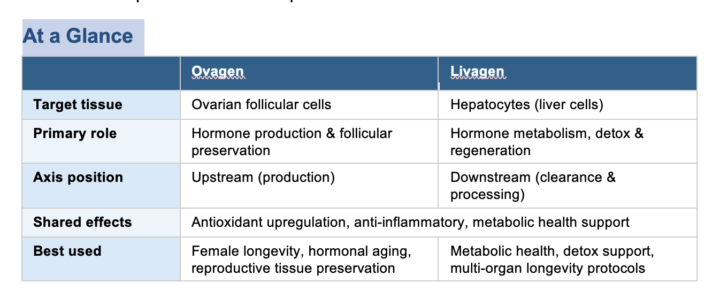
Ovagen vs. Livagen: Two Bioregulators, One Hormonal Axis
❇️ At first glance, a comparison between a reproductive bioregulator and a liver bioregulator might seem like an odd pairing. But Ovagen and Livagen are more interconnected than they appear — they operate on opposite ends of the same hormonal axis, they share overlapping research interests in metabolic health and aging, and together they make a stronger case than either does alone. Here's how they stack up, where they diverge, and why researchers are increasingly looking at both. ❇️ Ovagen: The Ovarian Bioregulator Ovagen is a short-chain peptide bioregulator from the Khavinson series targeting ovarian tissue — specifically the granulosa and theca cells of the ovarian follicle responsible for estrogen and progesterone synthesis. As the ovaries are among the first organs to show significant age-related functional decline (often beginning in the late 30s and accelerating through perimenopause), Ovagen's research profile focuses on preserving hormonal output, follicular health, and the broader neuroendocrine balance that depends on ovarian function. Like all Khavinson bioregulators, Ovagen is thought to work at the gene expression level — modulating transcription in ovarian cells toward more youthful, functional signaling patterns rather than directly supplying hormones. 🔬 Key Research Findings — Ovagen • Preserved follicular activity in aging models: Studies in aging female rodents showed that ovarian peptide bioregulator treatment helped maintain follicular reserve and delay the depletion of primordial follicles — directly relevant to ovarian reserve research. • Estrogen and progesterone normalization: Research demonstrated more stable hormonal output patterns in treated aging subjects, with reduced amplitude of the hormonal fluctuations characteristic of perimenopause-equivalent states in animal models. • Anti-inflammatory effects in ovarian tissue: Chronic low-grade inflammation accelerates follicular atresia and disrupts ovarian function. Ovagen treatment has been associated with reduced inflammatory cytokine expression specifically within ovarian tissue.
1
0
Dec '25 •
The Fountain of Youth Stack
1. First thing to do is make sure you get bloodwork and get your hormones dialed in, BHRT (Bioidentical hormone replacement therapy) is crucial for both men (testosterone) and women (estrogen, progesterone, testosterone). Having a solid hormonal foundation is a great starting point so that your body gets the most benefits from all the extra goodness you're bringing in. If you've never been on peptides: 1. Run a course of FOXO4 DRI - this cleans up senolytic (aging) cells and resets the system 2. Run a course of SS31 to heal cells at the mitochondria level to optimize energy and cellular health. If you need to lose weight: 1. Tirzepatide or reta once a week Along with: Morning: - Tesamorelin 5 days a week (GH for targeted fat loss around mid-section) - NAD+. 3 times a week (energy and cell regeneration) - Glutathione 5 days a week (detoxification and liver health) - KPV daily (anti-inflammatory) - GHK-Cu 5 days a week (Skin health and anti-inflammatory, should take Zinc Carnosine with it) - Vitamin C 3 days a week (anti-aging and cellular DNA repair) - Thioctic Acid 3 days a week (Anti-aging, collagen production) - MOTS C (optional for energy) - BPC157/TB500 (optional for healing injuries/inflammation) Evening: - Epitalon (cycle 2-3 times a year, for cellular health) - CJC1295/Ipamorelin (for metabolic optimization and sleep) - DSIP (for sleep) - Laennec (optional, human placenta for liver function improvement and skin rejuvenation) 3 days a week as needed
1-30 of 333
powered by

skool.com/peptide-resource-center-3431
We are here for you because we've been there. Get support, education, resources and more!!!
Suggested communities
Powered by