
9d • General discussion
Why the Advice You’ve Been Following About Motivation and Discipline Might Be Keeping You Stuck
Why is it that so many people understand what they “should” do… yet still feel stuck?
Most people assume they lack discipline or motivation. But when you look more closely at how the mind actually works, a very different picture starts to appear.
Many of the strategies people use to change their behavior are built on misunderstandings about control, motivation, and the way the brain handles conflict.
And ironically, these misunderstandings often make change harder instead of easier.
The first big misunderstanding is about outcomes.
Most people set goals in terms of outcomes. They say things like “I’m going to stay sober for a year,” “I’m going to be consistent,” “I’m going to become confident,” or “I’m going to get a girlfriend.”
But there’s a problem here: outcomes are not actions.
Your brain cannot execute an outcome. It can only execute a step in the present moment.
(Dr K has an amazing interview with Mel Robbins on this topic which blew my mind)
When someone says “I will stay sober for a year,” the mind is trying to control something that exists entirely in the future. It creates pressure, because now every moment becomes a test of whether you are succeeding or failing at the outcome.
But the brain doesn’t operate in the future. It operates in the next action.
The only thing you can ever actually do is the next step.
You can take a breath.
You can send a message.
You can say hello.
You can decide not to smoke right now.
This is really really key
When people shift their attention from outcomes to actions, something interesting happens. The weight of the future disappears. The mind becomes lighter because it is no longer trying to manage something it cannot control.
Another misunderstanding involves motivation.
Most people think motivation is a feeling. They imagine motivation as excitement, drive, or emotional energy.
But motivation in cognitive science looks much simpler than that.
Motivation is largely the ability to hold one thought in mind long enough for action to happen.
If the mind can stay with a single intention... “write for ten minutes,” “walk over and say hi,”
“do one pushup”.... then the body naturally follows.
The problem most people face is not lack of energy. It’s the constant switching of thoughts.
One moment they are thinking about taking action.
The next moment they are thinking about rejection.
Then they start imagining failure.
Then they wonder what people will think.
Every time the mind switches like this, the action gets interrupted.
The task itself is usually simple. The mental switching is what makes it feel overwhelming.
Another key piece people miss is the role of internal conflict.
Inside the brain there are systems that monitor when two impulses are competing with each other. One part of you might want to act while another part wants to avoid risk.
For example, you might think:
“I should go talk to her.”
And at the same time:
“What if she rejects me?”
These two impulses fire simultaneously, and the brain begins trying to resolve the contradiction.
This process consumes a surprising amount of energy.
People often feel exhausted before they’ve done anything. They assume the task itself is draining. But the exhaustion actually comes from the internal argument.
The mind is stuck in a tug-of-war.
And the longer the conflict continues, the heavier everything feels.
This is why you will maybe feel tired after work. This internal conflict.
This is one of the reasons meditation can be so powerful.
Meditation trains you to step back and notice the conflict instead of immediately reacting to it. You begin to see the two sides clearly.. the part that wants to act and the part that wants to avoid discomfort.
When you observe this conflict instead of being pulled into it, something interesting happens. The energy drain slows down.
You are no longer trapped inside the argument. You are simply aware that the argument exists.
And from that place of awareness, action becomes easier.
Another counterintuitive insight involves consistency.
Many people believe that success requires perfect consistency. They become obsessed with streaks and daily performance.
They say things like “I must do this every day” or “I can’t break the chain.”
At first this seems motivating. But over time it often creates a fragile system.
The moment someone misses a day, the mind reacts harshly.
“I broke the streak.”
“I failed.”
“What’s the point now?”
Instead of returning to the action the next day, the person abandons the behavior entirely.
Ironically, the people who stay consistent the longest are often the ones who are least obsessed with consistency.
They don’t treat each day like a pass-or-fail test. If they miss a day, they simply return to the action when they can.
Their focus is not on maintaining a perfect record. Their focus is on continuing the process.
There’s another subtle issue that interferes with action... attention.
Many people believe discipline is about forcing yourself to do something you don’t want to do.
But often the real problem is not lack of discipline. It’s misplaced attention.
When your attention is on the process itself, action feels manageable. When your attention shifts to what the outcome means about you, everything becomes heavy.
Think about approaching someone you find attractive a girl you see at the coffee shop, something we all talk about a lot here.
If your attention is on the simple act of saying hello, the step is small. But if your attention jumps to questions like “Will she like me?” or “What does this say about my confidence?” the moment suddenly carries enormous psychological weight.
The task hasn’t changed. Only the meaning attached to it has changed.
And meaning is powerful.
The brain does not operate purely on logic. It responds to what situations represent emotionally.
You might logically understand that approaching someone is harmless. But if your mind interprets that moment as a test of your worth or identity, the brain treats it as a high-stakes situation.
That’s when fear, hesitation, and avoidance begin to take over.
Finally, there is one insight that surprises many people: sometimes simply becoming aware of a pattern can begin to dissolve it.
Most people think they need to solve their problems through analysis and effort. But many behaviors persist because they are happening automatically and unconsciously.
When you clearly see the pattern while it is happening the procrastination loop, the internal conflict, the self-criticism... the system begins to change.
Awareness interrupts the automatic cycle.
You stop reacting in the same way because you are no longer asleep inside the pattern.
This doesn’t mean change happens instantly. But it creates space. And in that space, new choices become possible.
So if you feel stuck, it might not be because you lack motivation or discipline.
It might simply be that you’ve been trying to control outcomes instead of actions.
You’ve been switching thoughts too quickly to sustain focus.
You’ve been draining energy through internal conflict.
You’ve been attaching too much meaning to each moment.
And you’ve been trying to force consistency instead of returning gently to the process.
When you start to see these patterns clearly, something shifts.
The future becomes less heavy.
The next step becomes smaller.
And action begins to feel possible again.
Hope that helps.
Joe
2
0 comments
Why the Advice You’ve Been Following About Motivation and Discipline Might Be Keeping You Stuck
powered by
skool.com/out-of-your-head-7076
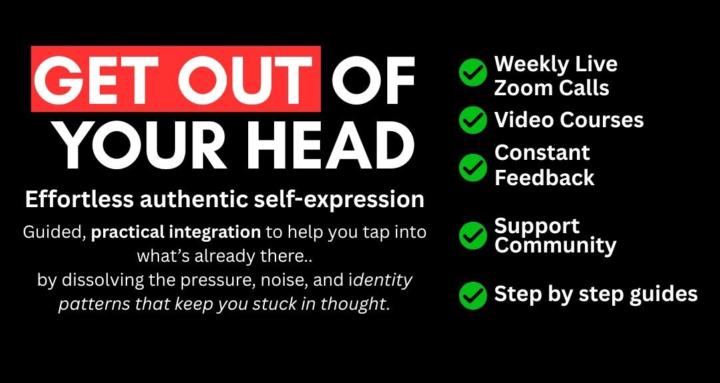
Learn how to tap into authentic self-expression, removing pressure, overthinking, and self-doubt, so confidence, clarity, and action can emerge easily
Suggested communities
Powered by