
Write something

2d •
GOOGL, META, AMZN, CMG: What the Volatility Surface Tells Me Before the Print
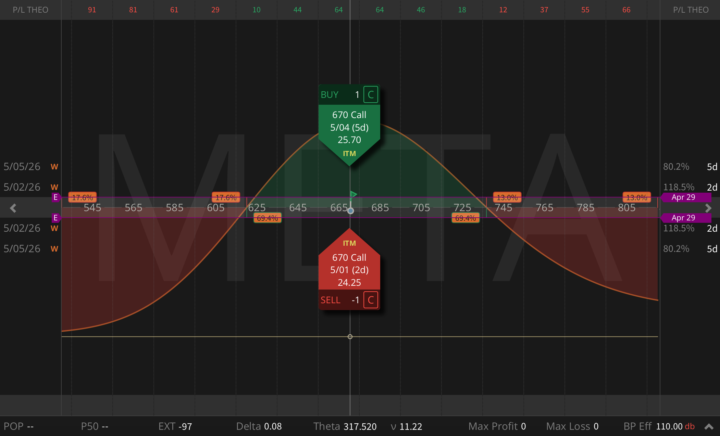
GOOGL, META, AMZN, CMG all print after the close. I've been running the numbers on this cluster for the past few days. The volatility picture is genuinely interesting because of where the mispricings are, and why they exist. Earnings are the most violent binary event in options trading. The volatility surface completely distorts. IV inflates on the front expiries, skew steepens, term structure flattens or inverts. The 3D surface looks nothing like a normal trading day. And after the print, all of that unwinds. Most traders try to guess the direction. That's the wrong game. My edge is in reading the 3D surface. So here's what I see tonight across these four names, and what I'm doing about it. 1. GOOGL Earnings Jade Lizard Sell 310 Put, Sell 350 Call, Buy 355 Call, net credit $610, Probability of Profit 84%. Let's start with the most important number in this entire cluster: GOOGL's six-quarter realized/implied ratio is 0.49. Average realized move 2.64%, average implied 5.36%. Realized exceeded implied exactly once out of six earnings. The options market is consistently paying double what the stock actually delivers. What makes this genuinely strange is that the fundamental picture is strong. Cloud growing 61% year-over-year. Search re-accelerating; the last print was a clean beat (EPS 2.82 vs 2.58), but stock ended essentially flat. The market priced a 5%+ move, got nothing. What's happening is that the AI capex narrative is functioning as a permanent fear tax on GOOGL's volatility surface. The story keeps options elevated. The stock keeps ignoring it. That wedge is the edge. Tonight's implied move is 4.67%; still rich versus a six-quarter realized average of 2.64%. My Earnings Jade Lizard fits the situation for a specific reason. The real risk in GOOGL tonight is actually to the upside. If the Street decides to finally bless the Cloud backlog and Gemini monetization story, you could see a genuine upside re-rating. The call spread eliminates that completely.
1
0
10d •
The most powerful way to capitalize on the upcoming correction: the Calendarized Ratio-Backratio Spread
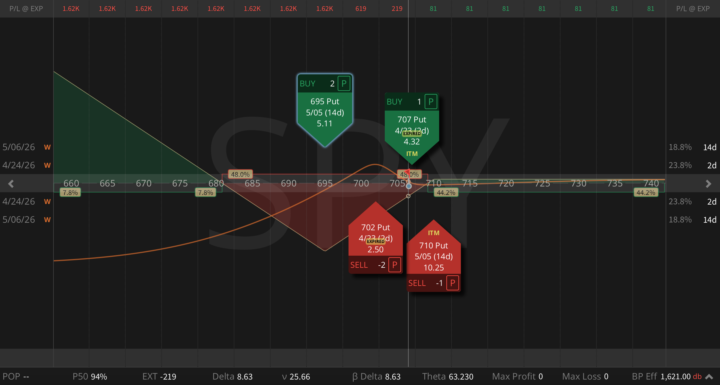
I waited for market close before posting this on purpose. This trade takes time to sit with, it's not something you copy during the session. It's a two-layer construction where each layer is useless alone and extremely powerful together. So I want you to read it slowly. 48 hours of escalation (US seized an Iranian tanker, Iran fired on vessels, Hormuz traffic hit again, a US naval force still blockading the Strait), equities dipped only 0.6%, oil spiked 5%. The "talks on" narrative via Pakistan is keeping the S&P near record territory even as Trump renews bombing threats. I can see the pattern: relief rally on peace-talk headlines, sharp but brief risk-off when a deadline slips or a tanker gets hit, and short-dated index volatility compresses between events. Crude still gaps 3-10% every time Hormuz makes the wire. That's the regime I built this trade for. Front leg: put ratio spread, 1 DTE - Long 1 x 707 Put @ 4.32 - Short 2 x 702 Put @ 2.50 - Net credit: $68, peak value at 702 is around $568. Back leg: put back-ratio, 14 DTE (the Trump hedge from my last post) - Short 1 x 710 Put @ 10.25 - Long 2 x 695 Put @ 5.11 - Net credit: $3, essentially free. Pays big below 680, loses in the valley around 695. On their own, neither leg is impressive. The front has unlimited downside below 696. The back has a nasty valley at 695. If you showed me either one alone, I would pass. But together, the math changes. The combined Greeks (initial): Delta: +8.63, Vega: +25.66, Theta: +63.23, P50: 94%, BP effect: $1,621 Positive theta AND positive vega at the same time - most theta-positive trades bleed on volatility expansion, and this one gains on it! The front ratio is short vega. The back backspread is more long vega than the front is short. Net long vol. The front is 1 DTE, so theta is concentrated and large. The back is 14 DTE and decays slowly. Net positive theta of about $63/day. Both Greeks line up in my favor. That is the trick: the shared wing.
20d •
How to Repair a Breached Strangle: My Ultimate Management Masterclass (Part 1)
If you sell short strangles long enough, breaches are inevitable. Every trader will face it, and that's not a flaw in the strategy. The question is what you do when it happens. A breached strangle creates four problems hitting you at the same time: - your delta is now too directional, - your gamma is rising, especially as expiration gets closer, - your buying power may start to get ugly, - and psychologically, you feel the urge to "do something". When a strangle gets breached, my question is not "how do I save this trade?", but "what's the best structure for the market I have in front of me right now?". That's a completely different mindset. Old strikes are not your children. You don't need to protect them. This article is the first part of my personal full playbook: 7 advanced ways to manage a breached short strangle, ranked from the simplest to the most surgical, with clear mechanics, and exactly when to use each one. Technique #1: The Tom Sosnoff Classic (Close & Re-Center) I'm putting this first because it's the adjustment most traders resist the most. Close the entire strangle, book the loss, and immediately sell a brand new strangle at the current stock price with fresh 16-delta strikes, 45 DTE. The old trade is gone, you move on. Now, this sounds like giving up, but it's not. It works because implied volatility tends to overstate realized volatility over time. That's the Variance Risk Premium, documented for decades in academic research and backtests. The edge in short premium isn't in any one trade, it's in repeatedly placing trades with positive expectancy over a large sample. So when you close a loser and re-center, you're not starting over. You're placing the next trade in the same long campaign. And the move that breached your old strangle probably pushed IV higher, so the new strangle is often richer than the original one. Better premium, cleaner delta, no psychological baggage. Where this gets harder is when the loss is already too large relative to the portfolio. If I'm sitting on a 3x or 4x loss, closing and resetting becomes painful. That's when I reach for Techniques #2 through #7
1
0

23d •
Short Volatility Got Crushed? My Real VIX Squeeze Survival Plan – April 2026 Portfolio Update
If your short volatility portfolio got crushed over the past few weeks, you are not alone. I just recorded new update for you. No Excel spreadsheets, no cherry-picked backtests. Just my real portfolio, with real P&L, and the exact playbook I use when short volatility gets hit hard. Full breakdown in the new video: https://youtu.be/Y487L9fGPew
1
0
24d •
My Zero-Cost Trump Crash Hedge for Tonight
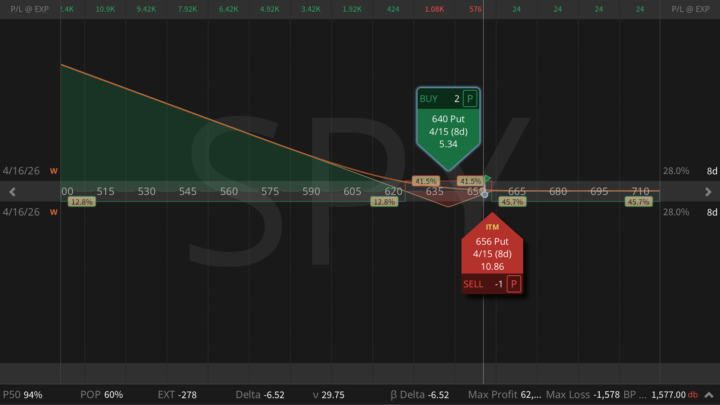
Trump has reportedly set an 8 p.m. ET deadline for Iran to reopen the Strait of Hormuz, threatening strikes on power plants and bridges if it refuses. Iran has rejected the ceasefire, launched missiles at Saudi Arabia, and vowed to target Gulf infrastructure in response. Three previous deadlines passed without full follow-through, so the base case is still another political fudge. But the specificity of tonight's threats makes the tail risk non-trivial. So, this morning I put on a unique, little-known zero-cost crash hedge. The structure: Sell 1 SPY 656 Put @ 10.86, Buy 2 SPY 640 Puts @ 5.34 each, 8 DTE. Net credit: $0.24 (essentially free). At expiration, three scenarios: - SPY above 656: all puts expire worthless, keep the $24 credit - SPY between 624-656: valley of death, max loss $1,578 at exactly 640 - SPY below 624: position prints with no cap (theoretical max profit $62,000) What makes this structure unique? Most traders confuse a back ratio with a standard ratio spread. They're opposites. Standard put ratio (buy 1, sell 2 lower) leaves you net short below the lower strike. A crash destroys it. Put back ratio (sell 1, buy 2 lower) leaves you net long below the lower strike. The worse things get, the more it pays, at an accelerating rate. Completely different animal. At VIX 26, the ITM 656 put generates $10.86 enough to fund two OTM puts with $0.24 left over. You're using the market's fear premium to fund your own tail protection. OTM puts carry higher IV than ITM puts (put skew technically works against the long legs). But we're not trading volatility ratios, we're trading dollar premium. The ITM put is priced on intrinsic value. At extreme volatility levels, that absolute dollar premium overwhelms the skew penalty. What the P&L diagram doesn't show: the two long OTM puts carry significant volga and vanna, meaning as volatility spikes and SPY falls simultaneously, vega itself accelerates and delta compounds faster than gamma alone suggests. All five greeks move in your favor at once in a real crash. And at 8 DTE, gamma is the dominant greek. If SPY breaks through 640, the position moves close to dollar-for-dollar with the market immediately.
1
0
1-30 of 33
powered by

skool.com/options-jive-1159
STOP trading market direction. Start using options strategies to turn volatility into steady income. We sell premium, and think in probabilities.
Suggested communities
Powered by