
Pinned

⭐
17d •
🗽 START HERE: How to join our Group Calls!
We built this community for people who want to talk, not just scroll. The real action happens in our group calls, where we argue ideas in good faith and tackle the week's biggest global events. Here is how you can participate: 🔥 1. Open Calls These are our public town halls. Open to everyone. Whether you want to take the stage to challenge a point or just listen in, this is the "public square." 💎2. Premium Calls For members who want to go deeper. These calls are exclusive to our supporters and offer a space for more focused discussion and priority access. - 📅 Check the Schedule & Join Here: https://www.skool.com/libertypolitics/calendar - 💎 Become a Premium Member: https://www.skool.com/libertypolitics/plans Heads up: We believe these conversations are worth sharing! Our group calls are recorded and may be posted to our social media channels. By joining the stage, you’re helping us bring these important discussions to a larger audience. By participating in group calls and voice discussions, you consent to being recorded. 👋 New to the group? Say hello! We want to get to know you. Drop a comment below to introduce yourself. Tell us where you're from and what you like to do for fun (outside of arguing politics!). Welcome to the community!
⭐
5d •
More group calls!
Let me know if this is a good idea. I was planning to schedule more group calls at different hours. I will only be available for the ones at noon Pacific Time. Would you be able to manage the other ones without me? Is there a demand for this?

21h •
Quantum AI Just Made Contact With God (Scientists Are Terrified)
Quantum AI Just Made Contact With God (Scientists Are Terrified)
23m •
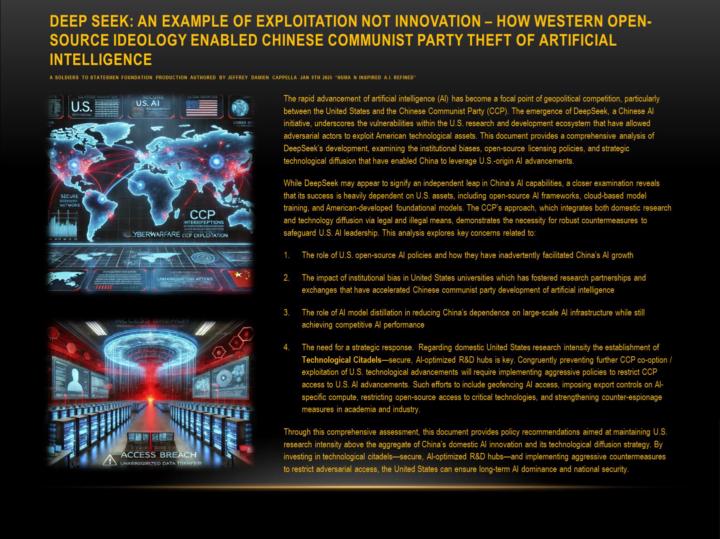
Predation Disguised as Progress: Why the Chinese Communist Party’s AI Strategy Demands a Firm U.S. Response
The DeepSeek episode is not evidence of superior Chinese innovation—it is a case study in predatory state behavior. The Chinese Communist Party (CCP) has systematically exploited Western openness by harvesting open-source frameworks, distilling U.S.-trained models, embedding researchers in American institutions, and leveraging cloud compute and supply chains that were never intended for adversarial use. This is not free-market competition or parallel development; it is an extractive strategy designed to avoid the costs, risks, and time associated with genuine innovation. By repackaging U.S. breakthroughs as domestic achievements, the CCP accelerates its capabilities while weakening the very ecosystem that produced them. What makes this behavior especially dangerous is that it is paired with economic and informational warfare. The CCP does not merely seek technical parity—it seeks to undermine confidence in U.S. technology leadership, destabilize markets, and discourage long-term American investment in high-cost AI infrastructure. The DeepSeek narrative, amplified through financial and media channels, contributed to massive market losses not because it represented a true breakthrough, but because it was framed to suggest that U.S. efforts were inefficient or obsolete. This mirrors historical CCP doctrine: weaken the adversary psychologically and economically while avoiding direct confrontation. Left unchecked, this strategy rewards predation and penalizes innovation. Countering these practices is therefore a national security necessity, not a protectionist impulse. The United States must recognize that unrestricted access to frontier AI research, compute, and academic ecosystems is being weaponized against it. Effective countermeasures include tightening export controls on advanced compute, restricting adversarial access to high-risk AI models, hardening research institutions against infiltration, and establishing secure, AI-optimized research hubs that cannot be externally exploited. This is not about retreating from openness—it is about enforcing reciprocity and defending the conditions that make real innovation possible. History shows that adversaries who rely on extraction rather than creation ultimately falter—but only if the innovators protect their advantage. The time to do so is now.

23m •
In Today's News:
Colonel Pumpkin- head, IRCG 4th division had this to say: Fuck looking for Jews behind trees and rocks!!! You fucking idiots, they are in your closets, under your beds and behind your doors SHIT MAN I don’t what to tell you. Help is not on the way.
0
0
1-30 of 1,591

skool.com/libertypolitics
Talk politics with others who care, in live calls and community posts. Share your views, ask questions, or just listen in.
Leaderboard (30-day)
1

+594
2

+252
3

+221
4

+212
5

+178
Powered by