
Pinned

⭐
Jan 18 •
🗽 START HERE: How to join our Group Calls!
We built this community for people who want to talk, not just scroll. The real action happens in our group calls, where we argue ideas in good faith and tackle the week's biggest global events. Here is how you can participate: 🔥 1. Open Calls These are our public town halls. Open to everyone. Whether you want to take the stage to challenge a point or just listen in, this is the "public square." 💎2. Premium Calls For members who want to go deeper. These calls are exclusive to our supporters and offer a space for more focused discussion and priority access. - 📅 Check the Schedule & Join Here: https://www.skool.com/libertypolitics/calendar - 💎 Become a Premium Member: https://www.skool.com/libertypolitics/plans Heads up: We believe these conversations are worth sharing! Our group calls are recorded and may be posted to our social media channels. By joining the stage, you’re helping us bring these important discussions to a larger audience. By participating in group calls and voice discussions, you consent to being recorded. 👋 New to the group? Say hello! We want to get to know you. Drop a comment below to introduce yourself. Tell us where you're from and what you like to do for fun (outside of arguing politics!). Welcome to the community!

3h •
Dictator Trump!
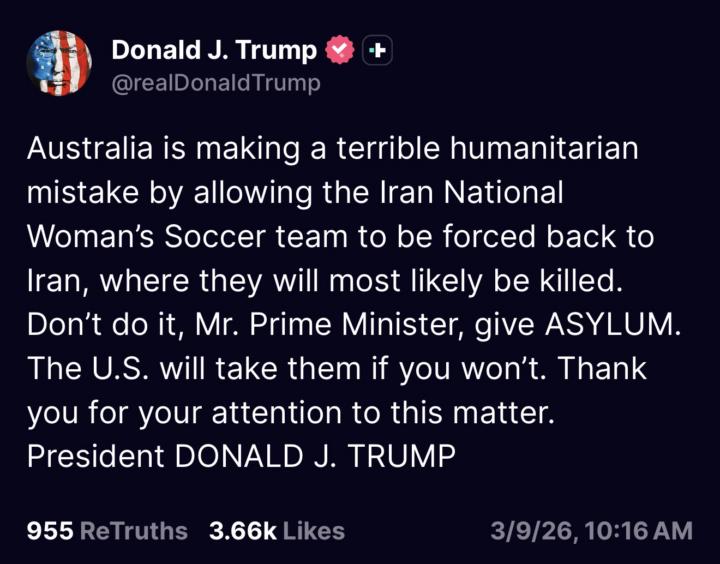
There goes our dictator again trying to save innocent lives!!! The audacity 🧐🤣👍💕🇺🇸☀️🦁 Which Olympics was it that the Israeli athletes were killed? Ah yes Munchen 1972 and who did that again? Oh yes that’s right the Balestinians!!!! Weird but hey Free Balestine right????

7h •
Iraq’s WMD Claims and Why the Lesson Still Matters Today
Some people (and this can be heard in our discussions) still insist that Iraq’s WMD claims were proven or that critics misunderstand the issue. The historical record—including official U.S. government sources—says otherwise. Before the invasion of Iraq in 2003, the United States government repeatedly argued that the regime of Saddam Hussein possessed active weapons of mass destruction (WMD) programs that posed an urgent threat. This claim was presented publicly as one of the central reasons for military intervention. For example, on February 5, 2003, Secretary of State Colin Powell presented intelligence to the United Nations Security Council arguing that Iraq possessed chemical and biological weapons in violation of its disarmament obligations and that Iraq was actively concealing these programs (Arms Control Association, 2004, UN Story, 2024). However, the evidence presented at that time later proved to be incorrect. Even the George W. Bush Presidential Library now acknowledges this in its own historical materials: “The Central Intelligence Agency initially reported to United States government officials that Iraq was actively seeking to make and acquire weapons of mass destruction. This reporting was in error.” The same source also states: “After the invasion, it was revealed that there were no stockpiles of weapons of mass destruction in Iraq, and that the United States government’s allegations thereof had been based on unreliable or misinterpreted intelligence.” After the invasion, the U.S.-led Iraq Survey Group (ISG) conducted the most comprehensive investigation into Iraq’s weapons programs. Its findings were published in what is commonly known as the Duelfer Report. The report concluded: “ISG has not found evidence that Saddam Husayn possessed WMD stocks in 2003, but the available evidence from its investigation—including detainee interviews and document exploitation—leaves open the possibility that some weapons existed in Iraq although not of a militarily significant capability” (Duelfer Report, 2004).

1h •
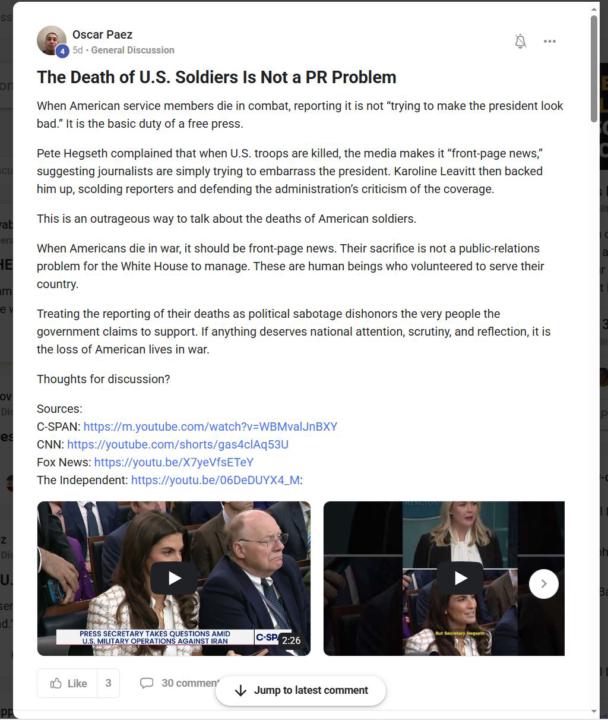
Dear Noninterventionists, Keep My Fellow Soldiers Names / Sacrifices Out of Your @#$% Mouth
The deaths of American soldiers deserve respect, reflection and national attention. No one who has served or stood beside those who served would ever argue otherwise. That being said noninterventionist hijacking the blood shed by my fellow soldiers much less while they are still under fire in attempts to “grievance wash” sedition is not the same as “honoring their sacrifices”. Those are two very different things, and they know it. There is a long, filthy historical pattern—Vietnam, Iraq, Afghanistan—where seditionist try to spotlight the human cost of military action for one calculated reason: to gradually poison public debate / erode national will and make everyone forget the savage strategic threat that started the damn fight in the first place. The result? The entire conversation becomes a one-sided false and performative “sob fest” by defeatists that attempts to dismiss the catastrophic cost of inaction. That isn’t journalism much less care for our fallen. That’s enemy propaganda dressed up as “concern”. Such reckless noninterventionist crap has very real strategic consequences. When Tehran, Moscow, Beijing and every other pack of jackals watch such domestic sedition framed entirely around attempts to weaponize American’s sensitivity to casualties, they hear the same message loud and clear: “Inflict or highlight enough losses and the United States national will collapse.” (1) Craven noninterventionist's attempt to amplify the mullah regime soft power / influence operations doesn’t honor my fellow soldiers; it turns their sacrifice into a cheap messaging tool for political sabotage. My fellow servicemen who volunteer to serve this country do so knowing the risks. What they deserve in return is an honest discussion about the strategic realities they are confronting—not selective, manipulative narrative that co-opts, hijacks and amplifies the tragedy befallen to them by our enemies as a subtext to the defeatist narratives that allow hostile regimes to run wild.

1-30 of 2,337

skool.com/libertypolitics
Talk politics with others who care, in live calls and community posts. Share your views, ask questions, or just listen in.
Leaderboard (30-day)
1
+435
2

+389
3

+324
4

+252
5

+229
Powered by