
Pinned

⭐
Jan 18 •
🗽 START HERE: How to join our Group Calls!
We built this community for people who want to connect, debate, and strategize, not just scroll. The real action happens in our group calls, where we argue ideas in good faith and tackle the week's biggest global events. Here is how you can participate: 🔥 1. Open Calls These are our public town halls. Open to everyone. Whether you want to take the stage to challenge a point or just listen in, this is the "public square." 💎2. Premium Calls For members who want to go deeper. These calls are exclusive to our supporters and offer a space for more focused discussion and priority access. 👑 3. VIP Calls Reserved for our top-tier members. These are intimate, mastermind-style sessions where you get direct Q&A access with special guests and deep dives into high-level strategy. - 📅 Check the Schedule & Join Here: https://www.skool.com/libertypolitics/calendar - 💎👑 Become a Premium or VIP Member: https://www.skool.com/libertypolitics/plans Heads up: We believe these conversations are worth sharing! Our group calls are recorded and may be posted to our social media channels. By joining the stage, you’re helping us bring these important discussions to a larger audience. By participating in group calls and voice discussions, you consent to being recorded. You can read our community rules here: https://www.skool.com/libertypolitics/-/rules Moderation decisions and bans by mods are made with Armin's approval. 👋 New to the group? Say hello! We want to get to know you. Drop a comment below to introduce yourself. Tell us where you're from and what you like to do for fun (outside arguing politics!). Welcome to the community!
4m •
On Contrarians Undermining the Pahlavi US relationship online
State-sponsored trolls and domestic ideologues use these tactics to infiltrate and divide communities: 1. They build trust over time by asking many personal questions, steering conversations toward friendships and feelings rather than sticking to facts and truth, slowly creating emotional bonds that make people lower their guard. 2. Subtly amplify grievances by repeatedly highlighting and exaggerating real or perceived complaints, turning minor frustrations into major sources of resentment. 3. Pit subgroups against each other by selectively boosting certain voices or complaints to create artificial conflicts between different factions within the same community. 4. Escalate existing tensions by using the personal knowledge they gained to pit people against each other at a personal level, often twisting private details into public attacks or accusations that make disagreements feel deeply personal and irreconcilable. Opposing views are welcome in open discussions, but don’t let time trolls waste your energy with disingenuous arguments. Their pattern is clear: advance their own political ideology and sow division between Reza Pahlavi supporters and the US government. These tactics are especially visible now during Iran’s internet blackouts. While ordinary citizens are cut off, IRGC Cyber Army operatives keep posting nonstop thanks to special white SIM cards granting them privileged, unfiltered access. Many sound like genuine Iranians, fluent in Persian and steeped in the culture, yet they are regime agents. They infiltrate pro-Pahlavi communities as insiders or concerned supporters, then amplify grievances, push anti-Pahlavi or anti-US narratives, and coordinate efforts to fracture the group from within. This selective access shows that a large share of today’s anti-Pahlavi voices are not grassroots citizens but state-backed infiltrators working to undermine Reza Pahlavi’s support and drive a wedge between his backers and the United States. State-sponsored operatives from regimes like Iran, Russia, China, and their allies have long infiltrated online communities with fake personas posing as genuine supporters. They build trust, amplify grievances, pit people against each other, and escalate tensions using classic divide-and-conquer tactics to erode unity. A parallel dynamic exists with non-state actors, domestic or ideologically driven individuals who operate independently but achieve the same result. Motivated by opposing political views, they pose as insiders, use sockpuppets, and employ concern trolling or astroturfing to undermine cohesion without central coordination. This mix of foreign and independent efforts has repeatedly targeted diaspora and opposition communities.

7h •
Capitalism 101 series
Video one of the series, 5 minutes total length. Important quote from 2015 Denmark PM “many in the US associate the Nordic model with socialism… Denmark is far from a socialist planned economy” https://www.prageru.com/videos/capitalism-vs-socialism Video 2 “A moral case for capitalism” : https://www.prageru.com/videos/a-moral-case-for-capitalism
16h •
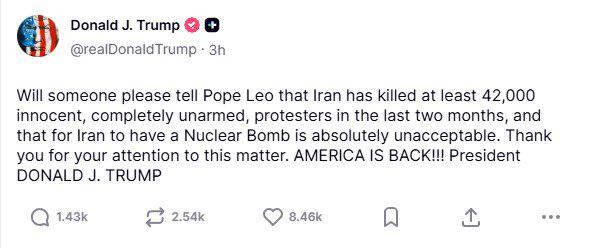
Mr President Trump's message to Pope
میشه لطفا یه نفر به پاپ لئو بگه که جمهوری اسلامی در دو ماه گذشته حداقل ۴۲۰۰۰ معترض بیگناه و کاملا غیرمسلح رو کشته، و اینکه رژیم بمب هستهای داشته باشه مطلقا غیرقابل قبوله؟ از توجه شما به این موضوع متشکرم. آمریکا برگشته است. I just love his crystal clear language specially for those who needs direct talk. What about you?

1-30 of 2,677
skool.com/libertypolitics
Talk politics with others who care, in live calls and community posts. Share your views, ask questions, or just listen in.
Leaderboard (30-day)
1
+649
2

+331
3

+326
4
+275
5
+271
Powered by