

User
Write something
🔥 Welcome to Witchfire Forge 🔥
Witches, seekers, and shadow-walkers you’ve stepped into the Forge, where magic is shaped in fire and mystery. This is not a place for surface spells. Here, we dive into the ancient rites, the whispered knowledge of the Old Gods, and the transformation that comes when you truly forge your craft. Every month, you’ll receive: 🌑 Ritual Packets — digital grimoires with guided rites 🔥 Exclusive Group Rituals — work the flame alongside me and the circle 🗝 Knowledge Drops — hidden practices revealed 🌙 The Inner Circle — a community walking this path together ✨ To begin, step forward into the circle: Introduce yourself below. Share: - Your name (or magical name if you prefer) - Where in the world you’re forging your craft - What called you to Witchfire Forge The fire has been lit. Now, it’s time to shape your magic. Welcome, witch. 🖤
Shadow Work Isn’t Healing. It’s Accountability
Most people say they want to heal. What they often mean is that they want relief. They want the anxiety to quiet down, the heartbreak to stop aching, the triggers to disappear. But shadow work is not relief. It is confrontation. Shadow work is not about candles, journals, or the aesthetic of darkness. It is not about calling yourself “evolved” because you can name your trauma. It is about taking responsibility for the parts of you that hurt others while you were busy surviving. It begins with a difficult truth: you are not just the wounded one. You are also the one who adapted. The version of you that shuts down instead of communicating did not appear out of nowhere. That was a strategy. The version of you that controls conversations, tests loyalty, withholds affection, or leaves before you can be left those were not flaws. They were armor. At some point in your life, those behaviors kept you safe. They protected you from rejection, humiliation, abandonment, chaos. But survival strategies, when left unexamined, become self-sabotage. Your trauma explains your patterns. It does not excuse them. That is where real shadow work begins. Not in blaming your past. Not in endlessly dissecting what was done to you. But in asking yourself how you are now participating in your own suffering. The shadow is not evil. It is unintegrated. It is the part of you that learned distorted lessons in order to cope. Your jealousy may be unspoken desire. Your anger may be violated boundaries that were never defended. Your need for control may be fear of unpredictability. Your detachment may be grief that never had language. When you refuse to look at these parts, they operate unconsciously. They choose your partners. They repeat the same relational dynamic in different faces. They sabotage intimacy just as it begins to feel real. And because they are hidden, you will swear it is fate, bad luck, or “just the way things are.” But the moment you bring awareness to them, everything changes.
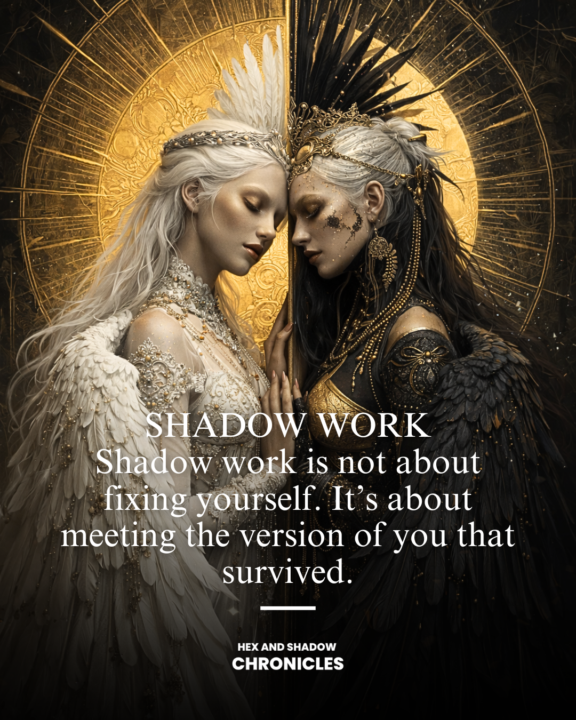
Shadow Work Isn’t Healing. It’s Accountability
Lilith and Eve
Lilith and Eve are often painted as opposites, as if a woman must decide which archetype she will embody. One is framed as rebellion and the other as submission. One walks away and the other stays. One is demonized and the other sanctified. But the deeper story is not about rivalry. It is about fragmentation. Lilith represents the part of the feminine that refuses to kneel, that will not barter equality for comfort, that would rather be alone than live unseen. She leaves the garden rather than shrink inside it. Her exile is not a punishment but a declaration of autonomy. She embodies the untamed instinct that says dignity is not negotiable. Eve represents the part of the feminine that chooses relationship, that steps into experience, that tastes knowledge even when warned not to. She is often blamed for the fall, yet without her there would be no awakening. She reaches for wisdom and accepts the consequences of becoming conscious. Her choice brings pain, but it also brings evolution. The world has long tried to separate these two energies within women. You are told to be agreeable but not demanding, nurturing but not wild, sensual but not sovereign. You are asked to soften your edges while carrying everyone else’s weight. You are praised when you comply and questioned when you assert. Dark feminine energy does not ask you to choose between Lilith and Eve. It asks you to integrate them. There is a time to walk away and a time to stay and transform the space you occupy. There is a time to rebel and a time to endure. There is a time to burn the garden down and a time to plant new seeds in its soil. Lilith without Eve can become isolation. Eve without Lilith can become self-betrayal. Together they form wholeness. Within you is the woman who will not bow and the woman who will risk everything for knowledge. Within you is instinct and awareness, shadow and growth, fire and fruit. The real exile was never from paradise. The real exile was from your own fullness. When you stop trying to be only the good woman or only the wild woman, you reclaim something ancient. You remember that power and softness were never enemies. They were meant to coexist.
The FerryMan
Let me start by saying I was brought up with a mix of music genre, my mother loved Chris De Burgh and the “Don’t Pay The Ferryman” peeked my interest over 25 years ago. (This and the Spanish train) Charon is older than pity. In early Greek cosmology, before morality became theatrical, death was a geography. The soul did not float upward it descended. Down into the chthonic dark, into the realm ruled by Hades and Persephone. But the entrance to that realm was not open land. It was divided by water. The Greeks named multiple rivers of the underworld: the Styx (river of oath and hatred), Acheron (river of sorrow), Cocytus (lamentation), Phlegethon (fire), and Lethe (forgetfulness). Charon most commonly ferries souls across the Styx or Acheron though the exact river shifts depending on the source. What does not shift is the rule: the dead must pay. The obol, a small coin was placed in the mouth of the corpse during burial. Archaeology confirms this was not merely story but ritual practice. To die without burial meant to wander. Souls without payment were said to drift along the banks for a hundred years, unable to cross, neither fully gone nor fully present. This detail reveals something important about ancient Greek belief: proper rites anchored the soul. The living had responsibility for the dead. Charon himself is described in later sources, particularly by Virgil in the Aeneid, as filthy, ancient, with a tangled white beard and eyes like burning coals. His boat is crude. Functional. No ornament. He is not divine in the Olympian sense, he is chthonic. A being of the deep earth. The son of Nyx (Night) and Erebus (Darkness) in some traditions, making him primordial rather than civilized. He does not comfort the dead. He commands them. He separates the unburied from those properly mourned. He resists the living. When Heracles forced passage, Charon was punished for allowing it. When Orpheus softened him with music, it was an anomaly a bending of natural order.
The FerryMan
Your Journal Is Your Grimoire (Even If You Don’t Call It That)
In witchcraft, we often look for the dramatic moments of transformation the candle burning low, the full moon glowing heavy in the sky, the feeling of energy shifting in the air. But some of the most powerful magic does not look like magic at all. It looks like journaling. Sitting down with a blank page is an act of courage. It asks you to meet yourself without distraction. Without performance. Without filters. And in that space, something subtle but profound happens: your inner world begins to take shape in language. In magical practice, naming something is powerful. To name a fear is to loosen its hold. To name a desire is to give it direction. To name a boundary is to reclaim energy that was scattered. Writing does this naturally. It turns emotion into awareness, and awareness into choice. A journal becomes a grimoire not because of ornate symbols or ancient spells, but because it holds your evolution. It documents your patterns, your shadows, your healing, your longings. It tracks the quiet shifts that you might otherwise overlook the way your standards rise, the way your intuition grows louder, the way your self-trust strengthens over time. When you write about what you are releasing, you are practicing banishment. When you articulate what you want, you are practicing manifestation. When you explore your triggers and contradictions, you are engaging in shadow work. Even gratitude written consistently becomes a form of energetic protection, training your mind to recognize abundance rather than lack. There is also something deeply sovereign about journaling. No one else interprets your words. No one edits your truth. It is a private ritual of self-witnessing. In a world that constantly demands performance, journaling is a refusal to perform. It is a return to self. And perhaps that is why it is so transformative. Magic is often imagined as something external tools, herbs, rituals, moon phases. But at its core, magic is awareness directed with intention. Journaling strengthens both. It sharpens perception. It reveals patterns. It gives your intuition language.
1-30 of 60
powered by
Hex and Shadow Chronicles
skool.com/hex-and-shadow-chronicles-4919
🌑 Monthly ritual (digital grimoires + guided rites)
🗝 Occult knowledge drops
🌙 A private circle of witches walking the path beside you
Build your own community
Bring people together around your passion and get paid.
Powered by