Activity
Mon
Wed
Fri
Sun
Nov
Dec
Jan
Feb
Mar
Apr
May
Jun
Jul
Aug
Sep
Oct
What is this?
Less
More
Owned by Laura
Ready-to-use artwork for creators who want to save time, post consistently and grow their social media.
74 contributions to Hex and Shadow Chronicles

Mar 4 •
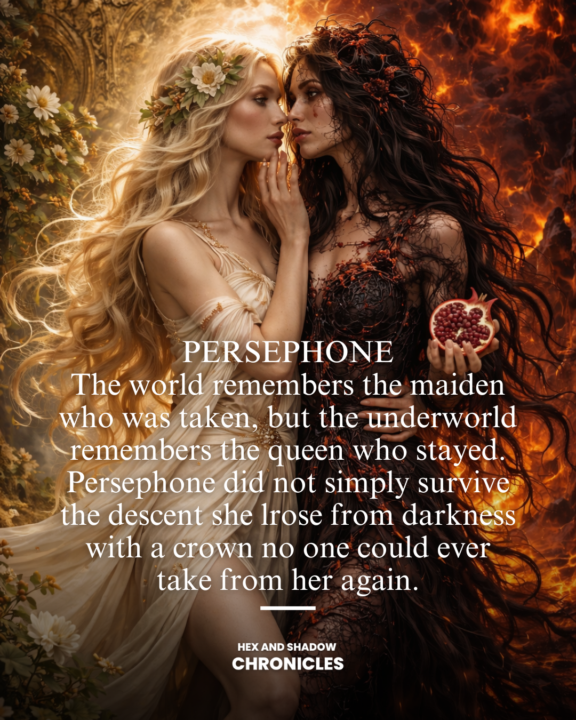
Persephone
Many people remember Persephone only as the girl in the meadow, the daughter of Demeter gathering flowers before the earth split open and Hades carried her into the depths. But mythology rarely ends where transformation begins. What the older traditions reveal is that Persephone did not remain the frightened maiden the world imagines. In time she became the Queen of the Underworld, a sovereign presence beside Hades, ruling over the realm of the dead with a quiet authority that even gods respected. Souls did not only answer to Hades. They answered to her. Ancient writers even called her Dread Persephone, a title that speaks not of cruelty, but of reverence. She was the one who understood both worlds, the living and the dead, the blooming earth above and the shadowed kingdom below. The descent changed her. It stripped away innocence and replaced it with knowledge few could carry. She learned the silence of the underworld, the weight of endings, and the truth that every life must pass through darkness before renewal. This is why Persephone is one of the most powerful dark feminine archetypes in mythology. She represents the woman who has walked through loss, betrayal, grief, or transformation and returned with a depth that cannot be undone. Her power is not loud like thunder. It is quiet like gravity. You feel it without needing explanation. Because once someone has lived through their own underworld, the illusions of the surface world no longer hold the same power over them. Persephone reminds us that descent is not always defeat. Sometimes the darkest place you are taken becomes the very place you discover who you truly are.
Mar 3 •
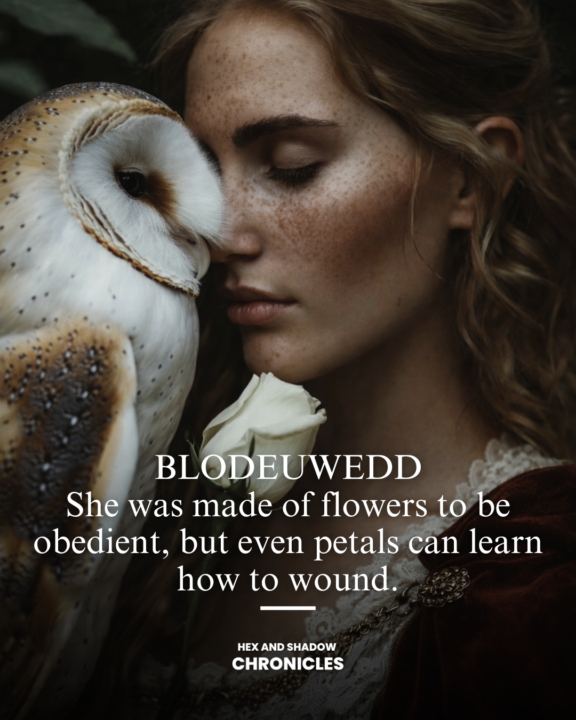
Blodeuwedd
Blodeuwedd was not born. She was arranged. In the Fourth Branch of the Mabinogion, the magician Gwydion and his uncle Math shaped her from oak blossoms, broom, and meadowsweet, weaving her into being because a curse had been laid upon the noble Lleu Llaw Gyffes. His mother, Arianrhod, had sworn he would never have a human wife, so the men answered fate with craft. They summoned a woman from the forest itself, white and golden and fragrant with summer, and they named her Blodeuwedd, which means “Flower Face.” She was created for marriage, created for beauty, created to soften a man’s destiny. And yet creation does not guarantee devotion. Blodeuwedd looked upon Lleu and felt no love. Instead, she saw a hunter named Gronw Pebr, fierce and mortal and flawed. What began as a glance ripened into conspiracy. But Lleu could not be killed in any ordinary way. He could only die under impossible conditions, standing with one foot on a goat and the other on a bath, beneath a thatched roof by a riverbank, struck by a spear forged only during certain sacred hours. Blodeuwedd coaxed the secret from her husband with tenderness, and once she knew it, she helped arrange the ritual of his undoing. The spear was cast. Lleu fell, transformed into an eagle, and vanished into the wild sky. But magic always circles back. Gwydion tracked the wounded eagle, restored Lleu to human form, and sought vengeance. Gronw was slain. And Blodeuwedd, flower-made and forest-born, was not granted death. Instead she was transformed into an owl, condemned to the night, shunned by other birds, forever bearing the memory of what she had chosen. And yet even this is not a simple punishment. The owl sees what others cannot. The owl moves in silence. The owl belongs to thresholds between light and dark. Blodeuwedd began as a wife shaped by men to solve a curse. She ended as a creature of the liminal hours, neither bride nor blossom, but watcher of shadows. Some call her traitor. Some call her villain. But beneath the accusation lies a quieter question: what happens when a woman made to be an answer decides to ask her own desire instead?
7
0
Mar 2 •
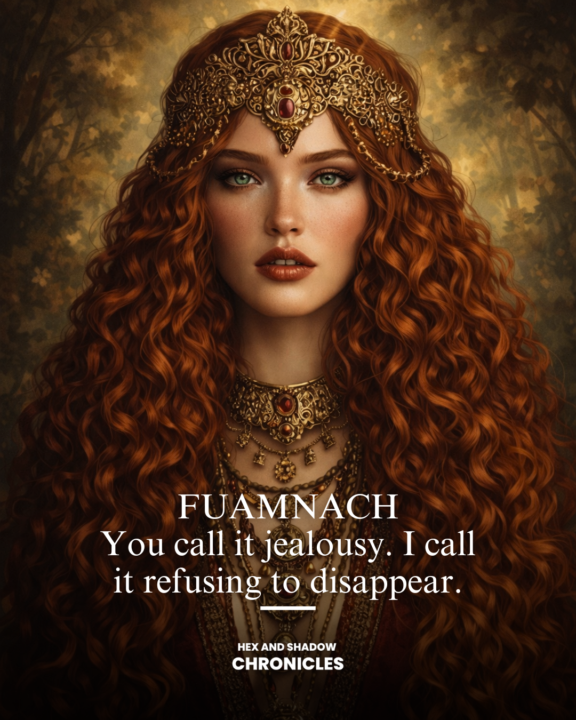
Fuamnach
In the older currents of Irish mythology, long before romance softened the edges of feminine power, there was Fuamnach, a queen and sorceress whose name is forever tied to jealousy, transformation, and the brutal consequences of displaced love. Her story appears in the tale of The Wooing of Étaín, a cycle woven into the mythic history of the Tuatha Dé Danann, and though she is often cast as the antagonist, her narrative reveals something deeper about grief, possession, and the instability of status when love shifts its allegiance. Fuamnach was the first wife of Midir, a lord of the Tuatha Dé Danann associated with the Otherworld, wealth, and sovereignty. As his queen, she held position, influence, and magical authority. In the cosmology of the Tuatha Dé Danann, queenship was not ornamental. It was bound to land, legitimacy, and spiritual balance. To be wife to a king was to embody a form of territorial and sacred power. Fuamnach’s role was not sentimental; it was structural. Étaín was luminous, beautiful, and newly arrived into Midir’s life. He loved her openly and deeply, and that love destabilized the existing order. What appears, on the surface, to be simple jealousy is in fact political displacement. Fuamnach was not merely losing affection; she was losing standing. In mythic societies where hierarchy and sovereignty intertwine, love is rarely separate from power. Fuamnach’s response was not impulsive violence but calculated magic. Drawing upon her knowledge of druidic arts, she transformed Étaín into a butterfly, a delicate creature condemned to drift without agency. Yet Fuamnach’s cruelty did not end with a single spell. When Midir sheltered the butterfly and attempted to protect his beloved, Fuamnach conjured winds to drive Étaín away, ensuring she would never rest long enough to regain stability. For years, Étaín wandered in fragile form, battered by storms summoned deliberately to prolong her suffering.
Feb 26 •
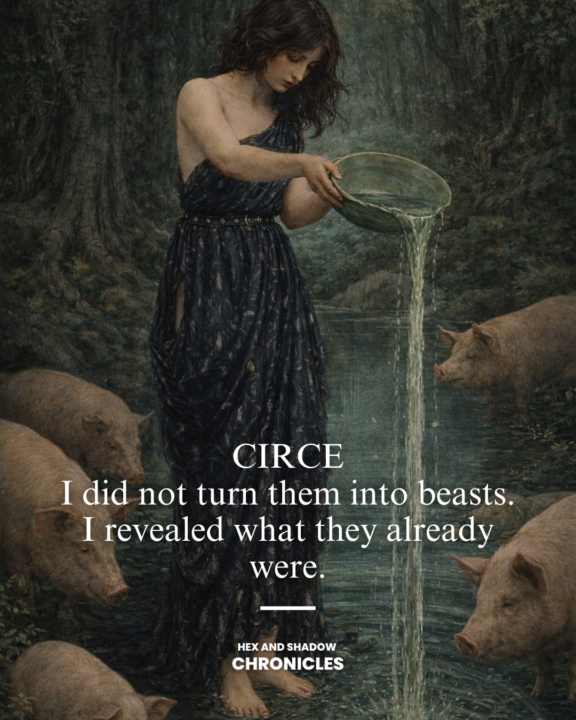
Circe The Witch Who Choose Herself
Circe is rarely portrayed as soft. In Homer’s Odyssey, she lives alone on the island of Aeaea. A sorceress. Daughter of Helios, the sun god. Exiled from Olympus. Self-contained. Self-sufficient. When Odysseus’ men arrive, she does not greet them with submission. She feeds them. She transforms them into swine. For centuries, she has been framed as a temptress. A manipulator. A dangerous woman who uses enchantment to control men. But look closer. She does not hunt them. They arrive uninvited. They consume what she offers without question. They underestimate her. Her magic does not create monsters. It reveals them. Circe represents the feminine archetype that refuses vulnerability without discernment. She lives alone not because she is unwanted but because she does not need attachment to survive. Her power is learned, practiced, honed. When Odysseus resists her spell (with the help of Hermes), she does not destroy him. She respects him. She becomes his ally. She offers guidance for the journey ahead. She does not hate men. She tests them. There is something deeply unsettling about a woman who can survive without needing to be chosen. Who can seduce, but also strategize. Who can isolate, but also instruct. Circe embodies autonomy without apology. Knowledge without permission. Transformation without explanation. She is not chaos. She is sovereignty in exile. And perhaps that is why she has always frightened the heroic narrative. Because a woman who does not need saving cannot be conquered. She can only be met as an equal.
1 like • Mar 2
@Alexa Vita 👏🏻👏🏻 yes! Blessings 🗝️🤍
1 like • Mar 2
@Violet Ravyn Rose no I completely understand that I don’t scroll anymore and try to schedule my posts so I’m not in there too much. 🗝️🤍
Feb 28 •
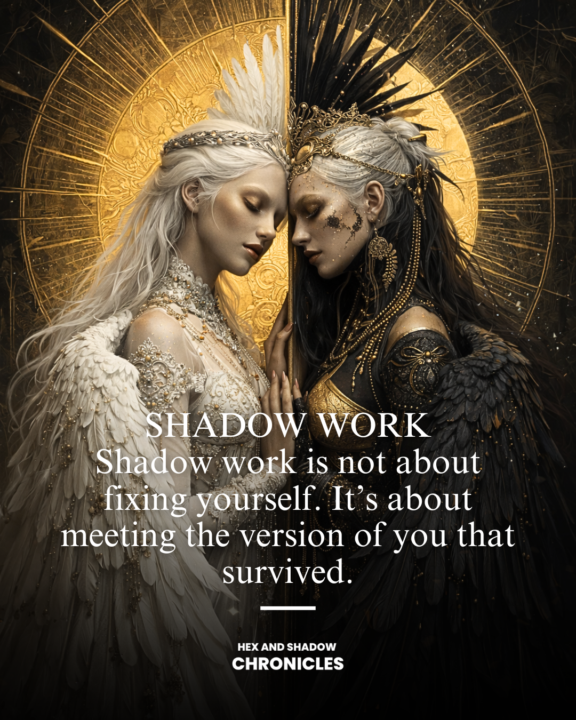
Shadow Work Isn’t Healing. It’s Accountability
Most people say they want to heal. What they often mean is that they want relief. They want the anxiety to quiet down, the heartbreak to stop aching, the triggers to disappear. But shadow work is not relief. It is confrontation. Shadow work is not about candles, journals, or the aesthetic of darkness. It is not about calling yourself “evolved” because you can name your trauma. It is about taking responsibility for the parts of you that hurt others while you were busy surviving. It begins with a difficult truth: you are not just the wounded one. You are also the one who adapted. The version of you that shuts down instead of communicating did not appear out of nowhere. That was a strategy. The version of you that controls conversations, tests loyalty, withholds affection, or leaves before you can be left those were not flaws. They were armor. At some point in your life, those behaviors kept you safe. They protected you from rejection, humiliation, abandonment, chaos. But survival strategies, when left unexamined, become self-sabotage. Your trauma explains your patterns. It does not excuse them. That is where real shadow work begins. Not in blaming your past. Not in endlessly dissecting what was done to you. But in asking yourself how you are now participating in your own suffering. The shadow is not evil. It is unintegrated. It is the part of you that learned distorted lessons in order to cope. Your jealousy may be unspoken desire. Your anger may be violated boundaries that were never defended. Your need for control may be fear of unpredictability. Your detachment may be grief that never had language. When you refuse to look at these parts, they operate unconsciously. They choose your partners. They repeat the same relational dynamic in different faces. They sabotage intimacy just as it begins to feel real. And because they are hidden, you will swear it is fate, bad luck, or “just the way things are.” But the moment you bring awareness to them, everything changes.
2 likes • Mar 2
@Violet Ravyn Rose aww that’s so amazing to hear, thank you. Blessings 🗝️🤍
1 like • Mar 2
@Elaine Dl thank you, that’s so kind to hear. blessings 🗝️🤍
1-10 of 74