User
Write something
Pinned

Expansion and growth > Spanish speaking markets
You can reach Latinos confidently with a few simple steps. We don't pretend to be Latinos. We are Latinos. We know and feel what feels right for Latinos!
1
0
Expansion and growth > Spanish speaking markets
Just in case... this is good to know!
Many companies treat Latin America as one single market. It isn’t. Brazil alone represents roughly one-third of Latin America’s population and about 43% of its GDP . It’s a massive opportunity. But it’s not Spanish-speaking. It operates in Portuguese, specifically pt-BR, with distinct cultural and regulatory nuances. Yet businesses often reuse Spanish materials or apply a generic Latin American strategy across the region. That shortcut creates friction. Brazilian Portuguese differs from European Portuguese. Tone, phrasing, and business etiquette vary. Legal documentation, employment contracts, and compliance language must reflect local labor laws and expectations. Direct translation from Spanish to Portuguese, or from English without localization, increases risk. Beyond language, Brazil has its own tax structures, HR requirements, and consumer behavior patterns. Marketing campaigns that resonate in Mexico or Colombia may fall flat in São Paulo. Brazil isn’t an extension of Spanish-speaking Latin America. It’s a strategic market of its own. And a large one at that. Are you treating Brazil as a checkbox, or as a serious growth engine with a tailored strategy?
0
0
Just in case... this is good to know!
Localization Is Not Translation. It’s Market Entry.
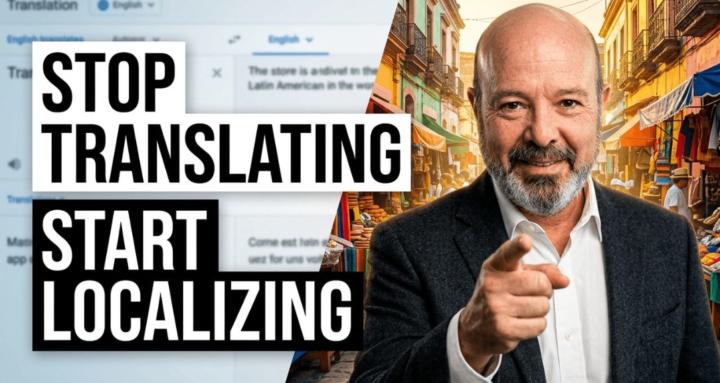
When global brands look at Latin America, they often ask the wrong question. “How do we translate this into Spanish?” That’s a language question. The real question is strategic: “How do we make this feel like it belongs here?” Because Latin America is not one market. Mexico is not Colombia. Colombia is not Chile. Argentina does not consume content the same way as Peru. Even when the language is technically the same, the emotional triggers, tone, humor, and buying motivations vary by country. And that difference matters. Take streaming platforms. When they launch a show, the core content is fixed. The actors speak their lines. The script doesn’t change. Subtitles may be accurate, but they are constrained. You cannot rewrite the dialogue to match each country’s tone. The words are the words. So where does localization actually happen? In their marketing. The trailers. The taglines. The email campaigns. The landing pages. The social media posts. This is where emotional resonance is created. A streaming service promoting the same series in Mexico might lean into family dynamics, shared cultural humor, or specific slang that feels natural locally. In Colombia, the same campaign might highlight aspiration, ambition, or a different emotional hook that connects with local storytelling traditions. The show doesn’t change. The feeling around it does. And that’s what drives sign-ups. Why Big Brands Get This Wrong Large companies often centralize Spanish content. One version. One set of subtitles. One campaign rolled out across the region. Technically correct. Emotionally flat. What works in Mexico may feel too formal in Colombia. What sounds natural in Argentina may feel distant in Peru. The result is subtle but costly: lower engagement, slower growth, weaker brand loyalty. Localization is not about rewriting everything. It’s about understanding where adaptation creates leverage. Marketing Collateral Is Where Strategy Lives You may not be able to change the core product.
0
0
Localization Is Not Translation. It’s Market Entry.
Newsy and relevant. $4T buying power? Who? ⚽ !! 🤠
With nearly $4T in economic output, US Latinos fall behind only Japan, Germany, China, and (of course) the United States overall. Otherwise, they outperform every other country despite numbering just 65M people in total. Impressive, right? Over six out of ten Hispanics in the US come from Mexico, while Colombians, Cubans, Dominicans, and Central Americans are also well represented. They are concentrated especially in the southwestern border states, Florida, and New York, and in some states – such as California and Texas – now make up a majority of the state population. Worth reaching them? The global companies we work for surely think so and add from 7% to 75% of revenue outside their domestic market. Have you thought about it? Not as hard to get started. In a few days you would be on your way! Easily! ✓ Gain visibility. ✓ Identify Latino audience. ✓ Tweak, fine-tune. Monitor traction. ✓ Refresh and repeat. Reaching Latinos in the US is a very good first step toward more revenue! Logistics, legalities, payment processes, all fairly straightforward. The key? Culturally aligned content! 💪
0
0
Newsy and relevant. $4T buying power? Who? ⚽ !! 🤠
Real life costly disasters through mistranslations
Still true in 2026 with advanced AI, beware! This is why adapting properly marketing copy saves time and resources. Adapting copy = Localization Copy that is relevant and culturally aligned with the target audience. Believe me, AI still makes unwanted mistakes when not properly reviewed and proofread by a native expert. The solution: The "human in the loop". Draft with AI + human review and proofreading. Test and tweak! If A/B testing is so key in monolingual situations, how much more when adapting to another language. You DON'T want these mistakes to happen to your business. It can be avoided! And it is worth it! Hispanics accounted for 63% of all U.S. population growth over the last five years. $4+ trillion dollars of purchasing power in the U.S. alone. (B2C) 14% of businesses in the US are Latino owned. (B2B) ... and then all of Latin America. If any fellow Skooler would like a review of content in Spanish, happy to take a quick look. A few international examples of costly mistranslations. - The HSBC Bank slogan was translated from “Assume Nothing” to “Do Nothing”. Since then, the company spent millions of dollars in an attempt to rebrand itself. - Pepsi: Their slogan "Come alive with the Pepsi Generation" fue interpretado erróneamente como "Pepsi resucita a tus antepasados de la tumba", one the famous marketing failures. - Airline: translated a slogan "Fly in Leather" as "Vuela en cuero". My fellow Latin Americans know that this can mean "fly naked". - Clairol (1986): The brand launched its curler "Mist Stick" in Germany without considering that "mist" is slang for manure, which made it difficult to sell a product that promised "manure". - Parker Pen (1971): When launching pens in Mexico, a mistranslation led consumers to believe the pen would prevent unwanted pregnancies ("it won't leak in your pocket and embarrass you" was confused with "embarazar" - literally, getting pregnant). - Coors: "Turn it Loose" translated to "Suffer from diarrhea."
0
0
Real life costly disasters through mistranslations
1-15 of 15
powered by
Reach Latinos with sabor
skool.com/global-solutions-6470
Expand and grow into Latino markets with AI-human driven Localization
Build your own community
Bring people together around your passion and get paid.
Powered by