
Pinned

21h •
Something I've been sitting on for a while — and I've finally decided to do it. 👇
Something I've been sitting on for a while — and I've finally decided to do it. 👇 A few days ago I mentioned I was thinking about building a training programme for certified functional safety engineers who want to move into nuclear. The response told me everything I needed to know. So here it is. Get Into Nuclear — Functional Safety Practitioner Programme. An 8-week live online programme built around ONR guidance and nuclear-specific standards. Weekly group calls. A real case study with personal feedback. Post-placement mentoring when you land your first nuclear role. There is nothing else like this. I've looked. Because you were here before this existed — you get first access. I'm giving away 2 free places before I open this to anyone else. To enter: ✅ Comment "I'm in" below and tell me: what is the single biggest thing stopping you from applying for nuclear functional safety roles right now? Winner announced in 3 days. Head to the Classroom to see exactly what is inside 👉 Get Into Nuclear — Functional Safety Practitioner Programme

2d •
Hi All - Systems that pre date 61508
Hi all thanks for the add, this looks like a really good way to share experience in the functional safety world. Thanks for setting up Richard. I have a question for you all on the requirements when adding a new SIF to an existing SIL2 system that was designed over 40 years ago and was never designed to 61508. What things would we consider to make this possible without a full system redesign.
4d •
Proof test coverage
Something that always makes me pause when reviewing designs… Proof test coverage that somehow always ends up being 100% effective. On paper it looks great. The numbers work nicely. The SIL calculation passes comfortably. But in the real world I always find myself thinking: Can we really detecting every dangerous failure with that test? In my experience, this is a major cause of rework. If the design progresses to the point where commissioning documents are written and then a FSA or design review reveals overly optimistic proof test coverage it’s a lot of work to correct. Anyone else experiencing this?

2d •
Source for failure modes
What is the best way to know the failure modes of components? Manufacturers usually don't provide failure modes and failure modes in databases as NPRD are usually very ambiguous.

4d •
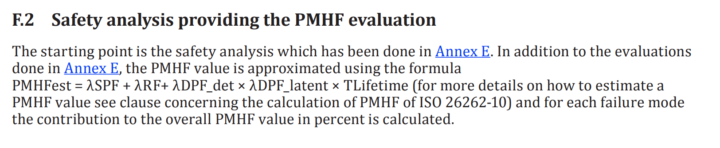
Probabilistic Metric for Hardware Failure calculations
I've been struggling with this point for some time. In Automotive, ISO 26262 part 5 provides an equation to calculate the PMHF. A follow-up example explains it with numbers. My issue is: When I try to apply the same equation on the solved example in the standard, I cannot generate the same results. The main tool we use to calculate the PMHF is Medini, and it uses a completely different strategy to get it. Can someone inform me how these values are generated with the equation?
1-23 of 23

skool.com/functionalsafety
Functional safety engineers discussing real project decisions, standards, and lifecycle challenges.
Leaderboard (30-day)
1
+4
2

+3
3

+2
4
+2
5
+2
Powered by