
Write something

22h •
The reason most people struggle to train consistently (has nothing to do with motivation)
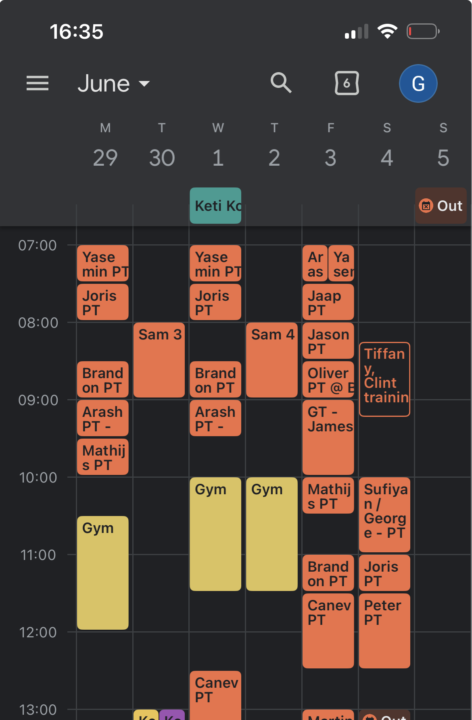
Every day you wake up and have to decide whether you're training, you've already started a negotiation with yourself. And that manifests at the worst possible time: When you're tired, when the week has already taken something from you, when the couch is right there and tomorrow genuinely exists as an option. The decision being open is the problem. Not your willpower, not your schedule, not how busy things have been. But here's the thing, your brain likes slots. Try this: make the decision once, in advance, and take it off the table entirely. That means booking your sessions at the start of the week the same way you'd book a client call or a meeting. Not as a reminder. Not as a rough intention. Make it a fixed appointment that has a time and a place attached to it. When Monday morning comes around and the week starts pulling at you, the decision is already made. There's nothing left to negotiate with. The practical version of this is simple: 1. pick your days 2. pick your times 3. put them in your calendar 4. treat a clash as a scheduling problem to solve rather than a reason to cancel. If something genuinely moves the session, you reschedule it, you don't drop it. This week, before you do anything else, open your calendar and book next week's sessions right now. Not the week after, not when things settle down. Now, while the intention is still there. That one action will do more for your consistency than anything else I could tell you. Onwards.
1
0
8d •
That conversation in your head sounds reasonable (but it's not actually about training)
There's a version of this that happens to everyone. You've already done the hard part of the day. You were good, you showed up, you got through it. And now there's one more thing on the list (the thing you put there yourself) and every part of you is building a case for why today is actually a reasonable day to skip it. The arguments are good, don't get me wrong. You're being logical: - You're tired for real reasons - Tomorrow genuinely exists - Rest is genuinely important And so you negotiate, and the negotiation sounds so reasonable that by the time you notice what's happening, you've already lost. I do this with my own training more than I'd like to admit. By the time my last client is done I've been on my feet since 6am, I've coached four or five sessions, and somewhere on the walk to my bag the conversation has already started. I could go tomorrow. I'll be fresher. It makes sense. What I've learned, slowly and mostly by getting it wrong, is that the conversation isn't actually about training, rather a feeling I'm waiting for before I give myself permission to go. And that feeling doesn't arrive first. In over twenty years of lifting, it never has. Motivation is a terrible starting condition. It shifts based on sleep, stress, how the morning went. And waiting for it to show up before you do means you're going to lose that internal argument more often than you'd like, and the losses tend to compound in the background until the habit just isn't there anymore. What actually kept me consistent through the easy periods and the hard ones was simpler than discipline: I stopped measuring whether I wanted to go and started measuring whether I went. Not the quality of the session, not my energy going in, just whether I showed up and did something. Because the motivation you're waiting for tends to arrive after you start, and once you understand that the whole negotiation stops making sense. There's a practical layer to this too. I know from experience that if I go home between my last client and my own session, the gym isn't happening.
2
0
14d •
The thing that kills consistency before the week starts
Fellas - new video is up. This one is about the consistency killer. In it I cover four things: - How to spot the internal negotiation your brain runs every time there's friction, and why recognising it is so important. - Why motivation is the wrong thing to measure, and what to track instead - How to structure the day so the session stops being a decision each time - Where to look for proof that training is working, if enjoying the sessions themselves isn't the signal you're getting There's also a COMPANION GUIDE with a reflection prompt for each section. Worth filling out for yourself while you're watching. If you want the actual system for building consistency into a full week, 'Get Consistent / Lifting' is inside Premium. Subscribe here for the system.
2
0

22d •
Have you ever felt real hunger?
Like, real, animalistic hunger? I'd wager that the majority of people haven't (at least for those of us lucky enough to live in the western world). And it's not because of eating "enough" or not, but usually it's that the signal fires so early and gets acted on so quickly that it never gets the chance to develop into something more than an impulse.. You feel something gurgle, some sort of restlessness, a hum of "maybe I should eat something." And within minutes (seconds?) you're reaching for food. The gap between signal and response is basically zero. And that's a problem. Because you never find out what the signal actually was. Several factors may be playing a role here. Stress, for example, shows up in the body in ways that feel remarkably similar to hunger. So does boredom. So does being tired. So does avoiding something you don't want to deal with, or just being at that time of day when your brain has learned to demand food. All of these can produce a sensation that says "I'm hungry". And the only way to learn the difference is to wait. This can be more challenging that it seems a first, as our habitual, non-intentional eating and food-obsessed cultures are forces to be reckoned with. But if you try it just long enough, you may find that the signal either builds into something undeniable, or fades because it was never hunger to begin with. So, here's a quick exercise for you to try to put this into practice: Next time you feel the pull to eat outside of a planned meal, give it fifteen minutes. Just delay it. Do something else. Trust me, you'll be fine. Then check back in. If the feeling's still there, possibly stronger, that's information. That might (might) be real hunger. If the feeling has faded or changed shape, that's also information. That was something else wearing hunger's clothes. Over time you'll finding it easier to start to recognize your own signals for what they are in real time. And that's where the work continues. This is exactly the kind of thing I dig into in the 'Get Consistent' guide inside Premium, building awareness around your own patterns so the habit actually sticks. Worth a look if you haven't yet.
3
0

1-4 of 4

skool.com/forge-lift-fast
Fasting and lifting for men in their 30s and 40s who want to get lean and strong without changing their whole life.
Leaderboard (30-day)
1

+2
2

+1
Powered by