

Feb 25 •
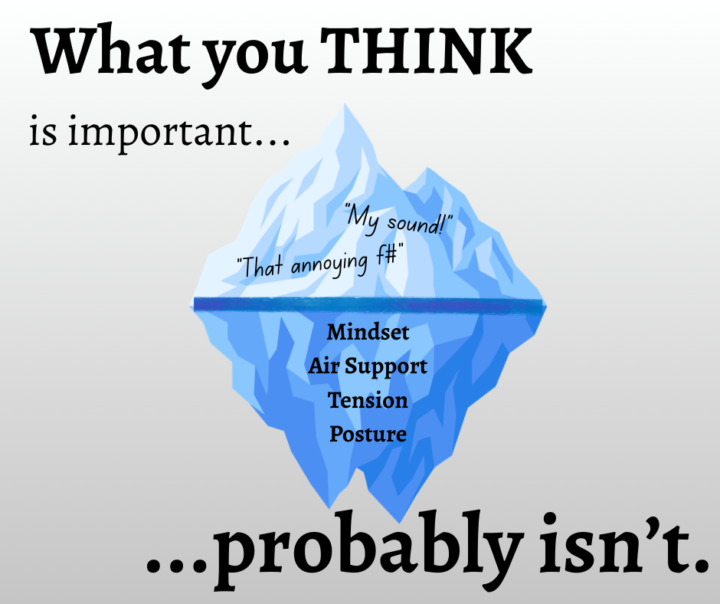
What you think is important... probably isn't.
Over the years, I’ve watched so many students fall into the same trap: obsessing over the wrong problem. “My sound isn’t clean enough in that section.” - but the real issue? The rhythms aren’t accurate. “I’m always so sharp in the high register.” -when the truth is the air support is inconsistent across the entire instrument and the “sharpness” up high is just a symptom. “My fingers just won’t move fast enough.” - when it’s actually tension (often fuelled by harsh self-criticism) that’s blocking technical freedom. “I wish I had bigger lungs so I could play longer phrases.” - when in reality, they’re leaking the precious air they do have through an inefficient embouchure… or simply playing louder than necessary. For myself, I was guilty of thinking that if I was able to play everything note perfectly that I would advance more in my career…. but all I really accomplished was adding a lot of tension to my playing. I spent 90% of my practice time drilling all of the most difficult music in the flute repertoire, hoping and praying that I’d be able to play it correctly when it came time to perform. After a 6 month period of total burnout where I didn’t play the flute at all (stemming from this horrible practice routine… lol), I picked it up with a fresh approach. I didn’t have regular lessons at that time, and decided I could become my own teacher. I purchased a little mini-disc player (now completely obsolete 😂) and started recording myself for feedback CONSTANTLY. I stopped trying to be perfect, and started getting curious: - Why were my fingers flubbing? - Why did I sound pinched in the high register? - Why didn’t I love what I was hearing? Maybe it wasn’t because I was “bad"... maybe there was a simpler explanation. When I began recording myself regularly, I discovered: - Small posture adjustments allowed me to breathe more deeply. - Finger tension was the real source of my technical inconsistency, so I created a plan to release it. - The phrasing I imagined wasn’t always what I was actually producing, so I examined how I was using dynamics, vibrato, and rubato to communicate my ideas. - Most importantly, I realized many of my “sound problems” were actually support problems. So instead of drilling isolated passages to death, I overhauled my air support.
1-1 of 1

skool.com/fluteforum
A place for flutists to think, share, and build their craft together.
Leaderboard (30-day)
1

+11
2

+9
3

+7
4
+3
5

+2
Powered by