
Write something

Jul 7 •
Interview Prep: Software Development Engineer → Forward Deployed Engineer
Most Software Development Engineers prepare for interviews by practicing: ✅ Data Structures & Algorithms ✅ System Design ✅ Coding Problems ✅ Low-Level Design That's enough for traditional SDE roles. But Forward Deployed Engineer (FDE) interviews test something very different. Instead of asking, "Can you build software?" They ask, "Can you solve a customer's problem using software?" Here's what you should prepare. 1️⃣ Strong Coding Fundamentals You still need to code well. Focus on: - Python - TypeScript/JavaScript - APIs - SQL - Git - Debugging real applications LeetCode helps but don't stop there. 2️⃣ API Integration Many FDE interviews involve connecting systems. Practice: - REST APIs - Authentication - Webhooks - JSON parsing - Error handling Build small integrations instead of only solving algorithms. 3️⃣ System Thinking Understand how products work end-to-end. Be able to explain: - Data flow - Backend architecture - Databases - Caching - Authentication - Cloud deployment Think beyond individual functions. 4️⃣ Customer Problem Solving This is where most SDE candidates struggle. An FDE should be able to answer: - What is the customer's real problem? - What information is missing? - How would you design a solution? - What trade-offs would you make? - How would you explain it to a non-technical stakeholder? Communication matters as much as coding. 5️⃣ AI Stack Knowledge Modern FDE roles increasingly involve AI products. Understand: - LLM APIs - Prompt engineering - Retrieval-Augmented Generation (RAG) - Vector databases - AI workflows - AI agents You don't need to be an AI researcher but you should know how to build with these tools. 6️⃣ Build Real Projects Projects speak louder than certificates. Ideas: - AI customer support chatbot - CRM integration - Document search assistant - Internal automation tool - AI workflow using APIs Interviewers love candidates who can demonstrate real-world problem solving.
1
0
Jun 26 •
Cracking the FDE Interview -> What They're Really Testing
Most candidates prepare for FDE interviews like a coding interview. That's why they fail. Here's what Forward Deployed Engineer interviews actually test 👇 1. Can you diagnose a messy problem? They'll give you a vague customer scenario. No clear requirements. No right answer. → They want to see how you think, not what you know. 2. Can you build fast under pressure? Expect a live coding task that mimics a real customer request - often in Python or SQL. → A working rough solution beats a perfect unfinished one. 3. Can you talk to non-technical people? "Explain your solution to a customer's VP who doesn't code." → If you can't simplify it, you won't survive in the role. 4. Do you care about the business outcome? They'll ask: "What would you prioritize and why?" → FDEs aren't feature builders. They're problem solvers. 💬 One question they almost always ask: "Tell me about a time you figured out what someone actually needed - not just what they asked for." Prepare a strong answer to this. It's the heart of the role. Quick prep checklist ✅ Practice vague, open-ended case problems Brush up on Python, SQL, REST APIs Prepare 2–3 stories showing customer empathy + technical execution Know why you want to be customer-facing Drop your FDE interview questions below 👇 Let's help each other prep!
2
0
Jun 25 •
Most FDE Candidates Prepare for the Wrong Interview
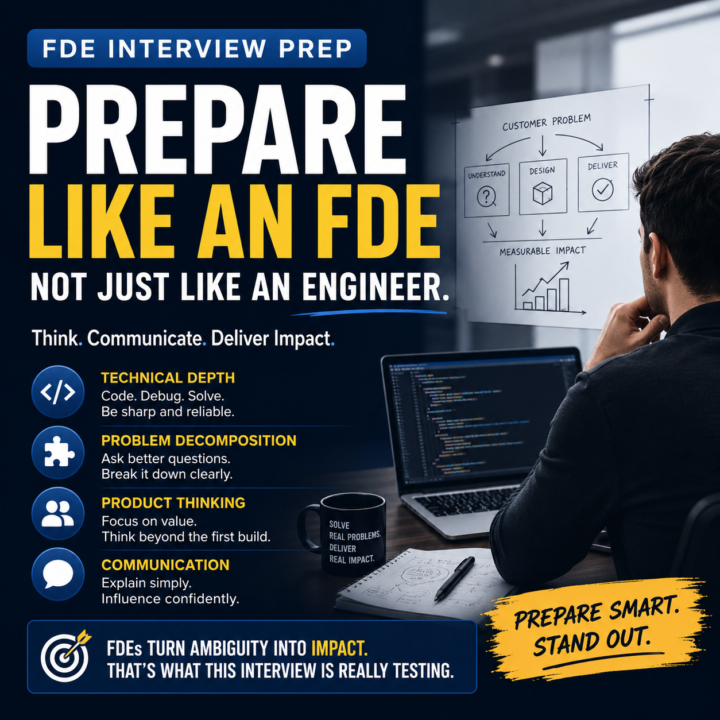
Most FDE interview prep fails for one simple reason: people train for coding, but get evaluated for judgment. A Forward Deployed Engineer interview is not just about writing correct code. It is about proving that you can: understand an ambiguous problem quickly, break it into something buildable, communicate clearly with non-technical stakeholders, and choose practical tradeoffs under real-world constraints. That is the real test. If you are preparing for an FDE interview, focus on these four layers: - Technical depth Be strong in coding fundamentals, debugging, and problem-solving. You do not need to be the most brilliant person in the room. You do need to be fast, accurate, and calm when the code is unfamiliar or messy. - Problem decomposition FDE interviews often reward clarity over complexity. When given an open-ended problem, your first move should not be to rush into a solution. Start by asking the right questions, defining the user, identifying constraints, and breaking the problem into logical parts. - Product thinking Strong FDEs do not build random features. They look for solutions that create real value and can scale beyond one customer. In interviews, always connect your solution back to impact: 1. Who benefits? 2. Why does this matter? 3. What changes for the customer? - Communication A great FDE can explain a technical decision in simple language without sounding vague. That matters more than most candidates realize. Interviewers want to see how you think, not just what you know. What separates strong candidates is not a perfect answer. It is the ability to turn ambiguity into structure. That is the FDE signal. If you are preparing for one, do not just practice LeetCode. Practice whiteboarding messy problems, explaining tradeoffs out loud, and defending simple solutions with confidence. What is the hardest part of FDE interview prep for you right now?
2
0
Jun 21 •
🎤 FDE Interview Question of the Day
A CIO says: "We want to implement AI across the organization." What's your FIRST response? ❌ Wrong answer: "Let's build a chatbot." ❌ Wrong answer: "Let's deploy GPT-5." ❌ Wrong answer: "Let's build agents." The best FDEs don't start with technology. They start with understanding the problem. Before proposing a solution, I'd want to understand: • Why now? • What business outcome are you trying to achieve? • How will success be measured? • Which teams are highest priority? Interviewers aren't testing your AI knowledge here. They're testing whether you can think like a trusted advisor. 💡 Remember: A junior engineer sees technology. An FDE sees business outcomes. 👇 Your turn: What would be the FIRST question you ask the CIO?
4
0
1-4 of 4

skool.com/fde
Build, deploy, and grow as forward deployed engineers solving real-world AI and enterprise problems with impact.
Leaderboard (30-day)
1

+21
2

+5
3

+2
4

+2
5

+1
Powered by