
Write something

🔥
13d •
Hey Blue Evergarden, Evergarden Academy 🚀
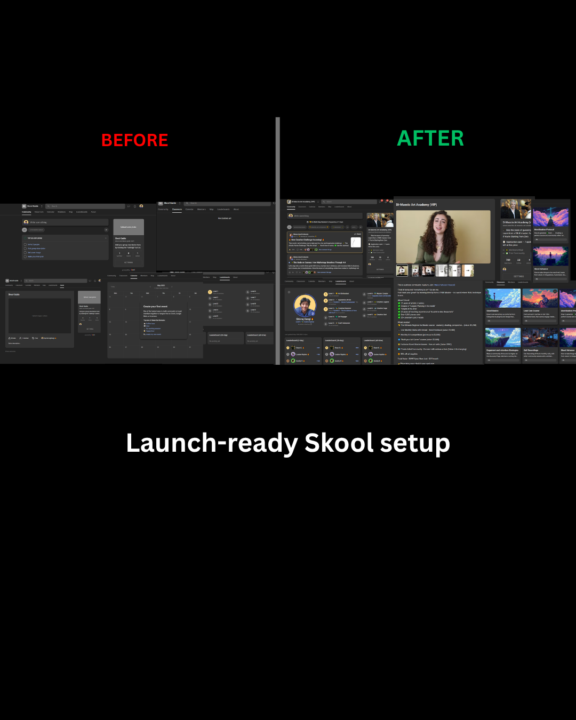
Hey Blue Evergarden 👋 Just checked out Evergarden Academy. You're still early enough to structure the community properly before growth starts kicking in — which honestly is the best possible timing. We're currently helping new Skool owners turn empty/basic communities into launch-ready ecosystems completely free. Examples + full breakdown here: 👉 Community Launch Before vs after examples below 👇

May 16 •
New lesson now live inside Evergarden Academy
New lesson now live inside Evergarden Academy: Observation: Observing to Orient—Orienting to Observe: How Our Body-System Communicates for Our Good (Pt. 3) This lesson explores: • self-regulation as the first pillar of de-escalation • discomfort versus danger • state-dependent perception • environmental awareness and atmospheric baselines • urban movement and orientation • proxemic push versus proxemic pull • observational presence versus hypervigilance Not every uncomfortable feeling is danger. Not every urge to intervene is wisdom. Sometimes awareness begins through learning the difference between what is actionably happening and what we feel may be happening. This full lesson is now available inside the free educational portion of Evergarden Academy as a bridge into the deeper framework systems explored throughout the curriculum.
0
0
May 11 •
Setting Boundaries 101
Setting a boundary is direct language with clear, actionable measures and clear consequences, alongside the willingness and self-worth (the most important part) to follow through on those consequences the moment the boundary is intentionally disregarded. A boundary does not need a “why.” No is a complete sentence all by itself. While giving the “why” can sometimes feel like it may help the boundary be received “well,” there are also moments where explaining the why can unintentionally turn the boundary itself into an open discussion rather than a moment to honor and respect the courage it takes to trust a rapport enough to establish a boundary in the first place (depending on context). Not all boundaries are negative. Some boundaries are created because the rapport or situation matters enough to protect it as it is. There’s a safe space in that.
May 15 •
Speak L.I.F.E: Observation Before Intervention
New framework essay now live inside Evergarden Academy: Speak L.I.F.E: Observation Before Intervention An exploration of self-regulation through the O.O.D.A Loop framework: • observation under stress • overwhelm and agency • avoidance as information • nervous system awareness • adaptive response and emotional regulation Sometimes the first step is not action. Sometimes the first step is learning how to observe what is happening within us before we attempt to intervene.
1
0
May 14 •
Mini Lesson 3 is now live inside Evergarden Academy: Naming What Is Happening
This lesson explores affect labeling, nervous system responses, emotional processing, associative conditioning, and the role awareness plays in beginning self-regulation during overwhelm. Sometimes regulation begins less through “fixing” ourselves and more through learning how to observe what is happening internally and externally without immediately abandoning ourselves in the process.
1
0
1-8 of 8
powered by

Suggested communities
Powered by