
Write something

12d •
The Hidden Connection Between Balance and Your Brain
We often hear that the brain is divided into two hemispheres — the right and the left — each shaping how we think, feel, and experience the world. The left hemisphere is associated with logic, structure, and analysis. It supports language, sequential thinking, and working with facts and numbers. It helps us organize reality, make decisions, and move step by step with clarity. The right hemisphere is the realm of creativity, imagination, and intuition. It allows us to feel deeply, perceive the bigger picture, create, and connect emotionally with the world around us. Interestingly, the body reflects this inner balance: Balancing on your right leg engages the left hemisphere, while balancing on your left leg activates the right hemisphere. You can even gently “check in” with yourself through this: If balancing on your right leg feels noticeably harder, it may suggest that your left hemisphere is less active at the moment and could benefit from more engagement and stimulation. If standing on your left leg is more challenging, it may indicate that your right hemisphere — your creative and intuitive side — is less involved right now. This isn’t a diagnosis, but rather a subtle signal from your body — an invitation to restore balance within. That’s why balance exercises are more than just physical practice. They are a way to harmonize both sides of the brain. By training balance, we develop coordination not only in the body, but also in our mental and emotional state. There is also a powerful connection with anxiety. When the mind is overwhelmed by racing or intrusive thoughts, it can get stuck in repetitive loops. In those moments, simple balance exercises can help interrupt this pattern. By giving your brain a new task — to stabilize, adjust, and coordinate movement — it begins to reorganize. Attention shifts, and gradually the intensity of thoughts softens. Balance becomes more than movement — it becomes a quiet reset for the mind.
0
0

13d •
🚀 NEW TOOL: Movement Lab is LIVE
Here’s a question most people never ask: When was the last time you tried something COMPLETELY NEW in your training? Not heavier. Not longer. Something your body has literally never done before. Because here’s the thing: Repeating the same routine = comfort = diminishing returns. Trying new movements = new neural pathways = actual growth. I just launched the Movement Lab inside the community 🔬 5 daily checkpoints + a zone selector (Comfort → Stretch → Growth → Breakthrough) + a space to document your experiments. 📊 Track your Neural Score. Build a streak. See which zone you spend the most time in. 📤 Share your weekly report — someone else’s experiment might become your next breakthrough. 💬 Want a training program designed to push your neural boundaries? Reach out to Alissia. Go to the Classroom and try it ¡¡ What’s your Neural Score today? 👇 #Elevare #MovementLab #ExperimentToGrow
0
0
26d •
🤍How to learn to love sports?
Many people start training with enthusiasm, but after a few weeks—or even days—it all stops. Sound familiar? The reason is often not a lack of willpower, but the wrong approach. Here are some tips to help you change your perspective on exercise and turn it into a habit rather than a chore. ✨Find your sport. Not everyone enjoys heavy strength training or long-distance running. Maybe you’ll like dancing, yoga, or even walking in nature. Experiment. The key is to choose something that brings you joy. ✨Add elements of play. Compete with yourself or friends, use activity-tracking apps, or try challenges—these can make workouts more fun. Focus on how you feel, not just the results. Instead of expecting immediate changes in weight or appearance, notice how exercise improves your mood, reduces stress, and boosts your energy. ✨Find like-minded people. Working out with friends or in a group is not only motivating but also enjoyable. A supportive atmosphere helps you stay consistent and avoid skipping sessions. ✨Stop punishing yourself with workouts. Exercise is not a punishment for eating cake—it’s a way to take care of yourself. Treat it as an investment in your health and well-being. ✨Plan your rest. Overtraining can quickly kill your motivation. Allow yourself to rest when needed, and don’t forget about stretching or recovery practices. ✨And most importantly—don’t stop. If something doesn’t work out the first time, remember that habits take time to build. Every workout is a small step toward becoming your best self. 💪🏼What are your favourite workouts? Write in the comments, let’s share ideas 💡

Mar 17 •
Why did you REALLY stop? 🛑
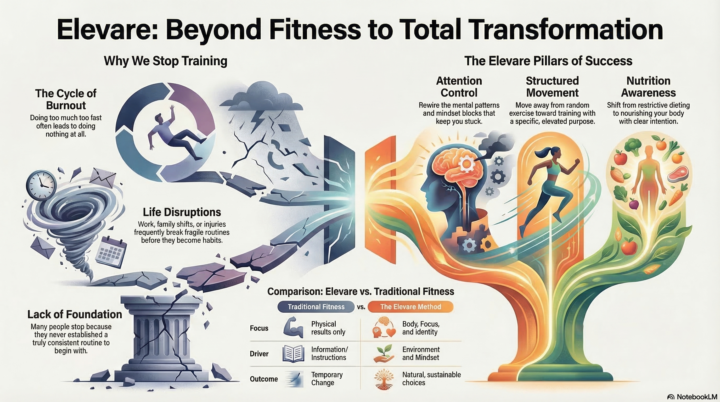
Hi everyone! 👋 Stopping isn't a lack of willpower—it’s a sign your identity hasn’t been upgraded yet. Most people fail because they "wing it" without the right mindset. Vote below: Why did your training stop last time? 👇 - Injury: Broke the routine and never came back. - Goal Reached: Hit the target and let it go. - Life Happened: Work/family got in the way. - Burnout: Did too much, then nothing. - No Routine: Never really started. At Elevare, we use Attention Control, Structured Movement, and Nutrition Awareness to rewire the mental patterns keeping you stuck. We help you become the person who naturally makes these choices every day, so you never have to "start over" again. What is your biggest hurdle to staying consistent? Let’s discuss below! 👇 Elevate. Raise. Improve. 🔥
Poll
Cast your vote
0
0
Mar 13 •
What does your training week actually look like right now?
Elevare views your current training frequency not just as a schedule, but as a reflection of your current mental patterns and identity. Based on the Elevare method and the provided options, here is how the program addresses each state: - 4-5 sessions — Structured and intentional: This is the target state of the program. It reflects a person who has successfully implemented the pillar of Structured Movement, training with a specific purpose to "elevate" their physical and mental state. In this state, training is no longer a mental battle; it is an integrated part of who you are. - 2-3 sessions — Good weeks and bad weeks: This frequency often indicates that you are stuck in a "start-stop" cycle. Elevare uses the pillar of Attention Control to identify and rewire the mental patterns that cause this inconsistency. The goal is to move away from "winging it" and toward a system where you no longer need to negotiate with yourself to show up. - 1 session or less — Life keeps getting in the way: This occurs when training is viewed as a "chore" or an external task rather than an internal priority. Elevare’s behavioral body transformation method is designed to help you find a way to train that actually fits your life by upgrading your identity. When you become the person who naturally prioritizes their health, "life getting in the way" becomes a barrier you are equipped to navigate. - Nothing right now — I'm starting from zero: This is the starting point for many who feel "stuck". Alissia created Elevare to provide the "right space to rise" for those at zero, offering a proven system and active guidance to ensure this isn't just another temporary start, but a permanent transformation. By identifying where you are on this spectrum, you can begin to apply the three pillars—Attention Control, Structured Movement, and Nutrition Awareness—to move toward a week that is consistently structured and intentional.
Poll
Cast your vote
0
0

1-6 of 6

Leaderboard (30-day)
1

+2
Powered by