

4h •
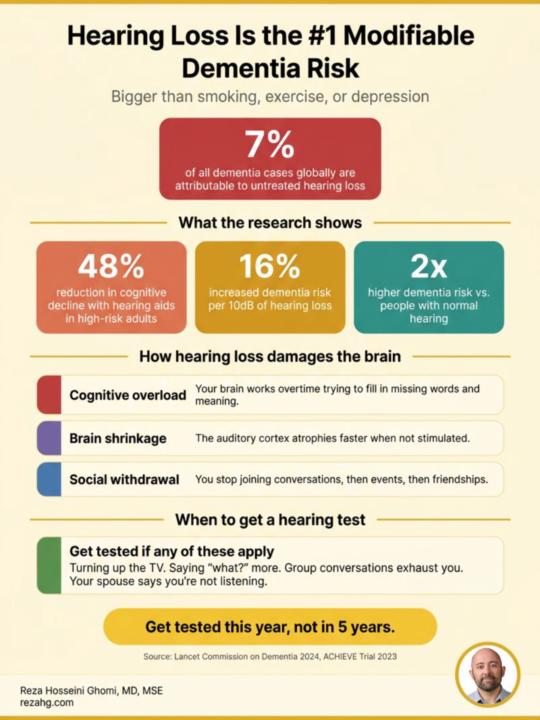
Hearing Loss is the #1 Modifiable Dementia Risk
Hearing loss is the #1 modifiable midlife dementia risk factor. Bigger than smoking. Bigger than physical inactivity. Bigger than depression. The 2024 Lancet Commission on dementia put it at 7% of all cases globally. That means roughly 1 in 14 dementia diagnoses might be preventable just by treating hearing loss properly. Most people are stunned when I tell them this. They expect the answer to be diet. Or supplements. Or some new drug. It's a hearing aid. I bring this up a lot because not a single week goes by where I'm not having this conversation with multiple people who have experienced untreated hearing loss for years. Here's what the evidence shows: 1. The risk is dose-dependent ↳ Every 10 decibels of hearing loss raises dementia risk by roughly 16% ↳ Even mild hearing loss matters 2. Hearing aids appear to slow cognitive decline ↳ The 2023 ACHIEVE trial found a 48% reduction in cognitive decline over 3 years in high-risk older adults who used hearing aids ↳ That's a bigger effect than any dementia drug currently on the market 3. The brain pays a price for hearing loss in three ways ↳ More cognitive load - your brain works overtime to fill in missing words ↳ Brain atrophy - the auditory cortex shrinks faster ↳ Social withdrawal - you stop joining conversations, then events, then friendships 4. Most adults wait years before getting tested ↳ The average person waits 7 to 10 years from first noticing hearing loss to seeking help ↳ By then, the cognitive damage has already started What I tell my patients in their 40s and 50s: If you find yourself turning up the TV. If you say "what?" more than you used to. If group conversations exhaust you. If your spouse keeps saying you're not listening. Get a hearing test. Not in 5 years. This year. Hearing aids today are nothing like the hearing aids your grandfather wore. Many fit invisibly in the ear. Many connect to your phone. The cheaper over-the-counter options keep getting better. Brain health is built on small decisions made decades before symptoms appear. This is one of the most powerful ones.
0
0
4d •
Jocelyn's Thursday Thought
You can choose to focus on the people you don't like or you can choose to focus on the people you love. The money you have or the money you don't. What has worked out or what hasn't. How far you have come or how far you have left to go. It's a simple thing to understand, but not so easy to remember. You are in charge of the direction your brains goes. You are the one with the compass. If you choose to focus on the negative, then that is how you will feel. If you focus on the abundance, the wonder, and the success you have, then you will feel amazing. You have running water. And lights. And a phone. And eyes that see. And curiosity. And love. There I got you started. Your turn. Spend some time wanting what you already have. You won't believe how fun it is.... Have a beautiful week! I love you all, Jocelyn
1
0
5d •
Thank You For Joining! 💜
Thank you to everyone who attended the Poolside Chat last night! If you missed our conversation, you can watch the recording here: https://www.skool.com/dementia-lifeboat/classroom Please register for our next Poolside Chat on May 26 at 5:30 pm Arizona https://us02web.zoom.us/meeting/register/PRzPtXKIRf-NNdHzhSToUg#/registration
1
0
6d •
🔴LIVE: Join us now!
Join us LIVE on Poolside Chat! We're here for you! Laura, Jocelyn, and other members are here to help support you on your journey.
0
0
6d •
He thought he was just getting older
Walter, 71. Came in because his wife insisted. His complaint: "I don't really have a problem. I'm just slower than I used to be." His wife's version was different. "He's lost two sets of car keys this year. He stopped going to his Tuesday card game because he couldn't keep up. He gets agitated in the afternoons and snaps at me, which has never been him." I asked Walter what a typical day looked like. "I wake up around 6. Read the paper. Used to do the crossword but I don't bother anymore. Watch TV. Take a nap. Watch more TV. Go to bed." I asked when he last initiated something. A phone call. A project. A trip. He couldn't remember. This is the symptom most families miss. Apathy is not depression. Walter wasn't sad. He wasn't hopeless. He just didn't care enough to start anything. Apathy is one of the earliest and most reliable signs of neurodegeneration. It often shows up before memory loss is obvious. And it gets dismissed as personality, aging, or laziness for years. Here's what apathy really looks like: Stops initiating activities they used to enjoy Drops out of social commitments without explanation Sits for hours doing nothing in particular Doesn't respond emotionally to good or bad news Lets hobbies, projects, and friendships quietly fade If you are watching this happen to someone you love, do not let a doctor write it off as normal aging. It might be. But it might not be. Walter had early Alzheimer's disease. We caught it years before it would have been obvious to anyone but his wife. Treatment helped. Planning helped more. His wife told me later: "I thought I was overreacting. I'm so glad I didn't listen to that voice." 📌 Follow me (Reza Hosseini Ghomi, MD, MSE) for the symptoms most doctors miss 💬 Comment below to share what you've noticed
1
0
1-30 of 206

skool.com/dementia-lifeboat
Dementia Care Support & Expert Guidance.
Powered by