

4d •
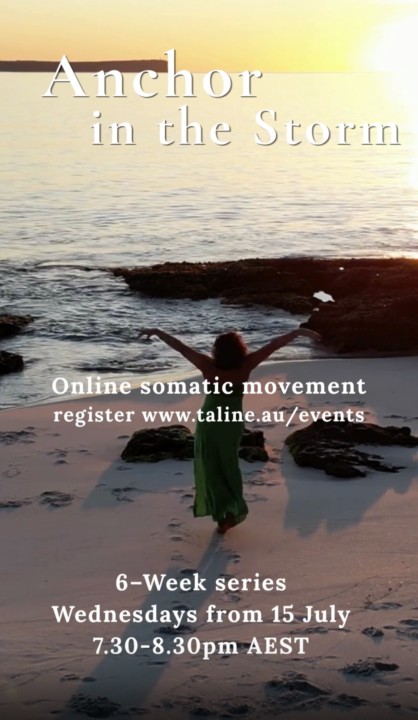
Anchor in the Storm — Round 2 is open 🌿
Six weeks of somatic movement for people who feel the weight of the world and want to find their ground again — without looking away from what matters. 👉 Register here Wednesdays from 15 July · 7:30pm AEST · $97 Our bodies are carrying the imprint of the world — and most of us have never been taught how to move it through. Not through talking. Through the body — through reflective, authentic movement, sensation, and breath. Over six weeks you'll explore: → Releasing what you've been holding → Understanding what yes and no feels like in your body → Shaking off the noise and listening to your gut → Moving from helplessness into empowered action → Developing your body wisdom → Feeling joy, connection and hope again → Letting your body lead 60 minutes online via Zoom. No experience needed. No right way to move. Just you, your body, and a little space to land. Plus a Skool classroom with resources, reflections, and replay access for everyone who joins. 👉 Register here
0
0
20d •
What brings you back to the shore? 🌊
Most sensitive people know the feeling of being pulled off centre. A friend in crisis. A news story that won't leave. A situation that hooks into you before you've even had time to decide whether you have the capacity for it. And suddenly you're out there — exhausted, trying hard, going nowhere. The current stronger than you expected. The shore further away than you remember. This is what compassion fatigue actually feels like in the body. Not a moral failing. Not too much sensitivity. Just — a rip current. Deceptive from the shore. Powerful once it has you. The thing they teach you about rips is this: you don't swim against them. You swim sideways — out of the current — until you find calmer water. And then you make your way back. And certainly not go in to save someone in the rip, unless you are a strong swimmer and have a paddle board or floatation device. But first, you have to know where the shore is. And you have to know what brings you back to it. Not in theory. In your body. The specific things that return you to yourself — to your own weight, your own rhythm, your own ground — when the world has pulled you too far out. For some people it's movement. A walk, a dance, a shake of the hands. For some it's silence. Or a particular song. Or bare feet on grass. For some it's connection with friends. For some it's a boundary named — an honest "I can be here for an hour, and then I need to go." For some it's a small act of directed energy — writing a letter, signing a petition, doing the one thing that transforms helplessness into something useful. None of these are about caring less. All of them are about staying in the water longer, more sustainably, without losing the shore. So I want to ask you — genuinely: What brings you back? What is the thing — or the few things — that reliably return you to yourself when the world has pulled you too far out? Drop it below. Even one word. 👇 This is the territory we explored in Session 5 of Anchor in the Storm — Compassion Without Collapse. 🌊

27d •
The gap between how you feel and what your body is doing. 🌿
Most of us are pretty good at describing our emotions. Anxious. Calm. Overwhelmed. Okay. But ask someone to describe what they're actually feeling in their body — as a sensation rather than an emotion — and it gets harder. Is it tight? Heavy? Buzzing? Expanding? Warm or cool? That gap between emotional fluency and sensory fluency is where so much gets lost. Including the difference between anxiety and intuition — which are both felt in the body, both can feel urgent, and both can be mistaken for each other. Because here's the thing: your body often knows before your mind does. A gut feeling isn't a metaphor. It's a real physiological signal. The question is whether we've developed enough body literacy to hear it — or whether we're so deep in our heads that the signal gets drowned out by the noise. Developing that capacity — learning to feel into sensation rather than just naming emotion — is one of the quieter, more powerful things somatic movement work offers. A question I'm genuinely curious about: When you've made a decision that turned out to be right — one you felt before your mind caught up — where did you feel it in your body? And what did it feel like? 👇 Drop it below. Even one word or one body part is enough. And for those of you who love a Poll... Right now, how connected do you feel to your body's signals?
Poll
Cast your vote
0
0
Jun 12 •
What is your body holding?
Your body holds everything. Tension, stress, cortisol, the news you scrolled at midnight, the sensory overload — even just the threat of modern existence on your soul. 😂😭 I had a long-overdue massage the other day and woah — agony. Especially in the forgotten crevices. Despite the yoga, body tapping, swimming, dancing, qigong and stretching I do. Sometimes it's just not enough. Too much is being asked of us collectively as humans right now. This discharging and resetting is what we explored in this session of Anchor in the Storm — disgust, anger, the full-body shake. The nervous system discharge that animals do naturally after a threat, and that we've been taught to suppress. Society expects us to be calm. Cool. Collected. People-pleasers. Instead of being as nature intended — animals, doing what animals do. What would actually serve humanity right now is the capacity to fully express our rage, grief and disgust at the state of this world. Instead of sucking it up and holding it in our forgotten crevices. Maybe you've forgotten how to shake, release, scream, or stomp. Or maybe you just haven't given your body the time and permission. Well — it's in there. Waiting. Try it now. Give your cheeks a little massage. Say hello. What are they holding? 🌀 Filmed during a live Anchor in the Storm session. Round 2 starts July 15 — 6 weeks of online somatic movement to help you release what your body's been holding. Free taster: July 8 — Register here.
0
0

Jun 5 •
Why we shake
Why we shake — and what's actually happening in your body 🌿 Most of us were taught to hold very still when things got overwhelming. Compose yourself. Keep it together. Don't make a scene. But here's what we now know: the body has a built-in mechanism for discharging stress — and it looks a lot like shaking. There are actually two kinds of shaking worth knowing about. Volitional shaking is conscious and chosen. You initiate it — hands first, travelling up through the arms, into the torso, the hips, the whole body. You're in control throughout. You can stop at any moment. This kind of shaking is therapeutic in its own right — it moves accumulated stress hormones, activates the body's natural discharge pathway, and begins to complete stress response cycles that were never finished. Neurogenic tremor is something different. It's involuntary — the nervous system initiating movement on its own, bypassing the thinking brain entirely. You didn't ask for it. It just happens. Think of a dog after something frightening — not just after a swim, but after something that scared it. That full-body shake it does immediately after? That's neurogenic tremor. Pure biology. The body completing what it started. Humans do this too — or we're supposed to. We just learned to suppress it. Volitional shaking is the door. Neurogenic tremor is what can begin to move through it when conditions are right. You start with the conscious shake — and sometimes in the quiet moments that follow, something involuntary begins to emerge. A subtle trembling in the hands or legs. A vibration in the chest that you didn't put there. That's not something going wrong. That's something finally going right. Something to sit with: Have you thought of using shaking before to 'shake something off"?
Poll
Cast your vote
0
0
1-7 of 7
powered by
skool.com/dance-heal-celebrate-taline-4950
Online somatic movement sessions, conscious dance events (Soul Dance) & dance therapy education. Sydney-based, online worldwide. Come as you are.
Suggested communities
Powered by